

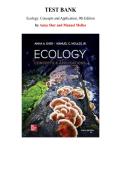
TEST BANK
Ecology: Concepts and Application, 9th Edition
by Anna Sher and Manuel Molles
SC
O
R
EG
U
ID
ES
, Table of Content
1 Introduction to Ecology: Historical Foundations and Developing Frontiers
Section I Natural History and Evolution
2 Life on Land
3 Life in Water
4 Population Genetics and Natural Selection
Section II Adaptations to the Environment
5 Temperature Relations
6 Water Relations
SC
7 Energy and Nutrient Relations
8 Social Relations
Section III Population Ecology
9 Population Distribution and Abundance
O
10 Population Dynamics
11 Population Growth
R
12 Life Histories
Section IV Interactions
EG
13 Species Interactions and Competition
14 Exploitative Interactions: Predation, Herbivory, Parasitism, and Disease
15 Mutualism
Section V Communities and Ecosystems
U
16 Species Abundance and Diversity
17 Species Interactions and Community Structure
ID
18 Primary and Secondary Production
19 Nutrient Cycling and Retention
20 Succession and Stability
ES
Section VI Large-Scale Ecology
21 Landscape Ecology
22 Geographic Ecology
23 Global Ecology
,Test Bank for Ecology Concepts andcAl a spspmlei rci ta. ctoimon—s T9h tehM Ea r dk eittpil oa cne tBo yB uAy annndaS eSll hSeturd,yM
Maatenriu
ales l Molles (All Chapters 100% Original
Verified, A+ Grade)
Chapter 1
Student name:
TRUE/FALSE - Write 'T' if the statement is true and 'F' if the statement is false.
1) Norris and colleagues found that warblers using different habitats did not have different
carbon isotopes in the tissues.
⊚ true
⊚ false
2) Field studies and laboratory studies are mutually exclusive.
SC
⊚ true
⊚ false
3) Temperate and tropical rain forest trees extract nutrients from epiphytic mats.
⊚ true
O
⊚ false
4) Stable isotope analysis uses variation in element masses to better understand ecological
R
phenomena.
⊚ true
⊚ false
EG
5) Margaret Davis' studies on lake pollen sediments indicate that the forests of eastern North
America did not change with the changing climate.
⊚ true
⊚ false
U
6) Ecology can be defined as the study of the impact of human activity on the environment.
⊚ true
ID
⊚ false
7) Ecology is a modern science of which ancient man had no knowledge.
⊚ true
ES
⊚ false
8) Even though ecologists would like to study isolated levels of the environment, that would be
difficult since all levels are interconnected.
⊚ true
⊚ false
, Chapter 1
9) Critical habitat protection for endangered species brings together the studies of adaptations of
species, community through geographic levels of ecology, and global ecology.
⊚ true
⊚ false
MULTIPLE CHOICE - Choose the one alternative that best completes the statement or
answers the question.
10) Which of the following levels of organization is/are correctly ordered?
SC
A) Population, ecosystem, landscape, individual
B) Individual, population, community, ecosystem
C) Biosphere, landscape, individual, community
D) Ecosystem, landscape, region, population
E) None of the choices are correct.
O
11) Robert MacArthur's observations on the Warblers of North America indicate that they
A) are fiercely competitive.
B) cannot coexist.
R
C) reduce competition by feeding during different times of the day.
D) reduce competition by feeding in different zones.
EG
E) both are fiercely competitive and cannot coexist.
12) What is ecology?
A) The study of relationships between organisms and the environment
B) The study of animal and plant population interactions
C) The study of the abiotic portion of the environment
U
D) The study of the biosphere
E) The study of environmental change
ID
13) Nalini Nadkarni's study of tropical and temperate rain forests determined that
A) rain forests have nutrient rich soils.
B) the herbaceous layer determines the nutrient balance.
ES
C) epiphyte mats contain a significant source of nutrients.
D) as one moves up the canopy, species richness decreases.
E) None of the choices are correct.
Ecology: Concepts and Application, 9th Edition
by Anna Sher and Manuel Molles
SC
O
R
EG
U
ID
ES
, Table of Content
1 Introduction to Ecology: Historical Foundations and Developing Frontiers
Section I Natural History and Evolution
2 Life on Land
3 Life in Water
4 Population Genetics and Natural Selection
Section II Adaptations to the Environment
5 Temperature Relations
6 Water Relations
SC
7 Energy and Nutrient Relations
8 Social Relations
Section III Population Ecology
9 Population Distribution and Abundance
O
10 Population Dynamics
11 Population Growth
R
12 Life Histories
Section IV Interactions
EG
13 Species Interactions and Competition
14 Exploitative Interactions: Predation, Herbivory, Parasitism, and Disease
15 Mutualism
Section V Communities and Ecosystems
U
16 Species Abundance and Diversity
17 Species Interactions and Community Structure
ID
18 Primary and Secondary Production
19 Nutrient Cycling and Retention
20 Succession and Stability
ES
Section VI Large-Scale Ecology
21 Landscape Ecology
22 Geographic Ecology
23 Global Ecology
,Test Bank for Ecology Concepts andcAl a spspmlei rci ta. ctoimon—s T9h tehM Ea r dk eittpil oa cne tBo yB uAy annndaS eSll hSeturd,yM
Maatenriu
ales l Molles (All Chapters 100% Original
Verified, A+ Grade)
Chapter 1
Student name:
TRUE/FALSE - Write 'T' if the statement is true and 'F' if the statement is false.
1) Norris and colleagues found that warblers using different habitats did not have different
carbon isotopes in the tissues.
⊚ true
⊚ false
2) Field studies and laboratory studies are mutually exclusive.
SC
⊚ true
⊚ false
3) Temperate and tropical rain forest trees extract nutrients from epiphytic mats.
⊚ true
O
⊚ false
4) Stable isotope analysis uses variation in element masses to better understand ecological
R
phenomena.
⊚ true
⊚ false
EG
5) Margaret Davis' studies on lake pollen sediments indicate that the forests of eastern North
America did not change with the changing climate.
⊚ true
⊚ false
U
6) Ecology can be defined as the study of the impact of human activity on the environment.
⊚ true
ID
⊚ false
7) Ecology is a modern science of which ancient man had no knowledge.
⊚ true
ES
⊚ false
8) Even though ecologists would like to study isolated levels of the environment, that would be
difficult since all levels are interconnected.
⊚ true
⊚ false
, Chapter 1
9) Critical habitat protection for endangered species brings together the studies of adaptations of
species, community through geographic levels of ecology, and global ecology.
⊚ true
⊚ false
MULTIPLE CHOICE - Choose the one alternative that best completes the statement or
answers the question.
10) Which of the following levels of organization is/are correctly ordered?
SC
A) Population, ecosystem, landscape, individual
B) Individual, population, community, ecosystem
C) Biosphere, landscape, individual, community
D) Ecosystem, landscape, region, population
E) None of the choices are correct.
O
11) Robert MacArthur's observations on the Warblers of North America indicate that they
A) are fiercely competitive.
B) cannot coexist.
R
C) reduce competition by feeding during different times of the day.
D) reduce competition by feeding in different zones.
EG
E) both are fiercely competitive and cannot coexist.
12) What is ecology?
A) The study of relationships between organisms and the environment
B) The study of animal and plant population interactions
C) The study of the abiotic portion of the environment
U
D) The study of the biosphere
E) The study of environmental change
ID
13) Nalini Nadkarni's study of tropical and temperate rain forests determined that
A) rain forests have nutrient rich soils.
B) the herbaceous layer determines the nutrient balance.
ES
C) epiphyte mats contain a significant source of nutrients.
D) as one moves up the canopy, species richness decreases.
E) None of the choices are correct.


