

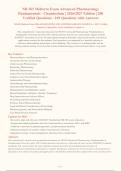
NR 565 Midterm Exam Advanced Pharmacology
Fundamentals - Chamberlain | 2026/2027 Edition | 200
Verified Questions - 169 Questions with Answers
NR 565 Midterm Exam 2026-169 QUESTIONS AND ANSWERS ALREADY GRADED A+. 100% Verified
Solutions | Updated Per Latest Guidelines | Graded A+
This comprehensive exam prep document for NR 565 Advanced Pharmacology Fundamentals at
Chamberlain University provides 200 verified questions and answers, meticulously aligned with the
2026/2027 curriculum. It covers all major pharmacological principles, drug classifications, and clinical
applications essential for the midterm. Each question is accompanied by a detailed rationale to
reinforce understanding and promote critical thinking. This resource is an indispensable tool for
nursing students aiming to excel in their advanced pharmacology coursework and achieve a top grade.
Key Features:
Pharmacokinetics and Pharmacodynamics
Autonomic Nervous System Drugs
Cardiovascular Pharmacology
Respiratory Pharmacology
Endocrine Pharmacology
Central Nervous System Pharmacology
Analgesics and Anti-inflammatory Agents
Antimicrobial Therapy
Chemotherapy and Immunopharmacology
Gastrointestinal Pharmacology
Dermatological and Ophthalmic Agents
Special Populations (Pediatric, Geriatric, Pregnancy)
Drug Interactions and Adverse Effects
Prescribing and Patient Education
Evidence-Based Pharmacotherapy
Legal and Ethical Considerations in Prescribing
Pharmacogenomics and Personalized Medicine
Case-Based Clinical Scenarios
Updates for 2026:
- Revised to align with the latest 2026/2027 Chamberlain NR 565 course objectives
- Incorporated updated guidelines from the American Heart Association, ADA, and WHO
- Added new questions on pharmacogenomics and personalized medicine
- Enhanced rationales to include evidence-based practice references
- Expanded coverage of special populations and drug safety considerations
Abstract:
This meticulously curated exam preparation document for NR 565 Advanced Pharmacology Fundamentals at
Chamberlain University offers 200 verified questions and answers, reflecting the most current 2026/2027 academic
standards. The content spans the entire pharmacological spectrum, from foundational principles of
pharmacokinetics and pharmacodynamics to complex therapeutic regimens for chronic diseases. Each question is
designed to test clinical reasoning and application, with detailed rationales that explain both correct and incorrect
Page 1
,options. The document is organized to mirror the course syllabus, ensuring comprehensive coverage of all major
drug classes, including cardiovascular, endocrine, neurological, and antimicrobial agents. Special emphasis is
placed on safe prescribing practices, drug interactions, and patient education, aligning with the advanced practice
nursing role. This resource is an essential study aid for students seeking to master advanced pharmacology and
succeed on the midterm examination.
Keywords:
Advanced Pharmacology, NR 565, Chamberlain University, Midterm Exam, Pharmacokinetics,
Pharmacodynamics, Drug Classifications, Clinical Application
Answer Format:
Each question is followed by the correct answer and a comprehensive rationale explaining why the answer is
correct and why the other options are incorrect. Rationales include relevant clinical pearls, drug interactions, and
monitoring parameters to enhance learning and retention.
Compliance Checklist:
Aligned with Chamberlain University NR 565 course objectives
Updated to reflect 2026/2027 evidence-based practice guidelines
Includes 200 verified questions with accurate answers
Rationales provided for all correct and incorrect options
Covers all major content areas from the course syllabus
Suitable for self-assessment and exam preparation
Content Area Overview:
Content Area Questions Key Topics Weight
Pharmacokinetics and 1-20 Absorption, Distribution, Metabolism, 10%
Pharmacodynamics Excretion, Receptor Theory
Autonomic Nervous System 21-40 Adrenergic Agonists, Adrenergic 10%
Drugs Antagonists, Cholinergic Agonists,
Anticholinergics
Cardiovascular Pharmacology 41-70 Antihypertensives, Antiarrhythmics, 15%
Antianginals, Heart Failure Medications,
Anticoagulants
Respiratory Pharmacology 71-85 Bronchodilators, Corticosteroids, 7.5%
Antihistamines, Decongestants,
Expectorants
Endocrine Pharmacology 86-110 Insulin, Oral Hypoglycemics, Thyroid 12.5%
Hormones, Corticosteroids, Sex Hormones
Central Nervous System 111-135 Antidepressants, Antipsychotics, 12.5%
Pharmacology Anxiolytics, Anticonvulsants, Stimulants
Analgesics and 136-150 Opioids, NSAIDs, Acetaminophen, Muscle 7.5%
Anti-inflammatory Agents Relaxants, Gout Medications
Antimicrobial Therapy 151-170 Penicillins, Cephalosporins, Macrolides, 10%
Tetracyclines, Fluoroquinolones, Antivirals,
Antifungals
Chemotherapy and 171-180 Cytotoxic Agents, Targeted Therapy, 5%
Immunopharmacology Immunosuppressants, Monoclonal
Antibodies
Page 2
,Gastrointestinal Pharmacology 181-190 Antacids, Proton Pump Inhibitors, 5%
Antiemetics, Laxatives, Antidiarrheals
Special Populations and 191-200 Pediatric, Geriatric, Pregnancy, Drug 5%
Miscellaneous Interactions, Pharmacogenomics
Page 3
, Q1. A patient on chronic warfarin therapy requires an antifungal. Which azole is
LEAST likely to potentiate warfarin's anticoagulant effect via CYP2C9 inhibition?
A. Fluconazole
B. Voriconazole
C. Micafungin
D. Ketoconazole
Correct Answer: C. Micafungin
Rationale: Micafungin is an echinocandin that does not inhibit CYP450 enzymes, unlike
azoles, which variably inhibit CYP2C9/3A4. Fluconazole, voriconazole, and ketoconazole
all significantly inhibit CYP2C9, increasing warfarin levels and INR. Therefore,
micafungin is safest regarding warfarin interaction.
Why Wrong:
A - Fluconazole is a strong CYP2C9 inhibitor and would increase warfarin's effect,
making it less safe.
B - Voriconazole also inhibits CYP2C9 and CYP3A4, leading to enhanced
anticoagulation.
D - Ketoconazole is a potent CYP3A4 inhibitor and also affects CYP2C9, increasing
bleeding risk.
Reference: Lehne, R.A. (2026). Pharmacology for Nursing Care, 12th Ed., Ch. 88
(Antifungals) & Ch. 34 (Anticoagulants)
Q2. Which pharmacodynamic principle best explains why a drug with a high
therapeutic index can still cause toxicity when co-administered with a drug that
inhibits its metabolism?
A. Potency is increased, leading to a leftward shift in the dose-response curve.
B. Efficacy is enhanced beyond the maximum achievable effect.
C. The margin of safety narrows because the toxic dose approaches the effective dose.
D. The drug's half-life decreases, causing accumulation of active metabolites.
Correct Answer: C. The margin of safety narrows because the toxic dose approaches
the effective dose.
Rationale: The therapeutic index (TI) is the ratio of toxic dose to effective dose. A high TI
indicates a wide margin of safety, but metabolic inhibition can raise plasma levels,
effectively shifting the toxic dose closer to the therapeutic range, thereby narrowing the
margin of safety. This is a kinetic, not a dynamic, effect.
Why Wrong:
A - Potency refers to the dose required for a given effect; inhibition changes
concentration, not intrinsic potency.
B - Efficacy is the maximum effect and is not altered by metabolic inhibition.
D - Inhibition typically prolongs half-life, not decreases it, and may increase parent
Page 4
Fundamentals - Chamberlain | 2026/2027 Edition | 200
Verified Questions - 169 Questions with Answers
NR 565 Midterm Exam 2026-169 QUESTIONS AND ANSWERS ALREADY GRADED A+. 100% Verified
Solutions | Updated Per Latest Guidelines | Graded A+
This comprehensive exam prep document for NR 565 Advanced Pharmacology Fundamentals at
Chamberlain University provides 200 verified questions and answers, meticulously aligned with the
2026/2027 curriculum. It covers all major pharmacological principles, drug classifications, and clinical
applications essential for the midterm. Each question is accompanied by a detailed rationale to
reinforce understanding and promote critical thinking. This resource is an indispensable tool for
nursing students aiming to excel in their advanced pharmacology coursework and achieve a top grade.
Key Features:
Pharmacokinetics and Pharmacodynamics
Autonomic Nervous System Drugs
Cardiovascular Pharmacology
Respiratory Pharmacology
Endocrine Pharmacology
Central Nervous System Pharmacology
Analgesics and Anti-inflammatory Agents
Antimicrobial Therapy
Chemotherapy and Immunopharmacology
Gastrointestinal Pharmacology
Dermatological and Ophthalmic Agents
Special Populations (Pediatric, Geriatric, Pregnancy)
Drug Interactions and Adverse Effects
Prescribing and Patient Education
Evidence-Based Pharmacotherapy
Legal and Ethical Considerations in Prescribing
Pharmacogenomics and Personalized Medicine
Case-Based Clinical Scenarios
Updates for 2026:
- Revised to align with the latest 2026/2027 Chamberlain NR 565 course objectives
- Incorporated updated guidelines from the American Heart Association, ADA, and WHO
- Added new questions on pharmacogenomics and personalized medicine
- Enhanced rationales to include evidence-based practice references
- Expanded coverage of special populations and drug safety considerations
Abstract:
This meticulously curated exam preparation document for NR 565 Advanced Pharmacology Fundamentals at
Chamberlain University offers 200 verified questions and answers, reflecting the most current 2026/2027 academic
standards. The content spans the entire pharmacological spectrum, from foundational principles of
pharmacokinetics and pharmacodynamics to complex therapeutic regimens for chronic diseases. Each question is
designed to test clinical reasoning and application, with detailed rationales that explain both correct and incorrect
Page 1
,options. The document is organized to mirror the course syllabus, ensuring comprehensive coverage of all major
drug classes, including cardiovascular, endocrine, neurological, and antimicrobial agents. Special emphasis is
placed on safe prescribing practices, drug interactions, and patient education, aligning with the advanced practice
nursing role. This resource is an essential study aid for students seeking to master advanced pharmacology and
succeed on the midterm examination.
Keywords:
Advanced Pharmacology, NR 565, Chamberlain University, Midterm Exam, Pharmacokinetics,
Pharmacodynamics, Drug Classifications, Clinical Application
Answer Format:
Each question is followed by the correct answer and a comprehensive rationale explaining why the answer is
correct and why the other options are incorrect. Rationales include relevant clinical pearls, drug interactions, and
monitoring parameters to enhance learning and retention.
Compliance Checklist:
Aligned with Chamberlain University NR 565 course objectives
Updated to reflect 2026/2027 evidence-based practice guidelines
Includes 200 verified questions with accurate answers
Rationales provided for all correct and incorrect options
Covers all major content areas from the course syllabus
Suitable for self-assessment and exam preparation
Content Area Overview:
Content Area Questions Key Topics Weight
Pharmacokinetics and 1-20 Absorption, Distribution, Metabolism, 10%
Pharmacodynamics Excretion, Receptor Theory
Autonomic Nervous System 21-40 Adrenergic Agonists, Adrenergic 10%
Drugs Antagonists, Cholinergic Agonists,
Anticholinergics
Cardiovascular Pharmacology 41-70 Antihypertensives, Antiarrhythmics, 15%
Antianginals, Heart Failure Medications,
Anticoagulants
Respiratory Pharmacology 71-85 Bronchodilators, Corticosteroids, 7.5%
Antihistamines, Decongestants,
Expectorants
Endocrine Pharmacology 86-110 Insulin, Oral Hypoglycemics, Thyroid 12.5%
Hormones, Corticosteroids, Sex Hormones
Central Nervous System 111-135 Antidepressants, Antipsychotics, 12.5%
Pharmacology Anxiolytics, Anticonvulsants, Stimulants
Analgesics and 136-150 Opioids, NSAIDs, Acetaminophen, Muscle 7.5%
Anti-inflammatory Agents Relaxants, Gout Medications
Antimicrobial Therapy 151-170 Penicillins, Cephalosporins, Macrolides, 10%
Tetracyclines, Fluoroquinolones, Antivirals,
Antifungals
Chemotherapy and 171-180 Cytotoxic Agents, Targeted Therapy, 5%
Immunopharmacology Immunosuppressants, Monoclonal
Antibodies
Page 2
,Gastrointestinal Pharmacology 181-190 Antacids, Proton Pump Inhibitors, 5%
Antiemetics, Laxatives, Antidiarrheals
Special Populations and 191-200 Pediatric, Geriatric, Pregnancy, Drug 5%
Miscellaneous Interactions, Pharmacogenomics
Page 3
, Q1. A patient on chronic warfarin therapy requires an antifungal. Which azole is
LEAST likely to potentiate warfarin's anticoagulant effect via CYP2C9 inhibition?
A. Fluconazole
B. Voriconazole
C. Micafungin
D. Ketoconazole
Correct Answer: C. Micafungin
Rationale: Micafungin is an echinocandin that does not inhibit CYP450 enzymes, unlike
azoles, which variably inhibit CYP2C9/3A4. Fluconazole, voriconazole, and ketoconazole
all significantly inhibit CYP2C9, increasing warfarin levels and INR. Therefore,
micafungin is safest regarding warfarin interaction.
Why Wrong:
A - Fluconazole is a strong CYP2C9 inhibitor and would increase warfarin's effect,
making it less safe.
B - Voriconazole also inhibits CYP2C9 and CYP3A4, leading to enhanced
anticoagulation.
D - Ketoconazole is a potent CYP3A4 inhibitor and also affects CYP2C9, increasing
bleeding risk.
Reference: Lehne, R.A. (2026). Pharmacology for Nursing Care, 12th Ed., Ch. 88
(Antifungals) & Ch. 34 (Anticoagulants)
Q2. Which pharmacodynamic principle best explains why a drug with a high
therapeutic index can still cause toxicity when co-administered with a drug that
inhibits its metabolism?
A. Potency is increased, leading to a leftward shift in the dose-response curve.
B. Efficacy is enhanced beyond the maximum achievable effect.
C. The margin of safety narrows because the toxic dose approaches the effective dose.
D. The drug's half-life decreases, causing accumulation of active metabolites.
Correct Answer: C. The margin of safety narrows because the toxic dose approaches
the effective dose.
Rationale: The therapeutic index (TI) is the ratio of toxic dose to effective dose. A high TI
indicates a wide margin of safety, but metabolic inhibition can raise plasma levels,
effectively shifting the toxic dose closer to the therapeutic range, thereby narrowing the
margin of safety. This is a kinetic, not a dynamic, effect.
Why Wrong:
A - Potency refers to the dose required for a given effect; inhibition changes
concentration, not intrinsic potency.
B - Efficacy is the maximum effect and is not altered by metabolic inhibition.
D - Inhibition typically prolongs half-life, not decreases it, and may increase parent
Page 4


