

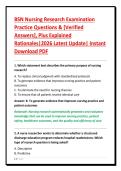
BSN Nursing Research Examination
Practice Questions & [Verified
Answers], Plus Explained
Rationales|2026 Latest Update| Instant
Download PDF
1. Which statement best describes the primary purpose of nursing
research?
A. To replace clinical judgment with standardized protocols
B. To generate evidence that improves nursing practice and patient
outcomes
C. To eliminate the need for nursing theories
D. To ensure that all patients receive identical care
Answer: B. To generate evidence that improves nursing practice and
patient outcomes
Rationale: Nursing research systematically generates and evaluates
knowledge that can be used to improve nursing practice, patient
safety, healthcare outcomes, and the quality and efficiency of care.
2. A nurse researcher wants to determine whether a structured
discharge education program reduces hospital readmissions. Which
type of research question is being asked?
A. Descriptive
B. Predictive
1|Page
,C. Causal
D. Philosophical
Answer: C. Causal
Rationale: A causal question examines whether one intervention or
exposure produces a change in an outcome. Here, the researcher is
examining whether discharge education causes a reduction in
readmissions.
3. Which component of a research problem identifies the population
being studied?
A. Intervention
B. Comparison
C. Population
D. Outcome
Answer: C. Population
Rationale: The population component specifies the individuals or
groups to whom the research question applies, such as adults with
type 2 diabetes or hospitalized older adults.
4. Which research question is most appropriate for a quantitative
study?
A. How do nurses experience caring for patients at the end of life?
B. What meaning do patients assign to living with chronic pain?
C. Does hourly rounding reduce patient falls in hospitalized adults?
D. How do newly graduated nurses describe their transition into
practice?
2|Page
,Answer: C. Does hourly rounding reduce patient falls in hospitalized
adults?
Rationale: Quantitative research examines measurable variables and
relationships between them. The effect of hourly rounding on fall
rates can be measured statistically.
5. A researcher uses interviews to explore how mothers experience
caring for a child with a chronic illness. Which methodology is most
appropriate?
A. Experimental
B. Qualitative
C. Correlational
D. Quasi-experimental
Answer: B. Qualitative
Rationale: Qualitative research is appropriate when the goal is to
understand experiences, perceptions, meanings, and perspectives
from the participants' viewpoints.
6. Which characteristic is most important in a well-developed research
question?
A. It must have an obvious answer
B. It should be vague enough to allow interpretation
C. It should be specific, researchable, and relevant
D. It should avoid identifying variables
Answer: C. It should be specific, researchable, and relevant
3|Page
, Rationale: A strong research question clearly identifies the issue being
investigated and can be addressed through systematic data collection
and analysis.
7. A nurse develops a research question using Population,
Intervention, Comparison, and Outcome. Which framework is being
used?
A. PICOT
B. SWOT
C. SOAP
D. SPSS
Answer: A. PICOT
Rationale: PICOT stands for Population, Intervention, Comparison,
Outcome, and Time. It helps nurses formulate focused clinical research
and evidence-based practice questions.
8. Which statement about a hypothesis is correct?
A. It is always proven to be true
B. It is a testable prediction about the relationship between variables
C. It is the same as a research finding
D. It can only be used in qualitative research
Answer: B. It is a testable prediction about the relationship between
variables
Rationale: A hypothesis is a tentative, testable prediction about
expected relationships or differences involving research variables.
4|Page
Practice Questions & [Verified
Answers], Plus Explained
Rationales|2026 Latest Update| Instant
Download PDF
1. Which statement best describes the primary purpose of nursing
research?
A. To replace clinical judgment with standardized protocols
B. To generate evidence that improves nursing practice and patient
outcomes
C. To eliminate the need for nursing theories
D. To ensure that all patients receive identical care
Answer: B. To generate evidence that improves nursing practice and
patient outcomes
Rationale: Nursing research systematically generates and evaluates
knowledge that can be used to improve nursing practice, patient
safety, healthcare outcomes, and the quality and efficiency of care.
2. A nurse researcher wants to determine whether a structured
discharge education program reduces hospital readmissions. Which
type of research question is being asked?
A. Descriptive
B. Predictive
1|Page
,C. Causal
D. Philosophical
Answer: C. Causal
Rationale: A causal question examines whether one intervention or
exposure produces a change in an outcome. Here, the researcher is
examining whether discharge education causes a reduction in
readmissions.
3. Which component of a research problem identifies the population
being studied?
A. Intervention
B. Comparison
C. Population
D. Outcome
Answer: C. Population
Rationale: The population component specifies the individuals or
groups to whom the research question applies, such as adults with
type 2 diabetes or hospitalized older adults.
4. Which research question is most appropriate for a quantitative
study?
A. How do nurses experience caring for patients at the end of life?
B. What meaning do patients assign to living with chronic pain?
C. Does hourly rounding reduce patient falls in hospitalized adults?
D. How do newly graduated nurses describe their transition into
practice?
2|Page
,Answer: C. Does hourly rounding reduce patient falls in hospitalized
adults?
Rationale: Quantitative research examines measurable variables and
relationships between them. The effect of hourly rounding on fall
rates can be measured statistically.
5. A researcher uses interviews to explore how mothers experience
caring for a child with a chronic illness. Which methodology is most
appropriate?
A. Experimental
B. Qualitative
C. Correlational
D. Quasi-experimental
Answer: B. Qualitative
Rationale: Qualitative research is appropriate when the goal is to
understand experiences, perceptions, meanings, and perspectives
from the participants' viewpoints.
6. Which characteristic is most important in a well-developed research
question?
A. It must have an obvious answer
B. It should be vague enough to allow interpretation
C. It should be specific, researchable, and relevant
D. It should avoid identifying variables
Answer: C. It should be specific, researchable, and relevant
3|Page
, Rationale: A strong research question clearly identifies the issue being
investigated and can be addressed through systematic data collection
and analysis.
7. A nurse develops a research question using Population,
Intervention, Comparison, and Outcome. Which framework is being
used?
A. PICOT
B. SWOT
C. SOAP
D. SPSS
Answer: A. PICOT
Rationale: PICOT stands for Population, Intervention, Comparison,
Outcome, and Time. It helps nurses formulate focused clinical research
and evidence-based practice questions.
8. Which statement about a hypothesis is correct?
A. It is always proven to be true
B. It is a testable prediction about the relationship between variables
C. It is the same as a research finding
D. It can only be used in qualitative research
Answer: B. It is a testable prediction about the relationship between
variables
Rationale: A hypothesis is a tentative, testable prediction about
expected relationships or differences involving research variables.
4|Page


