

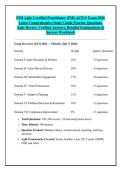
PMI Agile Certified Practitioner (PMI-ACP)® Exam 2026
Latest Comprehensive Study Guide Practice Questions,
Agile Review, Verified Answers, Detailed Explanations &
Success Workbook
Exam Overview (ECO 2026 — Effective July 9, 2026)
Domain Weight Approx. Questions
Domain I: Agile Principles & Mindset 16% ~19 questions
Domain II: Value-Driven Delivery 20% ~24 questions
Domain III: Stakeholder Engagement 17% ~20 questions
Domain IV: Team Performance 16% ~19 questions
Domain V: Adaptive Planning 12% ~14 questions
Domain VI: Problem Detection & Resolution 10% ~12 questions
Domain VII: Continuous Improvement 9% ~11 questions
• Total Questions: 120 (100 scored + 20 unscored pretest items)
• Time Allotted: 180 minutes
• Question Formats: Multiple-choice, scenario-based, matching, and drag-
and-drop
• Agile Frameworks Covered: Scrum, Kanban, Lean, XP, Crystal, DSDM,
FDD, and SAFe
, • Key Updates (2026): Contact hours reduced from 28 to 21; emphasis on
hybrid delivery, AI influence, stakeholder complexity, and decision-making
under uncertainty
DOMAIN I: AGILE PRINCIPLES & MINDSET (16%)
Question 1
An organization has adopted Scrum events, Agile tools, and velocity dashboards,
but teams are still not empowered to make decisions. What is the BIGGEST
concern?
A. The organization has too many retrospectives
B. The organization may be doing Agile mechanically without changing decision-
making, empowerment, and culture
C. The team needs more training on Scrum events
D. The velocity dashboards are not accurate
Correct Answer: B
Rationale: The Agile Principles and Mindset domain emphasizes that Agile is a
mindset, not just a set of practices. Adopting ceremonies and tools without cultural
transformation—specifically empowerment and decentralized decision-making—is
"mechanical Agile" and misses the core philosophy. The concern is that the
organization is going through the motions without embracing Agile values. Too
many retrospectives (A) is not typically a problem; more training (C) on events
won't address the empowerment gap; velocity accuracy (D) is a symptom, not the
root cause.
Question 2
A project manager is new to Agile and has been asked to lead a Scrum team. The
team is struggling with self-organization. What should the project manager do
FIRST?
A. Assign specific tasks to each team member to provide structure
B. Coach the team on self-organization principles and allow them to figure out
how to work together
,C. Escalate the issue to the product owner
D. Replace team members who cannot self-organize
Correct Answer: B
Rationale: Agile Principles and Mindset emphasize servant leadership and self-
organizing teams. The project manager's role is to coach and enable the team, not
to dictate. Assigning tasks (A) undermines self-organization. Escalation (C)
bypasses the project manager's responsibility. Replacement (D) is premature
without coaching.
Question 3
A team is new to Agile and is struggling to deliver working software at the end of
each sprint. The product owner is frustrated. What is the MOST likely root cause?
A. The sprints are too long
B. The team is not embracing the Agile principle of delivering working software
frequently
C. The product owner is not attending sprint reviews
D. The team needs better development tools
Correct Answer: B
Rationale: One of the core Agile principles is delivering working software
frequently (from every few weeks to every few weeks, with a preference for
shorter timescales). If the team cannot deliver, they may not be embracing this
principle. Sprint length (A) could be a factor but is less likely the root cause.
Product owner attendance (C) affects feedback, not delivery. Tools (D) are
enablers, not root causes.
Question 4
During a sprint retrospective, a team member suggests that the team should stop
doing daily stand-up meetings because they are "a waste of time." What should the
Agile coach do?
A. Immediately eliminate the daily stand-up
B. Explore why the team member feels this way and facilitate a discussion about
, the value of the stand-up
C. Require the team to continue the stand-up as mandated
D. Escalate the concern to the product owner
Correct Answer: B
Rationale: The Agile mindset values inspection and adaptation. The coach should
explore the root cause of the concern and facilitate a team discussion. Immediately
eliminating (A) bypasses the Agile principle of inspection. Mandating continuation
(C) without discussion is not Agile. Escalation (D) avoids the coach's
responsibility.
Question 5
An organization is transitioning to Agile. Leadership expects to see results
immediately and is pressuring the team to deliver faster. What should the Agile
coach advise?
A. Promise faster delivery to satisfy leadership
B. Explain that Agile is a journey and that sustainable pace and continuous
improvement take time
C. Increase team velocity by reducing quality standards
D. Hire more developers to accelerate delivery
Correct Answer: B
Rationale: Agile Principles and Mindset emphasize sustainable development and
continuous improvement. The coach should manage expectations about the
transformation journey. Promising faster delivery (A) sets unrealistic expectations.
Reducing quality (C) violates Agile principles. Hiring more (D) may not address
the root issue and can disrupt team dynamics.
Question 6
A team is using XP (Extreme Programming) practices. A developer suggests that
pair programming is slowing down development. What should the Agile coach do?
A. Eliminate pair programming to increase speed
B. Explain the benefits of pair programming—knowledge sharing, code quality,
Latest Comprehensive Study Guide Practice Questions,
Agile Review, Verified Answers, Detailed Explanations &
Success Workbook
Exam Overview (ECO 2026 — Effective July 9, 2026)
Domain Weight Approx. Questions
Domain I: Agile Principles & Mindset 16% ~19 questions
Domain II: Value-Driven Delivery 20% ~24 questions
Domain III: Stakeholder Engagement 17% ~20 questions
Domain IV: Team Performance 16% ~19 questions
Domain V: Adaptive Planning 12% ~14 questions
Domain VI: Problem Detection & Resolution 10% ~12 questions
Domain VII: Continuous Improvement 9% ~11 questions
• Total Questions: 120 (100 scored + 20 unscored pretest items)
• Time Allotted: 180 minutes
• Question Formats: Multiple-choice, scenario-based, matching, and drag-
and-drop
• Agile Frameworks Covered: Scrum, Kanban, Lean, XP, Crystal, DSDM,
FDD, and SAFe
, • Key Updates (2026): Contact hours reduced from 28 to 21; emphasis on
hybrid delivery, AI influence, stakeholder complexity, and decision-making
under uncertainty
DOMAIN I: AGILE PRINCIPLES & MINDSET (16%)
Question 1
An organization has adopted Scrum events, Agile tools, and velocity dashboards,
but teams are still not empowered to make decisions. What is the BIGGEST
concern?
A. The organization has too many retrospectives
B. The organization may be doing Agile mechanically without changing decision-
making, empowerment, and culture
C. The team needs more training on Scrum events
D. The velocity dashboards are not accurate
Correct Answer: B
Rationale: The Agile Principles and Mindset domain emphasizes that Agile is a
mindset, not just a set of practices. Adopting ceremonies and tools without cultural
transformation—specifically empowerment and decentralized decision-making—is
"mechanical Agile" and misses the core philosophy. The concern is that the
organization is going through the motions without embracing Agile values. Too
many retrospectives (A) is not typically a problem; more training (C) on events
won't address the empowerment gap; velocity accuracy (D) is a symptom, not the
root cause.
Question 2
A project manager is new to Agile and has been asked to lead a Scrum team. The
team is struggling with self-organization. What should the project manager do
FIRST?
A. Assign specific tasks to each team member to provide structure
B. Coach the team on self-organization principles and allow them to figure out
how to work together
,C. Escalate the issue to the product owner
D. Replace team members who cannot self-organize
Correct Answer: B
Rationale: Agile Principles and Mindset emphasize servant leadership and self-
organizing teams. The project manager's role is to coach and enable the team, not
to dictate. Assigning tasks (A) undermines self-organization. Escalation (C)
bypasses the project manager's responsibility. Replacement (D) is premature
without coaching.
Question 3
A team is new to Agile and is struggling to deliver working software at the end of
each sprint. The product owner is frustrated. What is the MOST likely root cause?
A. The sprints are too long
B. The team is not embracing the Agile principle of delivering working software
frequently
C. The product owner is not attending sprint reviews
D. The team needs better development tools
Correct Answer: B
Rationale: One of the core Agile principles is delivering working software
frequently (from every few weeks to every few weeks, with a preference for
shorter timescales). If the team cannot deliver, they may not be embracing this
principle. Sprint length (A) could be a factor but is less likely the root cause.
Product owner attendance (C) affects feedback, not delivery. Tools (D) are
enablers, not root causes.
Question 4
During a sprint retrospective, a team member suggests that the team should stop
doing daily stand-up meetings because they are "a waste of time." What should the
Agile coach do?
A. Immediately eliminate the daily stand-up
B. Explore why the team member feels this way and facilitate a discussion about
, the value of the stand-up
C. Require the team to continue the stand-up as mandated
D. Escalate the concern to the product owner
Correct Answer: B
Rationale: The Agile mindset values inspection and adaptation. The coach should
explore the root cause of the concern and facilitate a team discussion. Immediately
eliminating (A) bypasses the Agile principle of inspection. Mandating continuation
(C) without discussion is not Agile. Escalation (D) avoids the coach's
responsibility.
Question 5
An organization is transitioning to Agile. Leadership expects to see results
immediately and is pressuring the team to deliver faster. What should the Agile
coach advise?
A. Promise faster delivery to satisfy leadership
B. Explain that Agile is a journey and that sustainable pace and continuous
improvement take time
C. Increase team velocity by reducing quality standards
D. Hire more developers to accelerate delivery
Correct Answer: B
Rationale: Agile Principles and Mindset emphasize sustainable development and
continuous improvement. The coach should manage expectations about the
transformation journey. Promising faster delivery (A) sets unrealistic expectations.
Reducing quality (C) violates Agile principles. Hiring more (D) may not address
the root issue and can disrupt team dynamics.
Question 6
A team is using XP (Extreme Programming) practices. A developer suggests that
pair programming is slowing down development. What should the Agile coach do?
A. Eliminate pair programming to increase speed
B. Explain the benefits of pair programming—knowledge sharing, code quality,


