

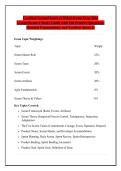
Certified ScrumMaster (CSM)® Exam Prep 2026
Comprehensive Study Guide with 100 Practice Questions,
Detailed Explanations, and Verified Answers
Exam Topic Weightings:
Topic Weight
Scrum Master Role 22%
Scrum Team 20%
Scrum Events 20%
Scrum Artifacts 20%
Agile Fundamentals 6%
Scrum Theory & Values 6%
Key Topics Covered:
• Scrum Framework (Roles, Events, Artifacts)
• Scrum Theory (Empirical Process Control, Transparency, Inspection,
Adaptation)
• The Five Scrum Values (Commitment, Courage, Focus, Openness, Respect)
• Product Owner, Scrum Master, and Developer Accountabilities
• Sprint Planning, Daily Scrum, Sprint Review, Sprint Retrospective
• Product Backlog, Sprint Backlog, Increment
• Product Goal, Sprint Goal, Definition of Done
,SECTION 1: SCRUM THEORY & VALUES (6 Questions)
Question 1
Which of the following BEST describes the three pillars of empirical process
control in Scrum?
A) Transparency, Inspection, and Adaptation
B) Planning, Execution, and Review
C) Commitment, Courage, and Focus
D) Analysis, Design, and Testing
Answer: A
Rationale: The three pillars of empirical process control are Transparency
(making work visible), Inspection (frequently inspecting the product and progress),
and Adaptation (adjusting based on inspection results). These pillars form the
foundation of Scrum's approach to complex work. Options B, C, and D describe
other concepts—Option C lists Scrum values, while Options B and D describe
generic process phases.
Question 2
Which of the following is NOT one of the five Scrum values?
A) Commitment
B) Courage
C) Efficiency
D) Respect
Answer: C
Rationale: The five Scrum values are Commitment, Courage, Focus, Openness,
and Respect. "Efficiency" is not a Scrum value—it is a desirable outcome but not
one of the core values that guide Scrum team behavior. The Scrum values help
create an environment of trust and collaboration.
Question 3
,What is the PRIMARY purpose of the Sprint Retrospective?
A) To inspect the product increment and adapt the Product Backlog
B) To inspect how the last Sprint went and identify improvements for the next
Sprint
C) To plan the work for the upcoming Sprint
D) To review the team's progress with stakeholders
Answer: B
Rationale: The Sprint Retrospective is an event where the Scrum Team inspects
itself and creates a plan for improvements to be enacted during the next Sprint. It
focuses on the team's process, not the product. Option A describes the Sprint
Review. Option C describes Sprint Planning. Option D also describes the Sprint
Review.
Question 4
When does a Sprint typically begin?
A) After all requirements are fully documented
B) Immediately after the previous Sprint ends
C) After the Product Owner approves the Sprint Backlog
D) When the Scrum Master decides the team is ready
Answer: B
Rationale: Sprints are continuous and sequential—a new Sprint starts immediately
after the previous Sprint ends. There is no gap between Sprints. Options A, C, and
D describe conditions that are not required for a Sprint to begin.
Question 5
What is the PRIMARY benefit of the Sprint time-box?
A) It ensures the team works overtime to meet deadlines
B) It creates a regular cadence and limits the risk of scope creep
C) It allows the Product Owner to change priorities daily
D) It eliminates the need for planning
, Answer: B
Rationale: The Sprint time-box (typically 1-4 weeks) creates a regular, predictable
cadence for delivery and limits the risk of scope creep by providing a fixed period
for work. It does not require overtime (Option A). While the Product Owner can
reprioritize, this happens between Sprints, not daily (Option C). Planning is still
essential (Option D).
Question 6
What does "Inspection" in Scrum primarily enable?
A) The team to find defects in the final product
B) The team to identify unwanted variances and adapt
C) The Product Owner to change requirements
D) The Scrum Master to assign tasks
Answer: B
Rationale: Inspection in Scrum enables the team to detect unwanted variances
from the expected outcomes so they can adapt. It is not just about finding defects
(Option A)—it's about inspecting progress, process, and product. While the
Product Owner can change requirements, that is not the primary purpose of
inspection (Option C). The Scrum Master does not assign tasks (Option D).
SECTION 2: SCRUM ROLES & ACCOUNTABILITIES (22 Questions)
Question 7
Who is accountable for maximizing the value of the product resulting from the
work of the Scrum Team?
A) The Scrum Master
B) The Developers
C) The Product Owner
D) The stakeholders
Answer: C
Comprehensive Study Guide with 100 Practice Questions,
Detailed Explanations, and Verified Answers
Exam Topic Weightings:
Topic Weight
Scrum Master Role 22%
Scrum Team 20%
Scrum Events 20%
Scrum Artifacts 20%
Agile Fundamentals 6%
Scrum Theory & Values 6%
Key Topics Covered:
• Scrum Framework (Roles, Events, Artifacts)
• Scrum Theory (Empirical Process Control, Transparency, Inspection,
Adaptation)
• The Five Scrum Values (Commitment, Courage, Focus, Openness, Respect)
• Product Owner, Scrum Master, and Developer Accountabilities
• Sprint Planning, Daily Scrum, Sprint Review, Sprint Retrospective
• Product Backlog, Sprint Backlog, Increment
• Product Goal, Sprint Goal, Definition of Done
,SECTION 1: SCRUM THEORY & VALUES (6 Questions)
Question 1
Which of the following BEST describes the three pillars of empirical process
control in Scrum?
A) Transparency, Inspection, and Adaptation
B) Planning, Execution, and Review
C) Commitment, Courage, and Focus
D) Analysis, Design, and Testing
Answer: A
Rationale: The three pillars of empirical process control are Transparency
(making work visible), Inspection (frequently inspecting the product and progress),
and Adaptation (adjusting based on inspection results). These pillars form the
foundation of Scrum's approach to complex work. Options B, C, and D describe
other concepts—Option C lists Scrum values, while Options B and D describe
generic process phases.
Question 2
Which of the following is NOT one of the five Scrum values?
A) Commitment
B) Courage
C) Efficiency
D) Respect
Answer: C
Rationale: The five Scrum values are Commitment, Courage, Focus, Openness,
and Respect. "Efficiency" is not a Scrum value—it is a desirable outcome but not
one of the core values that guide Scrum team behavior. The Scrum values help
create an environment of trust and collaboration.
Question 3
,What is the PRIMARY purpose of the Sprint Retrospective?
A) To inspect the product increment and adapt the Product Backlog
B) To inspect how the last Sprint went and identify improvements for the next
Sprint
C) To plan the work for the upcoming Sprint
D) To review the team's progress with stakeholders
Answer: B
Rationale: The Sprint Retrospective is an event where the Scrum Team inspects
itself and creates a plan for improvements to be enacted during the next Sprint. It
focuses on the team's process, not the product. Option A describes the Sprint
Review. Option C describes Sprint Planning. Option D also describes the Sprint
Review.
Question 4
When does a Sprint typically begin?
A) After all requirements are fully documented
B) Immediately after the previous Sprint ends
C) After the Product Owner approves the Sprint Backlog
D) When the Scrum Master decides the team is ready
Answer: B
Rationale: Sprints are continuous and sequential—a new Sprint starts immediately
after the previous Sprint ends. There is no gap between Sprints. Options A, C, and
D describe conditions that are not required for a Sprint to begin.
Question 5
What is the PRIMARY benefit of the Sprint time-box?
A) It ensures the team works overtime to meet deadlines
B) It creates a regular cadence and limits the risk of scope creep
C) It allows the Product Owner to change priorities daily
D) It eliminates the need for planning
, Answer: B
Rationale: The Sprint time-box (typically 1-4 weeks) creates a regular, predictable
cadence for delivery and limits the risk of scope creep by providing a fixed period
for work. It does not require overtime (Option A). While the Product Owner can
reprioritize, this happens between Sprints, not daily (Option C). Planning is still
essential (Option D).
Question 6
What does "Inspection" in Scrum primarily enable?
A) The team to find defects in the final product
B) The team to identify unwanted variances and adapt
C) The Product Owner to change requirements
D) The Scrum Master to assign tasks
Answer: B
Rationale: Inspection in Scrum enables the team to detect unwanted variances
from the expected outcomes so they can adapt. It is not just about finding defects
(Option A)—it's about inspecting progress, process, and product. While the
Product Owner can change requirements, that is not the primary purpose of
inspection (Option C). The Scrum Master does not assign tasks (Option D).
SECTION 2: SCRUM ROLES & ACCOUNTABILITIES (22 Questions)
Question 7
Who is accountable for maximizing the value of the product resulting from the
work of the Scrum Team?
A) The Scrum Master
B) The Developers
C) The Product Owner
D) The stakeholders
Answer: C


