

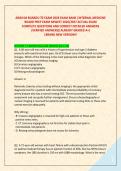
ABIM IM BOARDS ITE EXAM 2026 EXAM BANK |INTERNAL MEDICINE
BOARD PREP EXAM NEWEST 2026/2027 ACTUAL EXAM
COMPLETE QUESTIONS AND CORRECT DETAILED ANSWERS
(VERIFIED ANSWERS)|ALREADY GRADED A+|
|BRAND NEW VERSION!!
SECTION 1: CARDIOVASCULAR DISEASE (Qs 1-50)
Q1. A 68-year-old man with a history of hypertension and type 2 diabetes
presents with exertional chest pain. His ECG shows sinus rhythm with no ischemic
changes. Which of the following is the most appropriate initial diagnostic test?
A) Exercise stress test without imaging
B) Coronary angiography
C) CT coronary angiography
D) Resting echocardiogram
Answer: A
Rationale: Exercise stress testing without imaging is the appropriate initial
diagnostic test for a patient with intermediate pretest probability of coronary
artery disease who has a normal resting ECG. The test provides functional
assessment and can guide further management. Stress echocardiography or
nuclear imaging is reserved for patients with abnormal resting ECGs or those who
cannot exercise adequately.
Why Wrong:
- B: Invasive angiography is reserved for high-risk patients or those with
positive stress tests.
- C: CT coronary angiography is not first-line for stable chest pain in
intermediate-risk patients.
- D: Resting echocardiogram does not assess for ischemia.
Q2. A 72-year-old woman with heart failure with reduced ejection fraction (HFrEF)
on optimal medical therapy has an ejection fraction of 28%. She has NYHA Class II
symptoms. Her QRS duration is 150 ms with LBBB morphology. What is the most
1
,appropriate next step?
A) Add digoxin
B) Implantable cardioverter-defibrillator (ICD) placement
C) Cardiac resynchronization therapy (CRT) with ICD
D) Increase loop diuretic dose
Answer: C
Rationale: Cardiac resynchronization therapy (CRT) is indicated for patients with
HFrEF (EF ≤35%), NYHA Class II-IV symptoms, and QRS ≥150 ms with LBBB
morphology.
The combination CRT-D provides both resynchronization and defibrillation
protection. CRT improves symptoms, quality of life, and reduces mortality in
these patients.
Why Wrong:
- A: Digoxin is not the next step; CRT is indicated.
- B: ICD alone does not address dyssynchrony; CRT is needed.
- D: Diuretic adjustment does not address the underlying dyssynchrony.
Q3. A 55-year-old man with no prior cardiac history presents with acute onset of
severe substernal chest pain radiating to the jaw. ECG shows ST-segment
elevation in leads V1-V4. Which of the following is the most appropriate initial
management?
A) Aspirin and primary PCI within 90 minutes
B) Aspirin and fibrinolytic therapy
C) Aspirin and transfer to the nearest ED
D) Aspirin and observation
Answer: A
Rationale: The patient has an ST-segment elevation myocardial infarction (STEMI).
Primary percutaneous coronary intervention (PCI) is the preferred reperfusion
strategy if it can be performed within 90 minutes of first medical contact. Early
reperfusion is critical to salvage myocardium and reduce mortality.
2
,Why Wrong:
- B: Fibrinolytics are indicated if PCI cannot be performed within 120 minutes.
- C: Transfer to ED without reperfusion is not acceptable.
- D: Observation without reperfusion is not appropriate for STEMI.
Q4. A 48-year-old woman with palpitations and lightheadedness has a resting ECG
showing sinus rhythm with frequent premature ventricular contractions (PVCs).
Holter monitoring shows a PVC burden of 25%. Echocardiogram is normal. What is
the most appropriate management?
A) Start amiodarone
B) Start beta-blocker
C) Radiofrequency ablation
D) Observation and reassurance
Answer: C
Rationale: Radiofrequency ablation is indicated for symptomatic patients with a
high PVC burden (>20%) and normal cardiac function. Ablation can eliminate
PVCs, improve symptoms, and prevent PVC-induced cardiomyopathy. Medical
therapy with beta-blockers is less effective for frequent PVCs.
Why Wrong:
- A: Amiodarone has significant toxicity and is not first-line.
- B: Beta-blockers may reduce symptoms but are less effective for eliminating
PVCs.
- D: Observation is not appropriate with 25% PVC burden and symptoms.
Q5. A 62-year-old man with hypertension and type 2 diabetes is found to have a
blood pressure of 155/92 mmHg on three separate occasions. His labs show
creatinine 1.2 mg/dL and potassium 4.2 mEq/L. Which of the following is the
most appropriate initial antihypertensive agent?
A) Hydrochlorothiazide
B) Lisinopril
C) Amlodipine
3
, D) Metoprolol
Answer: B
Rationale: Lisinopril (ACE inhibitor) is the preferred initial agent for
hypertension in patients with diabetes due to its renoprotective effects. ACE
inhibitors slow the progression of diabetic nephropathy and are indicated in
patients with microalbuminuria or proteinuria.
Why Wrong:
- A: Thiazides are effective but do not provide renoprotection.
- C: Calcium channel blockers do not provide renoprotection.
- D: Beta-blockers are not first-line for uncomplicated hypertension.
Q6. A 70-year-old man with atrial fibrillation has a CHA2DS2-VASc score of 4.
He has no contraindications to anticoagulation. Which of the following is the
most appropriate antithrombotic therapy?
A) Aspirin 81 mg daily
B) Aspirin 325 mg daily
C) Warfarin with target INR 2-3
D) Direct oral anticoagulant (DOAC)
Answer: D
Rationale: Direct oral anticoagulants (DOACs) are preferred over warfarin for
stroke prevention in non-valvular atrial fibrillation. DOACs have a more favorable
safety profile with lower rates of intracranial hemorrhage and are easier to
manage without routine monitoring.
Why Wrong:
- A: Aspirin is ineffective for stroke prevention in AF patients with a CHA2DS2-
VASc score ≥2.
- B: Aspirin at any dose is inadequate for stroke prevention in AF.
- C: Warfarin is effective but DOACs are preferred due to better safety profile.
4
BOARD PREP EXAM NEWEST 2026/2027 ACTUAL EXAM
COMPLETE QUESTIONS AND CORRECT DETAILED ANSWERS
(VERIFIED ANSWERS)|ALREADY GRADED A+|
|BRAND NEW VERSION!!
SECTION 1: CARDIOVASCULAR DISEASE (Qs 1-50)
Q1. A 68-year-old man with a history of hypertension and type 2 diabetes
presents with exertional chest pain. His ECG shows sinus rhythm with no ischemic
changes. Which of the following is the most appropriate initial diagnostic test?
A) Exercise stress test without imaging
B) Coronary angiography
C) CT coronary angiography
D) Resting echocardiogram
Answer: A
Rationale: Exercise stress testing without imaging is the appropriate initial
diagnostic test for a patient with intermediate pretest probability of coronary
artery disease who has a normal resting ECG. The test provides functional
assessment and can guide further management. Stress echocardiography or
nuclear imaging is reserved for patients with abnormal resting ECGs or those who
cannot exercise adequately.
Why Wrong:
- B: Invasive angiography is reserved for high-risk patients or those with
positive stress tests.
- C: CT coronary angiography is not first-line for stable chest pain in
intermediate-risk patients.
- D: Resting echocardiogram does not assess for ischemia.
Q2. A 72-year-old woman with heart failure with reduced ejection fraction (HFrEF)
on optimal medical therapy has an ejection fraction of 28%. She has NYHA Class II
symptoms. Her QRS duration is 150 ms with LBBB morphology. What is the most
1
,appropriate next step?
A) Add digoxin
B) Implantable cardioverter-defibrillator (ICD) placement
C) Cardiac resynchronization therapy (CRT) with ICD
D) Increase loop diuretic dose
Answer: C
Rationale: Cardiac resynchronization therapy (CRT) is indicated for patients with
HFrEF (EF ≤35%), NYHA Class II-IV symptoms, and QRS ≥150 ms with LBBB
morphology.
The combination CRT-D provides both resynchronization and defibrillation
protection. CRT improves symptoms, quality of life, and reduces mortality in
these patients.
Why Wrong:
- A: Digoxin is not the next step; CRT is indicated.
- B: ICD alone does not address dyssynchrony; CRT is needed.
- D: Diuretic adjustment does not address the underlying dyssynchrony.
Q3. A 55-year-old man with no prior cardiac history presents with acute onset of
severe substernal chest pain radiating to the jaw. ECG shows ST-segment
elevation in leads V1-V4. Which of the following is the most appropriate initial
management?
A) Aspirin and primary PCI within 90 minutes
B) Aspirin and fibrinolytic therapy
C) Aspirin and transfer to the nearest ED
D) Aspirin and observation
Answer: A
Rationale: The patient has an ST-segment elevation myocardial infarction (STEMI).
Primary percutaneous coronary intervention (PCI) is the preferred reperfusion
strategy if it can be performed within 90 minutes of first medical contact. Early
reperfusion is critical to salvage myocardium and reduce mortality.
2
,Why Wrong:
- B: Fibrinolytics are indicated if PCI cannot be performed within 120 minutes.
- C: Transfer to ED without reperfusion is not acceptable.
- D: Observation without reperfusion is not appropriate for STEMI.
Q4. A 48-year-old woman with palpitations and lightheadedness has a resting ECG
showing sinus rhythm with frequent premature ventricular contractions (PVCs).
Holter monitoring shows a PVC burden of 25%. Echocardiogram is normal. What is
the most appropriate management?
A) Start amiodarone
B) Start beta-blocker
C) Radiofrequency ablation
D) Observation and reassurance
Answer: C
Rationale: Radiofrequency ablation is indicated for symptomatic patients with a
high PVC burden (>20%) and normal cardiac function. Ablation can eliminate
PVCs, improve symptoms, and prevent PVC-induced cardiomyopathy. Medical
therapy with beta-blockers is less effective for frequent PVCs.
Why Wrong:
- A: Amiodarone has significant toxicity and is not first-line.
- B: Beta-blockers may reduce symptoms but are less effective for eliminating
PVCs.
- D: Observation is not appropriate with 25% PVC burden and symptoms.
Q5. A 62-year-old man with hypertension and type 2 diabetes is found to have a
blood pressure of 155/92 mmHg on three separate occasions. His labs show
creatinine 1.2 mg/dL and potassium 4.2 mEq/L. Which of the following is the
most appropriate initial antihypertensive agent?
A) Hydrochlorothiazide
B) Lisinopril
C) Amlodipine
3
, D) Metoprolol
Answer: B
Rationale: Lisinopril (ACE inhibitor) is the preferred initial agent for
hypertension in patients with diabetes due to its renoprotective effects. ACE
inhibitors slow the progression of diabetic nephropathy and are indicated in
patients with microalbuminuria or proteinuria.
Why Wrong:
- A: Thiazides are effective but do not provide renoprotection.
- C: Calcium channel blockers do not provide renoprotection.
- D: Beta-blockers are not first-line for uncomplicated hypertension.
Q6. A 70-year-old man with atrial fibrillation has a CHA2DS2-VASc score of 4.
He has no contraindications to anticoagulation. Which of the following is the
most appropriate antithrombotic therapy?
A) Aspirin 81 mg daily
B) Aspirin 325 mg daily
C) Warfarin with target INR 2-3
D) Direct oral anticoagulant (DOAC)
Answer: D
Rationale: Direct oral anticoagulants (DOACs) are preferred over warfarin for
stroke prevention in non-valvular atrial fibrillation. DOACs have a more favorable
safety profile with lower rates of intracranial hemorrhage and are easier to
manage without routine monitoring.
Why Wrong:
- A: Aspirin is ineffective for stroke prevention in AF patients with a CHA2DS2-
VASc score ≥2.
- B: Aspirin at any dose is inadequate for stroke prevention in AF.
- C: Warfarin is effective but DOACs are preferred due to better safety profile.
4


