Page 1 of 187
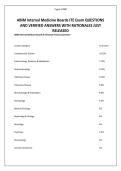
ABIM Internal Medicine Boards ITE Exam QUESTIONS
AND VERIFIED ANSWERS WITH RATIONALES JUST
RELEASED
ABIM Internal Medicine Boards & ITE Exam Practice Questions
Content Category % of Exam
Cardiovascular Disease 14-15%
Endocrinology, Diabetes, & Metabolism 7-10%
Gastroenterology 9-10%
Infectious Disease 9-10%
Pulmonary Disease 8-9%
Rheumatology & Orthopedics 8-9%
Hematology 4-6%
Medical Oncology 6%
Nephrology & Urology 6%
Neurology 4%
Psychiatry 3-4%
Dermatology 3%
Geriatric Syndromes 3%
, Page 2 of 187
Content Category % of Exam
Allergy & Immunology 2-3%
Miscellaneous (Patient Safety, Ethics, etc.) 6%
Section 1: Cardiovascular Disease
Question 1
A 62-year-old man with a history of chronic heart failure with reduced ejection fraction (HFrEF) is on
optimal medical therapy including sacubitril/valsartan 97/103 mg twice daily, carvedilol 25 mg twice
daily, and spironolactone 25 mg daily. Despite this regimen for the past 6 months, he continues to have
NYHA Class III symptoms with dyspnea on minimal exertion. His most recent echocardiogram shows a
left ventricular ejection fraction (LVEF) of 30% with severe left bundle branch block (LBBB) and a QRS
duration of 160 ms. There is no significant coronary artery disease on prior angiography. Which
intervention has been shown to reduce mortality and hospitalizations in this specific patient population
according to current guideline-directed medical therapy recommendations?
• A) Implantable cardioverter-defibrillator (ICD) alone
• B) Cardiac resynchronization therapy with defibrillator (CRT-D)
• C) Left ventricular assist device (LVAD) as destination therapy
, Page 3 of 187
• D) Heart transplantation listing
Answer: B
Rationale: In patients with HFrEF, a QRS duration ≥150 ms, and LBBB morphology, cardiac
resynchronization therapy with defibrillator (CRT-D) has been shown to reduce mortality and
hospitalizations. An ICD alone would address sudden cardiac death risk but does not improve symptoms
or reverse ventricular dyssynchrony . LVAD and transplantation are reserved for patients with advanced
heart failure with refractory symptoms despite optimal medical and device therapy .
Question 2
A 68-year-old woman with a history of hypertension and type 2 diabetes presents with progressive
dyspnea on exertion, orthopnea, and bilateral lower extremity edema that has worsened over the past 3
weeks. Physical examination reveals an S3 gallop, jugular venous distension, and crackles at the lung
bases. Echocardiography demonstrates a LVEF of 35% with global hypokinesis, and coronary
angiography shows nonobstructive coronary artery disease. Which pharmacologic intervention, when
initiated in this patient, has been shown to reduce all-cause mortality in patients with HFrEF based on
the landmark PARADIGM-HF trial?
• A) Ivabradine
• B) Vericiguat
, Page 4 of 187
• C) Sacubitril/valsartan
• D) Digoxin
Answer: C
Rationale: Sacubitril/valsartan (an angiotensin receptor-neprilysin inhibitor, or ARNI) reduces mortality
in HFrEF compared to enalapril in the PARADIGM-HF trial . Ivabradine reduces heart failure
hospitalizations but not mortality in HFrEF patients with a heart rate >70 beats per minute. Vericiguat is
approved for reducing cardiovascular death and HF hospitalization in patients with worsening HF but
does not show a mortality benefit. Digoxin reduces hospitalizations but does not improve survival.
Question 3
A 55-year-old man presents to the emergency department with acute-onset severe substernal chest
pain radiating to his back, associated with diaphoresis and nausea. He has a history of hypertension and
hyperlipidemia. On arrival, his blood pressure is 95/60 mm Hg in the right arm and 80/50 mm Hg in the
left arm. His heart rate is 110 beats per minute. ECG shows sinus tachycardia with no ST-segment
elevations. A chest radiograph reveals a widened mediastinum. Which is the most likely diagnosis and
what is the immediate next step in management?
• A) Acute myocardial infarction; administer aspirin and nitroglycerin
• B) Pulmonary embolism; obtain CT pulmonary angiography
ABIM Internal Medicine Boards ITE Exam QUESTIONS
AND VERIFIED ANSWERS WITH RATIONALES JUST
RELEASED
ABIM Internal Medicine Boards & ITE Exam Practice Questions
Content Category % of Exam
Cardiovascular Disease 14-15%
Endocrinology, Diabetes, & Metabolism 7-10%
Gastroenterology 9-10%
Infectious Disease 9-10%
Pulmonary Disease 8-9%
Rheumatology & Orthopedics 8-9%
Hematology 4-6%
Medical Oncology 6%
Nephrology & Urology 6%
Neurology 4%
Psychiatry 3-4%
Dermatology 3%
Geriatric Syndromes 3%
, Page 2 of 187
Content Category % of Exam
Allergy & Immunology 2-3%
Miscellaneous (Patient Safety, Ethics, etc.) 6%
Section 1: Cardiovascular Disease
Question 1
A 62-year-old man with a history of chronic heart failure with reduced ejection fraction (HFrEF) is on
optimal medical therapy including sacubitril/valsartan 97/103 mg twice daily, carvedilol 25 mg twice
daily, and spironolactone 25 mg daily. Despite this regimen for the past 6 months, he continues to have
NYHA Class III symptoms with dyspnea on minimal exertion. His most recent echocardiogram shows a
left ventricular ejection fraction (LVEF) of 30% with severe left bundle branch block (LBBB) and a QRS
duration of 160 ms. There is no significant coronary artery disease on prior angiography. Which
intervention has been shown to reduce mortality and hospitalizations in this specific patient population
according to current guideline-directed medical therapy recommendations?
• A) Implantable cardioverter-defibrillator (ICD) alone
• B) Cardiac resynchronization therapy with defibrillator (CRT-D)
• C) Left ventricular assist device (LVAD) as destination therapy
, Page 3 of 187
• D) Heart transplantation listing
Answer: B
Rationale: In patients with HFrEF, a QRS duration ≥150 ms, and LBBB morphology, cardiac
resynchronization therapy with defibrillator (CRT-D) has been shown to reduce mortality and
hospitalizations. An ICD alone would address sudden cardiac death risk but does not improve symptoms
or reverse ventricular dyssynchrony . LVAD and transplantation are reserved for patients with advanced
heart failure with refractory symptoms despite optimal medical and device therapy .
Question 2
A 68-year-old woman with a history of hypertension and type 2 diabetes presents with progressive
dyspnea on exertion, orthopnea, and bilateral lower extremity edema that has worsened over the past 3
weeks. Physical examination reveals an S3 gallop, jugular venous distension, and crackles at the lung
bases. Echocardiography demonstrates a LVEF of 35% with global hypokinesis, and coronary
angiography shows nonobstructive coronary artery disease. Which pharmacologic intervention, when
initiated in this patient, has been shown to reduce all-cause mortality in patients with HFrEF based on
the landmark PARADIGM-HF trial?
• A) Ivabradine
• B) Vericiguat
, Page 4 of 187
• C) Sacubitril/valsartan
• D) Digoxin
Answer: C
Rationale: Sacubitril/valsartan (an angiotensin receptor-neprilysin inhibitor, or ARNI) reduces mortality
in HFrEF compared to enalapril in the PARADIGM-HF trial . Ivabradine reduces heart failure
hospitalizations but not mortality in HFrEF patients with a heart rate >70 beats per minute. Vericiguat is
approved for reducing cardiovascular death and HF hospitalization in patients with worsening HF but
does not show a mortality benefit. Digoxin reduces hospitalizations but does not improve survival.
Question 3
A 55-year-old man presents to the emergency department with acute-onset severe substernal chest
pain radiating to his back, associated with diaphoresis and nausea. He has a history of hypertension and
hyperlipidemia. On arrival, his blood pressure is 95/60 mm Hg in the right arm and 80/50 mm Hg in the
left arm. His heart rate is 110 beats per minute. ECG shows sinus tachycardia with no ST-segment
elevations. A chest radiograph reveals a widened mediastinum. Which is the most likely diagnosis and
what is the immediate next step in management?
• A) Acute myocardial infarction; administer aspirin and nitroglycerin
• B) Pulmonary embolism; obtain CT pulmonary angiography