

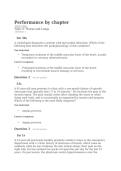
Performance by chapter
What's this?
Topic 4: Thorax and Lungs
Question 1
2m 36s
A cardiologist diagnoses a patient with myocardial infarction. Which of the
following best describes the pathophysiology of this condition?
You Selected:
Temporary ischemia of the middle muscular layer of the heart, usually
secondary to coronary atherosclerosis.
Correct response:
Prolonged ischemia of the middle muscular layer of the heart,
resulting in irreversible muscle damage or necrosis.
Question 2 See full question
52s
A 65-year-old man presents to clinic with a one-month history of episodic
chest pain that typically lasts “5 to 10 minutes.” He localizes the pain to the
sternal region. The pain usually arises after climbing the stairs or while
doing yard work, and is occasionally accompanied by nausea and dyspnea.
Which of the following is the most likely diagnosis?
You Selected:
Angina pectoris.
Correct response:
Angina pectoris.
Question 3 See full question
1m 1s
A 23-year-old previously healthy graduate student comes to the emergency
department with a 1-hour history of shortness of breath, which came on
suddenly while he was studying. He also notices sharp chest pain on the
right side. He has smoked two packs of cigarettes per day for the last 10
years. On percussion, the physicians notice hyperresonance over the
, superior right lung field. There are decreased breath sounds superiorly on
the right side. There are no wheezes, crackles, or rhonchi. Which of the
following is the most likely diagnosis?
You Selected:
Pneumothorax.
Correct response:
Pneumothorax.
Question 4 See full question
55s
A 51-year-old presents to pulmonology clinic with a two-week history of
hemoptysis. With the gown lowered, the pulmonoligist observes the chest to
determine the respiratory rate. Where are the primary breathing centers
located?
You Selected:
Hypothalamus.
Correct response:
Brainstem.
Question 5 See full question
12s
A chest radiograph demonstrates fluid between the visceral and parietal
pleura. Which of the following is the diagnosis?
You Selected:
Pleural effusion.
Correct response:
Pleural effusion.
Question 6 See full question
2m 19s
What's this?
Topic 4: Thorax and Lungs
Question 1
2m 36s
A cardiologist diagnoses a patient with myocardial infarction. Which of the
following best describes the pathophysiology of this condition?
You Selected:
Temporary ischemia of the middle muscular layer of the heart, usually
secondary to coronary atherosclerosis.
Correct response:
Prolonged ischemia of the middle muscular layer of the heart,
resulting in irreversible muscle damage or necrosis.
Question 2 See full question
52s
A 65-year-old man presents to clinic with a one-month history of episodic
chest pain that typically lasts “5 to 10 minutes.” He localizes the pain to the
sternal region. The pain usually arises after climbing the stairs or while
doing yard work, and is occasionally accompanied by nausea and dyspnea.
Which of the following is the most likely diagnosis?
You Selected:
Angina pectoris.
Correct response:
Angina pectoris.
Question 3 See full question
1m 1s
A 23-year-old previously healthy graduate student comes to the emergency
department with a 1-hour history of shortness of breath, which came on
suddenly while he was studying. He also notices sharp chest pain on the
right side. He has smoked two packs of cigarettes per day for the last 10
years. On percussion, the physicians notice hyperresonance over the
, superior right lung field. There are decreased breath sounds superiorly on
the right side. There are no wheezes, crackles, or rhonchi. Which of the
following is the most likely diagnosis?
You Selected:
Pneumothorax.
Correct response:
Pneumothorax.
Question 4 See full question
55s
A 51-year-old presents to pulmonology clinic with a two-week history of
hemoptysis. With the gown lowered, the pulmonoligist observes the chest to
determine the respiratory rate. Where are the primary breathing centers
located?
You Selected:
Hypothalamus.
Correct response:
Brainstem.
Question 5 See full question
12s
A chest radiograph demonstrates fluid between the visceral and parietal
pleura. Which of the following is the diagnosis?
You Selected:
Pleural effusion.
Correct response:
Pleural effusion.
Question 6 See full question
2m 19s


