

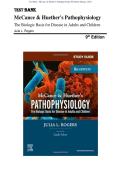
Test Bank - McCance & Huether's Pathophysiology 9th Edition (Rogers, 2023)
TEST BANK
McCance & Huether's Pathophysiology
The Biologic Basis for Disease in Adults and Children
Julia L. Rogers
9th Edition
, Test Bank - McCance & Huether's Pathophysiology 9th Edition (Rogers, 2023)
Table of Contents
Part One: Central Concepts of Pathophysiology: Cells and Tissues
Unit I: The Cell
1. Cellular Biology
2. Altered Cellular and Tissue Biology: Environmental Agents
3. The Cellular Environment: Fluids and Electrolytes, Acids and Bases
Unit II: Genes and Gene-Environment Interaction
4. Genes and Genetic Diseases
5. Genes, Environment-Lifestyle, and Common Diseases
6. Epigenetics and Disease
Unit III: Mechanisms of Self-Defense
7. Innate Immunity Inflammation and Wound Healing
8. Adaptive Immunity
9. Alterations in Immunity
10. Infection
11. Stress and Disease
Unit IV: Cellular Proliferation: Cancer
12. Cancer Biology
13. Cancer Epidemiology
14. Cancer in Children and Adolescents
Part Two: Structure, Function, and Pathophysiologic Alterations: Organs and Systems
Unit V: The Neurologic System
15. Structure and Function of the Neurologic System
16. Pain, Temperature Regulation, Sleep, and Sensory Function
17. Alterations in Cognitive Systems, Cerebral Hemodynamics, and Motor Function
18. Alterations of the Brain, Spinal Cord, and Peripheral Nerves
19. Neurobiology of Schizophrenia, Mood Disorders, Anxiety Disorders, Posttraumatic Stress Disorder, and
Obsessive-Compulsive Disorder
20. Alterations of Neurologic Function in Children
Unit VI: The Endocrine System
21. Mechanisms of Hormonal Regulation
22. Alterations of Hormonal Regulation
23. Obesity, Starvation, and Anorexia of Aging
Unit VII: The Reproductive Systems
24. Structure and Function of the Reproductive Systems
25. Alterations of the Female Reproductive System
26. Alterations of the Male Reproductive System
27. Sexually Transmitted Infections
Unit VIII: The Hematologic System
28. Structure and Function of the Hematologic System
29. Alterations of Hematologic Function
30. Alterations of Hematologic Function in Children
Unit IX: The Cardiovascular and Lymphatic Systems
31. Structure and Function of the Cardiovascular and Lymphatic Systems
32. Alterations of Cardiovascular Function
33. Alterations of Cardiovascular Function in Children
Unit X: The Pulmonary System
34. Structure and Function of the Pulmonary System
, Test Bank - McCance & Huether's Pathophysiology 9th Edition (Rogers, 2023)
35. Alterations of Pulmonary Function
36. Alterations of Pulmonary Function in Children
Unit XI: The Renal and Urologic Systems
37. Structure and Function of the Renal and Urologic Systems
38. Alterations of Renal and Urinary Tract Function
39. Alterations of Renal and Urinary Tract Function in Children
Unit XII: The Digestive System
40. Structure and Function of the Digestive System
41. Alterations of Digestive Function
42. Alterations of Digestive Function in Children
Unit XIII: The Musculoskeletal System
43. Structure and Function of the Musculoskeletal System
44. Alterations of Musculoskeletal Function
45. Alterations of Musculoskeletal Function in Children
Unit XIV: The Integumentary System
46. Structure, Function, and Disorders of the Integument
47. Alterations of the Integument in Children
Unit XV: Multiple Interacting Systems
48. Shock, Multiple Organ Dysfunction Syndrome, and Burns in Adults
49. Shock, Multiple Organ Dysfunction Syndrome, and Burns in Children
, Test Bank - McCance & Huether's Pathophysiology 9th Edition (Rogers, 2023)
Chapter 1: Cellular Biology
MULTIPLE CHOICE
1. Which statement best describes the cellular function of metabolic absorption?
a. Cells can produce proteins. c. Cells can take in and use nutrients.
b. Cells can secrete digestive enzymes. d. Cells can synthesize fats.
ANS: C
In metabolic absorption, all cells take in and use nutrients and other substances from their
surroundings. The remaining options are not inclusive in their descriptions of cellular
metabolic absorption.
PTS: 1 REF: Page 2
2. Most of a cell’s genetic information, including RNA and DNA, is contained in the:
a. Mitochondria c. Nucleolus
b. Ribosome d. Lysosome
ANS: C
The nucleus contains the nucleolus, a small dense structure composed largely of RNA,
most of the cellular DNA, and the DNA-binding proteins, such as the histones, which
regulate its activity. The other options do not contain most of a cell’s genetic information.
PTS: 1 REF: Page 2
3. Which component of the cell produces hydrogen peroxide (H2O2) by using oxygen to
remove hydrogen atoms from specific substrates in an oxidative reaction?
a. Lysosomes c. Ribosomes
b. Peroxisomes d. Oxyhydrosomes
ANS: B
Peroxisomes are so named because they usually contain enzymes that use oxygen to
remove hydrogen atoms from specific substrates in an oxidative reaction that produces
H2O2, which is a powerful oxidant and potentially destructive if it accumulates or escapes
from peroxisomes. Ribosomes are RNA-protein complexes (nucleoproteins) that are
synthesized in the nucleolus and secreted into the cytoplasm through pores in the nuclear
envelope called nuclear pore complexes. Lysosomes are saclike structures that originate
from the Golgi complex and contain more than 40 digestive enzymes called hydrolases,
which catalyze bonds in proteins, lipids, nucleic acids, and carbohydrates. Oxyhydrosomes
are involved in enzyme production.
PTS: 1 REF: Page 8
4. Which cell component is capable of cellular autodigestion when it is released during cell
injury?
a. Ribosome c. Smooth endoplasmic reticulum
b. Golgi complex d. Lysosomes
ANS: D
TEST BANK
McCance & Huether's Pathophysiology
The Biologic Basis for Disease in Adults and Children
Julia L. Rogers
9th Edition
, Test Bank - McCance & Huether's Pathophysiology 9th Edition (Rogers, 2023)
Table of Contents
Part One: Central Concepts of Pathophysiology: Cells and Tissues
Unit I: The Cell
1. Cellular Biology
2. Altered Cellular and Tissue Biology: Environmental Agents
3. The Cellular Environment: Fluids and Electrolytes, Acids and Bases
Unit II: Genes and Gene-Environment Interaction
4. Genes and Genetic Diseases
5. Genes, Environment-Lifestyle, and Common Diseases
6. Epigenetics and Disease
Unit III: Mechanisms of Self-Defense
7. Innate Immunity Inflammation and Wound Healing
8. Adaptive Immunity
9. Alterations in Immunity
10. Infection
11. Stress and Disease
Unit IV: Cellular Proliferation: Cancer
12. Cancer Biology
13. Cancer Epidemiology
14. Cancer in Children and Adolescents
Part Two: Structure, Function, and Pathophysiologic Alterations: Organs and Systems
Unit V: The Neurologic System
15. Structure and Function of the Neurologic System
16. Pain, Temperature Regulation, Sleep, and Sensory Function
17. Alterations in Cognitive Systems, Cerebral Hemodynamics, and Motor Function
18. Alterations of the Brain, Spinal Cord, and Peripheral Nerves
19. Neurobiology of Schizophrenia, Mood Disorders, Anxiety Disorders, Posttraumatic Stress Disorder, and
Obsessive-Compulsive Disorder
20. Alterations of Neurologic Function in Children
Unit VI: The Endocrine System
21. Mechanisms of Hormonal Regulation
22. Alterations of Hormonal Regulation
23. Obesity, Starvation, and Anorexia of Aging
Unit VII: The Reproductive Systems
24. Structure and Function of the Reproductive Systems
25. Alterations of the Female Reproductive System
26. Alterations of the Male Reproductive System
27. Sexually Transmitted Infections
Unit VIII: The Hematologic System
28. Structure and Function of the Hematologic System
29. Alterations of Hematologic Function
30. Alterations of Hematologic Function in Children
Unit IX: The Cardiovascular and Lymphatic Systems
31. Structure and Function of the Cardiovascular and Lymphatic Systems
32. Alterations of Cardiovascular Function
33. Alterations of Cardiovascular Function in Children
Unit X: The Pulmonary System
34. Structure and Function of the Pulmonary System
, Test Bank - McCance & Huether's Pathophysiology 9th Edition (Rogers, 2023)
35. Alterations of Pulmonary Function
36. Alterations of Pulmonary Function in Children
Unit XI: The Renal and Urologic Systems
37. Structure and Function of the Renal and Urologic Systems
38. Alterations of Renal and Urinary Tract Function
39. Alterations of Renal and Urinary Tract Function in Children
Unit XII: The Digestive System
40. Structure and Function of the Digestive System
41. Alterations of Digestive Function
42. Alterations of Digestive Function in Children
Unit XIII: The Musculoskeletal System
43. Structure and Function of the Musculoskeletal System
44. Alterations of Musculoskeletal Function
45. Alterations of Musculoskeletal Function in Children
Unit XIV: The Integumentary System
46. Structure, Function, and Disorders of the Integument
47. Alterations of the Integument in Children
Unit XV: Multiple Interacting Systems
48. Shock, Multiple Organ Dysfunction Syndrome, and Burns in Adults
49. Shock, Multiple Organ Dysfunction Syndrome, and Burns in Children
, Test Bank - McCance & Huether's Pathophysiology 9th Edition (Rogers, 2023)
Chapter 1: Cellular Biology
MULTIPLE CHOICE
1. Which statement best describes the cellular function of metabolic absorption?
a. Cells can produce proteins. c. Cells can take in and use nutrients.
b. Cells can secrete digestive enzymes. d. Cells can synthesize fats.
ANS: C
In metabolic absorption, all cells take in and use nutrients and other substances from their
surroundings. The remaining options are not inclusive in their descriptions of cellular
metabolic absorption.
PTS: 1 REF: Page 2
2. Most of a cell’s genetic information, including RNA and DNA, is contained in the:
a. Mitochondria c. Nucleolus
b. Ribosome d. Lysosome
ANS: C
The nucleus contains the nucleolus, a small dense structure composed largely of RNA,
most of the cellular DNA, and the DNA-binding proteins, such as the histones, which
regulate its activity. The other options do not contain most of a cell’s genetic information.
PTS: 1 REF: Page 2
3. Which component of the cell produces hydrogen peroxide (H2O2) by using oxygen to
remove hydrogen atoms from specific substrates in an oxidative reaction?
a. Lysosomes c. Ribosomes
b. Peroxisomes d. Oxyhydrosomes
ANS: B
Peroxisomes are so named because they usually contain enzymes that use oxygen to
remove hydrogen atoms from specific substrates in an oxidative reaction that produces
H2O2, which is a powerful oxidant and potentially destructive if it accumulates or escapes
from peroxisomes. Ribosomes are RNA-protein complexes (nucleoproteins) that are
synthesized in the nucleolus and secreted into the cytoplasm through pores in the nuclear
envelope called nuclear pore complexes. Lysosomes are saclike structures that originate
from the Golgi complex and contain more than 40 digestive enzymes called hydrolases,
which catalyze bonds in proteins, lipids, nucleic acids, and carbohydrates. Oxyhydrosomes
are involved in enzyme production.
PTS: 1 REF: Page 8
4. Which cell component is capable of cellular autodigestion when it is released during cell
injury?
a. Ribosome c. Smooth endoplasmic reticulum
b. Golgi complex d. Lysosomes
ANS: D


