

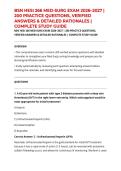
BSN HESI 266 MED-SURG EXAM 2026–2027 |
200 PRACTICE QUESTIONS, VERIFIED
ANSWERS & DETAILED RATIONALES |
COMPLETE STUDY GUIDE
BSN HESI 266 MED-SURG EXAM 2026–2027 | 200 PRACTICE QUESTIONS,
VERIFIED ANSWERS & DETAILED RATIONALES | COMPLETE STUDY GUIDE
OVERVIEW
• This comprehensive exam contains 200 verified practice questions with detailed
rationales to strengthen your Med-Surg nursing knowledge and prepare you for
licensing/certification exams.
• Study systematically by reviewing each question, attempting answers before
checking the rationale, and identifying weak areas for focused review.
QUESTIONS
1. A 62-year-old male patient with type 2 diabetes presents with a deep vein
thrombosis (DVT) in the right lower extremity. Which anticoagulant would be
most appropriate for initial treatment?
A) Aspirin
B) Warfarin
C) Unfractionated heparin (UFH)
D) Acetaminophen
E) Ibuprofen
Correct Answer: C - Unfractionated heparin (UFH)
Rationale: Unfractionated heparin is the gold standard for initial DVT treatment
because it has a rapid onset of action (1-2 hours), can be reversed with protamine
sulfate if bleeding occurs, and allows for continuous IV monitoring. Warfarin is used
,for long-term anticoagulation after heparin therapy is established. Aspirin and
NSAIDs are not appropriate anticoagulants for DVT treatment. Acetaminophen has
no anticoagulant properties.
2. A 45-year-old female patient recovering from abdominal surgery reports
severe lower back pain. The nurse assesses the patient and notes vital signs
are stable. Which intervention should be prioritized?
A) Administer opioid pain medication immediately
B) Assess pain characteristics and check surgical site first
C) Notify the physician without assessing the patient
D) Apply heat to the lower back
E) Encourage ambulation despite the pain
Correct Answer: B - Assess pain characteristics and check surgical site first
Rationale: Thorough assessment is essential before intervention. The severe lower
back pain could indicate a complication such as retroperitoneal bleeding, nerve
compression, or spinal issues. Checking the surgical site and assessing pain
characteristics helps determine the cause. While opioids may be needed, they
should not be given without first determining the underlying cause. Notifying the
physician without assessment is inefficient, and ambulation without assessment
could be harmful.
3. A 58-year-old patient with chronic obstructive pulmonary disease (COPD) is
admitted with acute exacerbation. Which oxygen delivery method should be
used?
A) Non-rebreather mask at 15 L/min
B) Nasal cannula at 2-3 L/min
C) Simple face mask at 8 L/min
D) Venturi mask at 24-28% oxygen
,E) Bag-valve-mask at maximum flow
Correct Answer: D - Venturi mask at 24-28% oxygen
Rationale: COPD patients have a chronic hypercapnia and rely on hypoxic drive for
respiration. High oxygen concentrations can suppress their respiratory drive and
cause CO2 retention. The Venturi mask delivers precise, controlled oxygen
concentrations (24-28%) which is ideal for COPD patients. Nasal cannula at 2-3
L/min may be insufficient during acute exacerbation. Non-rebreather masks deliver
too high oxygen concentration. The Venturi mask allows FiO2 control while
maintaining adequate oxygenation.
4. A 72-year-old male patient presents with an acute myocardial infarction
(AMI). Which enzyme marker is most specific for cardiac muscle injury?
A) Myoglobin
B) Lactate dehydrogenase (LDH)
C) Cardiac troponin I or T
D) Creatine kinase (CK)
E) Aspartate aminotransferase (AST)
Correct Answer: C - Cardiac troponin I or T
Rationale: Cardiac troponins (I and T) are the most specific markers for myocardial
injury. They appear 2-4 hours after MI onset, peak at 24-48 hours, and remain
elevated for 7-14 days. Myoglobin is sensitive but not specific and can be elevated
in skeletal muscle injury. CK-MB is cardiac-specific but troponins are more sensitive
and specific. LDH and AST are less specific cardiac markers. Troponins have
become the gold standard for diagnosing MI and detecting myocardial necrosis.
5. A 35-year-old female patient admitted with acute pancreatitis has severe
epigastric pain. Which position would provide maximum comfort?
A) Supine with legs extended
, B) Prone with pillow under abdomen
C) Sitting upright in a chair
D) Left side-lying with knees flexed
E) Trendelenburg position
Correct Answer: D - Left side-lying with knees flexed
Rationale: The left side-lying position with knees flexed reduces tension on the
pancreas and relieves pain in acute pancreatitis. This position decreases stress on
the abdominal musculature and allows for better breathing. Supine extension
increases abdominal tension. Sitting upright may not provide maximum relief.
Trendelenburg is contraindicated as it increases intra-abdominal pressure. Prone
position places pressure directly on the pancreas. Side-lying with flexed knees is the
classic comfort position for pancreatitis patients.
6. A 50-year-old male patient with a history of peptic ulcer disease (PUD)
presents with hematemesis. Which medication would be most appropriate to
reduce gastric acid?
A) Metoclopramide
B) Ranitidine (H2 receptor antagonist)
C) Sucralfate
D) Domperidone
E) Bismuth subsalicylate
Correct Answer: B - Ranitidine (H2 receptor antagonist)
Rationale: H2 receptor antagonists like ranitidine reduce gastric acid secretion by
blocking histamine-2 receptors on parietal cells. They decrease acid production by
60-70%, which helps protect the ulcer and promote healing. Metoclopramide and
domperidone are prokinetic agents that increase gastric motility. Sucralfate forms a
protective barrier but doesn't reduce acid. Bismuth subsalicylate has limited
200 PRACTICE QUESTIONS, VERIFIED
ANSWERS & DETAILED RATIONALES |
COMPLETE STUDY GUIDE
BSN HESI 266 MED-SURG EXAM 2026–2027 | 200 PRACTICE QUESTIONS,
VERIFIED ANSWERS & DETAILED RATIONALES | COMPLETE STUDY GUIDE
OVERVIEW
• This comprehensive exam contains 200 verified practice questions with detailed
rationales to strengthen your Med-Surg nursing knowledge and prepare you for
licensing/certification exams.
• Study systematically by reviewing each question, attempting answers before
checking the rationale, and identifying weak areas for focused review.
QUESTIONS
1. A 62-year-old male patient with type 2 diabetes presents with a deep vein
thrombosis (DVT) in the right lower extremity. Which anticoagulant would be
most appropriate for initial treatment?
A) Aspirin
B) Warfarin
C) Unfractionated heparin (UFH)
D) Acetaminophen
E) Ibuprofen
Correct Answer: C - Unfractionated heparin (UFH)
Rationale: Unfractionated heparin is the gold standard for initial DVT treatment
because it has a rapid onset of action (1-2 hours), can be reversed with protamine
sulfate if bleeding occurs, and allows for continuous IV monitoring. Warfarin is used
,for long-term anticoagulation after heparin therapy is established. Aspirin and
NSAIDs are not appropriate anticoagulants for DVT treatment. Acetaminophen has
no anticoagulant properties.
2. A 45-year-old female patient recovering from abdominal surgery reports
severe lower back pain. The nurse assesses the patient and notes vital signs
are stable. Which intervention should be prioritized?
A) Administer opioid pain medication immediately
B) Assess pain characteristics and check surgical site first
C) Notify the physician without assessing the patient
D) Apply heat to the lower back
E) Encourage ambulation despite the pain
Correct Answer: B - Assess pain characteristics and check surgical site first
Rationale: Thorough assessment is essential before intervention. The severe lower
back pain could indicate a complication such as retroperitoneal bleeding, nerve
compression, or spinal issues. Checking the surgical site and assessing pain
characteristics helps determine the cause. While opioids may be needed, they
should not be given without first determining the underlying cause. Notifying the
physician without assessment is inefficient, and ambulation without assessment
could be harmful.
3. A 58-year-old patient with chronic obstructive pulmonary disease (COPD) is
admitted with acute exacerbation. Which oxygen delivery method should be
used?
A) Non-rebreather mask at 15 L/min
B) Nasal cannula at 2-3 L/min
C) Simple face mask at 8 L/min
D) Venturi mask at 24-28% oxygen
,E) Bag-valve-mask at maximum flow
Correct Answer: D - Venturi mask at 24-28% oxygen
Rationale: COPD patients have a chronic hypercapnia and rely on hypoxic drive for
respiration. High oxygen concentrations can suppress their respiratory drive and
cause CO2 retention. The Venturi mask delivers precise, controlled oxygen
concentrations (24-28%) which is ideal for COPD patients. Nasal cannula at 2-3
L/min may be insufficient during acute exacerbation. Non-rebreather masks deliver
too high oxygen concentration. The Venturi mask allows FiO2 control while
maintaining adequate oxygenation.
4. A 72-year-old male patient presents with an acute myocardial infarction
(AMI). Which enzyme marker is most specific for cardiac muscle injury?
A) Myoglobin
B) Lactate dehydrogenase (LDH)
C) Cardiac troponin I or T
D) Creatine kinase (CK)
E) Aspartate aminotransferase (AST)
Correct Answer: C - Cardiac troponin I or T
Rationale: Cardiac troponins (I and T) are the most specific markers for myocardial
injury. They appear 2-4 hours after MI onset, peak at 24-48 hours, and remain
elevated for 7-14 days. Myoglobin is sensitive but not specific and can be elevated
in skeletal muscle injury. CK-MB is cardiac-specific but troponins are more sensitive
and specific. LDH and AST are less specific cardiac markers. Troponins have
become the gold standard for diagnosing MI and detecting myocardial necrosis.
5. A 35-year-old female patient admitted with acute pancreatitis has severe
epigastric pain. Which position would provide maximum comfort?
A) Supine with legs extended
, B) Prone with pillow under abdomen
C) Sitting upright in a chair
D) Left side-lying with knees flexed
E) Trendelenburg position
Correct Answer: D - Left side-lying with knees flexed
Rationale: The left side-lying position with knees flexed reduces tension on the
pancreas and relieves pain in acute pancreatitis. This position decreases stress on
the abdominal musculature and allows for better breathing. Supine extension
increases abdominal tension. Sitting upright may not provide maximum relief.
Trendelenburg is contraindicated as it increases intra-abdominal pressure. Prone
position places pressure directly on the pancreas. Side-lying with flexed knees is the
classic comfort position for pancreatitis patients.
6. A 50-year-old male patient with a history of peptic ulcer disease (PUD)
presents with hematemesis. Which medication would be most appropriate to
reduce gastric acid?
A) Metoclopramide
B) Ranitidine (H2 receptor antagonist)
C) Sucralfate
D) Domperidone
E) Bismuth subsalicylate
Correct Answer: B - Ranitidine (H2 receptor antagonist)
Rationale: H2 receptor antagonists like ranitidine reduce gastric acid secretion by
blocking histamine-2 receptors on parietal cells. They decrease acid production by
60-70%, which helps protect the ulcer and promote healing. Metoclopramide and
domperidone are prokinetic agents that increase gastric motility. Sucralfate forms a
protective barrier but doesn't reduce acid. Bismuth subsalicylate has limited


