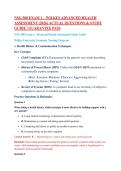
NSG 500 EXAM 1 – WILKES ADVANCED HEALTH
ASSESSMENT (2026) ACTUAL QUESTIONS & STUDY
GUIDE | GUARANTEE PASS
NSG 500 Exam 1: Advanced Health Assessment Study Guide
Wilkes University Graduate Nursing Program
1. Health History & Communication Techniques
Key Concepts
• Chief Complaint (CC): Documented in the patient's own words describing
the primary reason for seeking care.
• History of Present Illness (HPI): Utilizes the OLD CARTS mnemonic to
systematically explore symptoms:
o Onset | Location | Duration | Character | Aggravating factors |
Relieving factors | Timing | Severity
• Review of Systems (ROS): A systematic head-to-toe inventory of subjective
symptoms to uncover overlooked or omitted clinical details.
Practice Questions & Rationales
Question 1
When taking a health history, which technique is most effective for building rapport with a
new patient?
• A. Using medical terminology to demonstrate clinical expertise
• B. Maintaining eye contact and asking open-ended questions
• C. Completing the history as quickly as possible to preserve time
• D. Focusing strictly on the chief complaint
Correct Answer: B — Maintaining eye contact and asking open-ended questions
Rationale: Open-ended questions encourage the patient to describe symptoms fully in their own
words, while maintaining eye contact establishes trust and empathy, which is foundational to a
therapeutic clinician-patient relationship.
Question 2
, When interviewing an elderly patient with age-related hearing loss (presbycusis), which
approach should the advanced practice nurse take?
• A. Speak loudly and rapidly in a high-pitched tone
• B. Face the patient directly and speak clearly in a low-pitched voice
• C. Rely exclusively on written questionnaires
• D. Direct all questions to a family member or caregiver
Correct Answer: B — Face the patient directly and speak clearly in a low-pitched voice
Rationale: High-frequency sound perception declines first in presbycusis. Lowering pitch and
directly facing the patient provides visual lip-reading cues without producing distortion caused
by shouting.
Question 3
During a health history session, a patient becomes tearful while discussing a recent loss.
What is the most therapeutic response?
• A. Change the topic immediately to avoid causing further distress
• B. Allow silence and maintain a supportive, present demeanor
• C. Provide immediate advice on coping mechanisms
• D. Document the reaction and proceed to the physical exam
Correct Answer: B — Allow silence and maintain a supportive, present demeanor
Rationale: The therapeutic use of silence allows patients time to process emotional distress and
communicates empathy, strengthening the clinician-patient bond.
2. Physical Examination Techniques & Equipment
Physical Assessment Sequence
For almost all body systems, the physical examination follows this sequence:
Inspection ⟶ Palpation ⟶ Percussion ⟶ Auscultation
Critical Exception — Abdominal Exam:
Inspection ⟶ Auscultation ⟶ Percussion ⟶ Palpation
Auscultation precedes percussion and palpation in the abdomen to prevent artificial alteration of
bowel sounds.
Percussion Tones Reference
ASSESSMENT (2026) ACTUAL QUESTIONS & STUDY
GUIDE | GUARANTEE PASS
NSG 500 Exam 1: Advanced Health Assessment Study Guide
Wilkes University Graduate Nursing Program
1. Health History & Communication Techniques
Key Concepts
• Chief Complaint (CC): Documented in the patient's own words describing
the primary reason for seeking care.
• History of Present Illness (HPI): Utilizes the OLD CARTS mnemonic to
systematically explore symptoms:
o Onset | Location | Duration | Character | Aggravating factors |
Relieving factors | Timing | Severity
• Review of Systems (ROS): A systematic head-to-toe inventory of subjective
symptoms to uncover overlooked or omitted clinical details.
Practice Questions & Rationales
Question 1
When taking a health history, which technique is most effective for building rapport with a
new patient?
• A. Using medical terminology to demonstrate clinical expertise
• B. Maintaining eye contact and asking open-ended questions
• C. Completing the history as quickly as possible to preserve time
• D. Focusing strictly on the chief complaint
Correct Answer: B — Maintaining eye contact and asking open-ended questions
Rationale: Open-ended questions encourage the patient to describe symptoms fully in their own
words, while maintaining eye contact establishes trust and empathy, which is foundational to a
therapeutic clinician-patient relationship.
Question 2
, When interviewing an elderly patient with age-related hearing loss (presbycusis), which
approach should the advanced practice nurse take?
• A. Speak loudly and rapidly in a high-pitched tone
• B. Face the patient directly and speak clearly in a low-pitched voice
• C. Rely exclusively on written questionnaires
• D. Direct all questions to a family member or caregiver
Correct Answer: B — Face the patient directly and speak clearly in a low-pitched voice
Rationale: High-frequency sound perception declines first in presbycusis. Lowering pitch and
directly facing the patient provides visual lip-reading cues without producing distortion caused
by shouting.
Question 3
During a health history session, a patient becomes tearful while discussing a recent loss.
What is the most therapeutic response?
• A. Change the topic immediately to avoid causing further distress
• B. Allow silence and maintain a supportive, present demeanor
• C. Provide immediate advice on coping mechanisms
• D. Document the reaction and proceed to the physical exam
Correct Answer: B — Allow silence and maintain a supportive, present demeanor
Rationale: The therapeutic use of silence allows patients time to process emotional distress and
communicates empathy, strengthening the clinician-patient bond.
2. Physical Examination Techniques & Equipment
Physical Assessment Sequence
For almost all body systems, the physical examination follows this sequence:
Inspection ⟶ Palpation ⟶ Percussion ⟶ Auscultation
Critical Exception — Abdominal Exam:
Inspection ⟶ Auscultation ⟶ Percussion ⟶ Palpation
Auscultation precedes percussion and palpation in the abdomen to prevent artificial alteration of
bowel sounds.
Percussion Tones Reference