

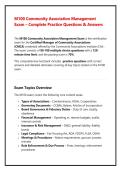
M100 Community Association Management
Exam – Complete Practice Questions & Answers
The M100 Community Association Management Exam is the certification
exam for the Certified Manager of Community Associations
(CMCA) credential offered by the Community Associations Institute (CAI) .
The exam consists of 80-100 multiple-choice questions with a 120-
minute time limit, and the passing score is 70% .
This comprehensive test bank includes practice questions with correct
answers and detailed rationales covering all key topics tested on the M100
exam .
Exam Topics Overview
The M100 exam covers the following core content areas:
• Types of Associations – Condominiums, HOAs, Cooperatives
• Governing Documents – CC&Rs, Bylaws, Articles of Incorporation
• Board Governance & Fiduciary Duties – Duty of care, loyalty,
obedience
• Financial Management – Operating vs. reserve budgets, audits,
internal controls
• Insurance & Risk Management – D&O, general liability, fidelity
bonds
• Legal Compliance – Fair Housing Act, ADA, FDCPA, FLSA, OSHA
• Meetings & Procedures – Notice requirements, quorum, proxies,
minutes
• Rule Enforcement & Due Process – Fines, hearings, enforcement
procedures
, • Maintenance & Capital Planning – Preventive maintenance,
reserves, contracts
• Management Forms – Portfolio, onsite, self-management
Section 1: Community Associations – Types &
Characteristics (Questions 1-30)
Question 1
Which of the following is NOT one of the three key characteristics common
to all community associations?
A. Mandatory membership in the association for all owners
B. Mandatory lien-based assessments levied on each owner
C. Binding governing documents that run with the land
D. Voluntary participation in association activities
*Correct Answer: D. Voluntary participation in association activities. *
Rationale: The three key characteristics common to all community
associations are: (1) mandatory membership for all owners, (2) mandatory
lien-based assessments, and (3) binding governing documents that run with
the land. Membership is not voluntary .
Question 2
In a condominium association, the owner owns:
A. Only the land and exterior of the building
B. Their individual unit plus an undivided interest in the common elements
C. Shares of stock in a corporation
D. A proprietary lease
,*Correct Answer: B. Their individual unit plus an undivided interest in
the common elements. *
Rationale: In a condominium, the owner owns their specific unit along with
an undivided interest (percentage) in the common elements such as hallways,
roofs, and amenities .
Question 3
Which type of community association involves the corporation owning all
real property, with owners holding shares and a proprietary lease?
A. Homeowners association (HOA)
B. Condominium
C. Cooperative
D. Timeshare
*Correct Answer: C. Cooperative. *
Rationale: In a cooperative, the corporation owns all real property. Owners
hold shares of stock in the corporation plus a proprietary lease giving them
the right to occupy their unit .
Question 4
What is the primary purpose of a community association?
A. To generate profit for the developers
B. To provide for the governance, business, and communal aspects of a
residential development
C. To enforce local building codes
D. To collect taxes from residents
, *Correct Answer: B. To provide for the governance, business, and
communal aspects of a residential development. *
Rationale: The primary purpose of a community association is to provide for
the governance, business, and communal aspects of the association by
administering, maintaining, and enhancing a residential real estate
development .
Question 5
In a planned community (HOA), the owner owns:
A. Only the interior of their unit
B. Their lot/home, while the association owns the common areas
C. Shares in the corporation
D. Nothing—the association owns everything
*Correct Answer: B. Their lot/home, while the association owns the
common areas. *
Rationale: In planned communities (HOAs), the owner owns their lot and
home, and the association owns and maintains the common areas .
Question 6
Which document establishes the association as a legal entity and is filed
with the state?
A. Declaration of CC&Rs
B. Bylaws
C. Articles of Incorporation
D. Rules and regulations
*Correct Answer: C. Articles of Incorporation. *
Exam – Complete Practice Questions & Answers
The M100 Community Association Management Exam is the certification
exam for the Certified Manager of Community Associations
(CMCA) credential offered by the Community Associations Institute (CAI) .
The exam consists of 80-100 multiple-choice questions with a 120-
minute time limit, and the passing score is 70% .
This comprehensive test bank includes practice questions with correct
answers and detailed rationales covering all key topics tested on the M100
exam .
Exam Topics Overview
The M100 exam covers the following core content areas:
• Types of Associations – Condominiums, HOAs, Cooperatives
• Governing Documents – CC&Rs, Bylaws, Articles of Incorporation
• Board Governance & Fiduciary Duties – Duty of care, loyalty,
obedience
• Financial Management – Operating vs. reserve budgets, audits,
internal controls
• Insurance & Risk Management – D&O, general liability, fidelity
bonds
• Legal Compliance – Fair Housing Act, ADA, FDCPA, FLSA, OSHA
• Meetings & Procedures – Notice requirements, quorum, proxies,
minutes
• Rule Enforcement & Due Process – Fines, hearings, enforcement
procedures
, • Maintenance & Capital Planning – Preventive maintenance,
reserves, contracts
• Management Forms – Portfolio, onsite, self-management
Section 1: Community Associations – Types &
Characteristics (Questions 1-30)
Question 1
Which of the following is NOT one of the three key characteristics common
to all community associations?
A. Mandatory membership in the association for all owners
B. Mandatory lien-based assessments levied on each owner
C. Binding governing documents that run with the land
D. Voluntary participation in association activities
*Correct Answer: D. Voluntary participation in association activities. *
Rationale: The three key characteristics common to all community
associations are: (1) mandatory membership for all owners, (2) mandatory
lien-based assessments, and (3) binding governing documents that run with
the land. Membership is not voluntary .
Question 2
In a condominium association, the owner owns:
A. Only the land and exterior of the building
B. Their individual unit plus an undivided interest in the common elements
C. Shares of stock in a corporation
D. A proprietary lease
,*Correct Answer: B. Their individual unit plus an undivided interest in
the common elements. *
Rationale: In a condominium, the owner owns their specific unit along with
an undivided interest (percentage) in the common elements such as hallways,
roofs, and amenities .
Question 3
Which type of community association involves the corporation owning all
real property, with owners holding shares and a proprietary lease?
A. Homeowners association (HOA)
B. Condominium
C. Cooperative
D. Timeshare
*Correct Answer: C. Cooperative. *
Rationale: In a cooperative, the corporation owns all real property. Owners
hold shares of stock in the corporation plus a proprietary lease giving them
the right to occupy their unit .
Question 4
What is the primary purpose of a community association?
A. To generate profit for the developers
B. To provide for the governance, business, and communal aspects of a
residential development
C. To enforce local building codes
D. To collect taxes from residents
, *Correct Answer: B. To provide for the governance, business, and
communal aspects of a residential development. *
Rationale: The primary purpose of a community association is to provide for
the governance, business, and communal aspects of the association by
administering, maintaining, and enhancing a residential real estate
development .
Question 5
In a planned community (HOA), the owner owns:
A. Only the interior of their unit
B. Their lot/home, while the association owns the common areas
C. Shares in the corporation
D. Nothing—the association owns everything
*Correct Answer: B. Their lot/home, while the association owns the
common areas. *
Rationale: In planned communities (HOAs), the owner owns their lot and
home, and the association owns and maintains the common areas .
Question 6
Which document establishes the association as a legal entity and is filed
with the state?
A. Declaration of CC&Rs
B. Bylaws
C. Articles of Incorporation
D. Rules and regulations
*Correct Answer: C. Articles of Incorporation. *


