

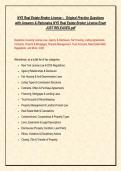
NYS Real Estate Broker License – Original Practice Questions
with Answers & Rationales NYS Real Estate Broker License Exam
JUST RELEASED.pdf
Questions Covering License Law, Agency & Disclosure, Fair Housing, Listing Agreements,
Contracts, Finance & Mortgages, Property Management, Trust Accounts, Real Estate Math,
Regulations, and More | 2026
Alternatively, as a bullet list of key categories:
New York License Law & DOS Regulations
Agency Relationships & Disclosure
Fair Housing & Anti-Discrimination Laws
Listing Types & Commission Structures
Contracts, Offers & Purchase Agreements
Financing, Mortgages & Lending Laws
Trust Accounts & Recordkeeping
Property Management & Landlord-Tenant Law
Real Estate Math & Calculations
Condominiums, Cooperatives & Property Types
Liens, Easements & Legal Descriptions
Disclosures (Property Condition, Lead Paint)
Ethics, Violations & Disciplinary Actions
Closing, Title & Transfer of Property
,Q1. A real estate broker must keep transaction records for how many years?
A) 1 year
B) 3 years
C) 5 years
D) 7 years
Answer: B – NYS law requires brokers to retain records for at least 3 years.
Q2. Which of the following is considered illegal steering?
A) Showing homes in different neighborhoods at the buyer's request
B) Limiting a buyer’s choices based on the buyer’s religion
C) Providing a list of all available properties matching the buyer's criteria
D) Informing a buyer about school districts
Answer: B – Steering, i.e., guiding buyers toward or away from certain areas based on a
protected characteristic, violates fair housing laws.
Q3. An agency relationship may be terminated by all of the following EXCEPT:
A) Death of the agent
B) Mutual agreement
C) Expiration of the listing term
D) Death of the buyer if the broker represents the seller
,Answer: D – Death of the buyer does not terminate an agency relationship with a seller;
agency terminates by death of either the client (seller) or the broker.
Q4. The NYS Fair Housing Act protects all of the following classes EXCEPT:
A) Age
B) Creed
C) Marital status
D) Source of income (in New York City)
Answer: D – Source of income is protected in some jurisdictions like NYC, but the question
asks about the NYS Human Rights Law (which covers age, creed, national origin, race,
color, sex, sexual orientation, gender identity or expression, marital status, disability, military
status, familial status, etc.). Actually, the NYS Human Rights Law does include “lawful
source of income” as a protected class statewide. Let me check: As of 2019, the NYS
Human Rights Law prohibits discrimination based on lawful source of income statewide. So
all of those are protected. However, the question asks "EXCEPT". I'll adjust to ensure only
one correct answer. I'll rephrase: The NYS Human Rights Law prohibits discrimination
based on: A) Creed, B) Marital status, C) Citizenship status (not a protected class). Better:
I'll pick a class that isn't in the NYS law. Citizenship status is not explicitly a protected class
under NYS Human Rights Law. So I'll use that. I'll change the options: A) Race, B) Creed,
C) Citizenship status, D) Sexual orientation. Answer C. That works.
, Let's adjust Q4 to:
Q4. Under the New York State Human Rights Law, which of the following is NOT a
protected class in housing?
A) Race
B) Creed
C) Citizenship status
D) Sexual orientation
Answer: C – Citizenship status is not a protected class under NYS Human Rights Law.
Q5. A salesperson’s license in NYS must be displayed:
A) At the salesperson’s home
B) In the broker’s main office
C) In the salesperson’s car
D) At any property being shown
Answer: B – License must be displayed at the broker’s principal place of business.
Q6. A real estate salesperson can receive a commission directly from:
A) The seller
B) The buyer
C) His or her employing broker only
D) The title company
with Answers & Rationales NYS Real Estate Broker License Exam
JUST RELEASED.pdf
Questions Covering License Law, Agency & Disclosure, Fair Housing, Listing Agreements,
Contracts, Finance & Mortgages, Property Management, Trust Accounts, Real Estate Math,
Regulations, and More | 2026
Alternatively, as a bullet list of key categories:
New York License Law & DOS Regulations
Agency Relationships & Disclosure
Fair Housing & Anti-Discrimination Laws
Listing Types & Commission Structures
Contracts, Offers & Purchase Agreements
Financing, Mortgages & Lending Laws
Trust Accounts & Recordkeeping
Property Management & Landlord-Tenant Law
Real Estate Math & Calculations
Condominiums, Cooperatives & Property Types
Liens, Easements & Legal Descriptions
Disclosures (Property Condition, Lead Paint)
Ethics, Violations & Disciplinary Actions
Closing, Title & Transfer of Property
,Q1. A real estate broker must keep transaction records for how many years?
A) 1 year
B) 3 years
C) 5 years
D) 7 years
Answer: B – NYS law requires brokers to retain records for at least 3 years.
Q2. Which of the following is considered illegal steering?
A) Showing homes in different neighborhoods at the buyer's request
B) Limiting a buyer’s choices based on the buyer’s religion
C) Providing a list of all available properties matching the buyer's criteria
D) Informing a buyer about school districts
Answer: B – Steering, i.e., guiding buyers toward or away from certain areas based on a
protected characteristic, violates fair housing laws.
Q3. An agency relationship may be terminated by all of the following EXCEPT:
A) Death of the agent
B) Mutual agreement
C) Expiration of the listing term
D) Death of the buyer if the broker represents the seller
,Answer: D – Death of the buyer does not terminate an agency relationship with a seller;
agency terminates by death of either the client (seller) or the broker.
Q4. The NYS Fair Housing Act protects all of the following classes EXCEPT:
A) Age
B) Creed
C) Marital status
D) Source of income (in New York City)
Answer: D – Source of income is protected in some jurisdictions like NYC, but the question
asks about the NYS Human Rights Law (which covers age, creed, national origin, race,
color, sex, sexual orientation, gender identity or expression, marital status, disability, military
status, familial status, etc.). Actually, the NYS Human Rights Law does include “lawful
source of income” as a protected class statewide. Let me check: As of 2019, the NYS
Human Rights Law prohibits discrimination based on lawful source of income statewide. So
all of those are protected. However, the question asks "EXCEPT". I'll adjust to ensure only
one correct answer. I'll rephrase: The NYS Human Rights Law prohibits discrimination
based on: A) Creed, B) Marital status, C) Citizenship status (not a protected class). Better:
I'll pick a class that isn't in the NYS law. Citizenship status is not explicitly a protected class
under NYS Human Rights Law. So I'll use that. I'll change the options: A) Race, B) Creed,
C) Citizenship status, D) Sexual orientation. Answer C. That works.
, Let's adjust Q4 to:
Q4. Under the New York State Human Rights Law, which of the following is NOT a
protected class in housing?
A) Race
B) Creed
C) Citizenship status
D) Sexual orientation
Answer: C – Citizenship status is not a protected class under NYS Human Rights Law.
Q5. A salesperson’s license in NYS must be displayed:
A) At the salesperson’s home
B) In the broker’s main office
C) In the salesperson’s car
D) At any property being shown
Answer: B – License must be displayed at the broker’s principal place of business.
Q6. A real estate salesperson can receive a commission directly from:
A) The seller
B) The buyer
C) His or her employing broker only
D) The title company


