

THAR test 1
THAR test 1
Study online at https://quizlet.com/_8tyxzp
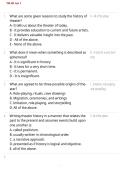
1. What are some given reasons to study the history of D - All of the above
theater?
A- It tells us about the theater of today.
B - It provides education to current and future artists.
C - It delivers valuable insight into the past.
D - All of the above.
E - None of the above.
2. What does it mean when something is described as B - It lasts for a very short
ephemeral? time
A - It is significant in history.
B - It lasts for a very short time.
C - It is permanent.
D - It is insignificant.
3. What are agreed to be three possible origins of the- C. Imitation, role-playing,
ater? and storytelling.
A. Role-playing, rituals, cave drawings
B. Migration, ceremonies, and writings
C. Imitation, role-playing, and storytelling
D. All of the above.
4. Writing theater history in a manner that relates the E. All of the above
past to the present and assumes events build upon
one another is:
A. called positivism.
B. usually written in chronological order.
C. a narrative approach.
D. presented as if history is logical and objective.
E. all of the above.
5.
1/8
, THAR test 1
THAR test 1
Study online at https://quizlet.com/_8tyxzp
Efficaciousness and methexis: sale rate ritual and cere-
A. Both mean group sharing. mony from theater
B. Separate ritual and ceremony from theater.
C. Are the result of popular entertainment.
D. All of the above.
6. What is considered significant in theater history is in- what is valued now may
trinsically difficult to determine because: not match what was valued
A. What is valued now may not match what was valued in a tridations own time.
in a tradition's own time.
B. c
C. Theater scholars do not share their work.
D. All of the above.
7. It is valuable when studying theater to consider defin- C. It offers better perspec-
ing characteristics of the audience (wealthy vs poor, tive and alters our inter-
nobility vs common people, general public vs a select pretation of plays and the-
group, etc.) for the following reason(s): ater practices.
A. Only work that appeals to the masses is worth study-
ing.
B. Higher-class audiences are better judges of art.
C. It offers better perspective and alters our interpre-
tation of plays and theater practices.
D. All of the above.
8. Which of the following changes happened in Europe all of the above
between the Middle Ages and the Renaissance
A. The Roman Catholic Church was not as dominant.
B. The feudal system gave way to autocratic rule of
kings and princes.
C. The merchant class rose to wealth and prominence.
D. All of the above.
2/8
THAR test 1
Study online at https://quizlet.com/_8tyxzp
1. What are some given reasons to study the history of D - All of the above
theater?
A- It tells us about the theater of today.
B - It provides education to current and future artists.
C - It delivers valuable insight into the past.
D - All of the above.
E - None of the above.
2. What does it mean when something is described as B - It lasts for a very short
ephemeral? time
A - It is significant in history.
B - It lasts for a very short time.
C - It is permanent.
D - It is insignificant.
3. What are agreed to be three possible origins of the- C. Imitation, role-playing,
ater? and storytelling.
A. Role-playing, rituals, cave drawings
B. Migration, ceremonies, and writings
C. Imitation, role-playing, and storytelling
D. All of the above.
4. Writing theater history in a manner that relates the E. All of the above
past to the present and assumes events build upon
one another is:
A. called positivism.
B. usually written in chronological order.
C. a narrative approach.
D. presented as if history is logical and objective.
E. all of the above.
5.
1/8
, THAR test 1
THAR test 1
Study online at https://quizlet.com/_8tyxzp
Efficaciousness and methexis: sale rate ritual and cere-
A. Both mean group sharing. mony from theater
B. Separate ritual and ceremony from theater.
C. Are the result of popular entertainment.
D. All of the above.
6. What is considered significant in theater history is in- what is valued now may
trinsically difficult to determine because: not match what was valued
A. What is valued now may not match what was valued in a tridations own time.
in a tradition's own time.
B. c
C. Theater scholars do not share their work.
D. All of the above.
7. It is valuable when studying theater to consider defin- C. It offers better perspec-
ing characteristics of the audience (wealthy vs poor, tive and alters our inter-
nobility vs common people, general public vs a select pretation of plays and the-
group, etc.) for the following reason(s): ater practices.
A. Only work that appeals to the masses is worth study-
ing.
B. Higher-class audiences are better judges of art.
C. It offers better perspective and alters our interpre-
tation of plays and theater practices.
D. All of the above.
8. Which of the following changes happened in Europe all of the above
between the Middle Ages and the Renaissance
A. The Roman Catholic Church was not as dominant.
B. The feudal system gave way to autocratic rule of
kings and princes.
C. The merchant class rose to wealth and prominence.
D. All of the above.
2/8


