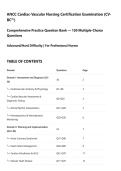
ANCC Cardiac-Vascular Nursing Certification Examination (CV-
BC™)
Comprehensive Practice Question Bank — 150 Multiple-Choice
Questions
Advanced/Hard Difficulty | For Professional Nurses
TABLE OF CONTENTS
Domain Questions Page
Domain I: Assessment and Diagnosis (Q1–
36 2
36)
└─ Cardiovascular Anatomy & Physiology Q1–Q8 2
└─ Cardiac/Vascular Assessment &
Q9–Q20 3
Diagnostic Testing
└─ ECG & Rhythm Interpretation Q21–Q28 5
└─ Hemodynamics & Hemodynamic
Q29–Q36 6
Monitoring
Domain II: Planning and Implementation
54 7
(Q37–90)
└─ Acute Coronary Syndromes Q37–Q48 7
└─ Heart Failure Management Q49–Q60 9
└─ Cardiac Arrhythmias & ACLS Q61–Q70 11
└─ Valvular Heart Disease Q71–Q76 12
,Domain Questions Page
└─ Vascular & Peripheral Vascular Disease Q77–Q84 13
└─ Pharmacological Interventions Q85–Q90 14
Domain III: Evaluation and Modification
30 15
(Q91–120)
└─ Adverse Event Recognition &
Q91–Q102 15
Management
└─ Treatment Outcome Evaluation Q103–Q110 17
└─ Post-Operative & Procedural Care Q111–Q120 18
Domain IV: Patient and Community
30 19
Education (Q121–150)
└─ Patient/Family Education & Self-
Q121–Q135 19
Management
└─ Health Promotion & Risk Reduction Q136–Q143 21
└─ Professional Role & Ethical Practice Q144–Q150 22
DOMAIN I: ASSESSMENT AND DIAGNOSIS
Subdomain: Cardiovascular Anatomy & Physiology
🟢 Q1. A 68-year-old male with longstanding hypertension and concentric left ventricular hypertrophy
presents with a new-onset fourth heart sound (S4) on apical auscultation. This finding is most directly
attributable to which of the following pathophysiological mechanisms?
A. Increased left ventricular compliance during early diastole
B. Reduced atrial contractility due to chronic pressure overload
C. Oscillation of the mitral valve apparatus during rapid ventricular filling
D. Atrial contraction against a non-compliant, stiff left ventricle
🔴🔴 Correct Answer: D
Rationale: S4 is an atrial gallop caused by forceful atrial systole ejecting blood into a hypertrophied,
,non-compliant (stiff) left ventricle. It occurs in late diastole just before S1. Option A is incorrect
because compliance is decreased, not increased. Option B is wrong because atrial contractility is
typically augmented to overcome resistance. Option C describes S3 (early diastolic filling).
🟢 Q2. During a cardiac catheterization, a patient's pulmonary capillary wedge pressure (PCWP) is
measured at 28 mm Hg. This finding is most consistent with which of the following hemodynamic
states?
A. Isolated right ventricular failure
B. Severe mitral stenosis with preserved left ventricular function
C. Left ventricular systolic dysfunction with volume overload
D. Acute pulmonary embolism with right heart strain
🔴🔴 Correct Answer: C
Rationale: PCWP reflects left atrial pressure and, in the absence of mitral valve disease, is a surrogate
for left ventricular end-diastolic pressure (LVEDP). A PCWP > 20 mm Hg indicates elevated left-sided
filling pressures, classically seen in left ventricular systolic or diastolic dysfunction. Option B (mitral
stenosis) can elevate PCWP, but the question implies a broader left ventricular dysfunction context.
Option A and D elevate right-sided pressures (CVP/RAP), not PCWP.
🟢 Q3. A patient with severe aortic stenosis has a resting cardiac index of 1.8 L/min/m². Which
compensatory mechanism is primarily responsible for maintaining coronary artery perfusion in this
patient?
A. Increased heart rate to shorten diastole
B. Reflex peripheral vasodilation to lower afterload
C. Concentric left ventricular hypertrophy with increased oxygen supply
D. Elevated diastolic aortic pressure from the pressure overload state
🔴🔴 Correct Answer: D
Rationale: In severe aortic stenosis, the left ventricle generates very high systolic pressures, but
coronary perfusion occurs during diastole and depends on the diastolic aortic-to-left ventricular
pressure gradient. The elevated aortic diastolic pressure (from the pressure overload) helps maintain
coronary perfusion pressure despite the hypertrophy. Option A is detrimental (shorter diastole reduces
coronary filling time). Option C is wrong because hypertrophy increases oxygen demand, not supply.
🟢 Q4. Which of the following changes in cardiac output (CO) and systemic vascular resistance (SVR)
would be expected in a patient with septic shock during the hyperdynamic (warm) phase?
A. CO ↑, SVR ↓
B. CO ↓, SVR ↑
C. CO ↑, SVR ↑
D. CO ↓, SVR ↓
🔴🔴 Correct Answer: A
Rationale: The hyperdynamic (early) phase of septic shock is characterized by profound vasodilation (↓
, SVR) and a compensatory increase in cardiac output (↑ CO) driven by tachycardia and increased stroke
volume. Option B describes cardiogenic or hypovolemic shock. Option C describes hypertensive crisis
or early neurogenic shock. Option D is incorrect because CO is typically elevated, not decreased.
🟢 Q5. A 72-year-old female with chronic atrial fibrillation has a left atrial appendage thrombus.
Which anatomical feature of the left atrial appendage most predisposes it to thrombus formation?
A. High-velocity laminar flow due to its tubular shape
B. Presence of pectinate muscles creating stagnant flow zones
C. Direct communication with the pulmonary veins
D. Absence of endothelial lining
🔴🔴 Correct Answer: B
Rationale: The left atrial appendage contains intricate pectinate muscles that create irregular surfaces
and cul-de-sacs, promoting blood stasis, especially in the absence of effective atrial contraction (as in
atrial fibrillation). Option A is false; flow is low-velocity and turbulent. Option C is irrelevant to
thrombogenesis. Option D is anatomically incorrect.
🟢 Q6. A patient with an acute inferior wall ST-elevation myocardial infarction develops hypotension,
bradycardia, and relative bradypnea. Which of the following receptor-mediated reflexes is the most
likely cause?
A. Bezold-Jarisch reflex
B. Cushing reflex
C. Baroreceptor reflex
D. Bainbridge reflex
🔴🔴 Correct Answer: A
Rationale: The Bezold-Jarisch reflex is a cardioinhibitory reflex triggered by mechanical stretch or
chemical stimulation of ventricular chemoreceptors/mechanoreceptors (often during inferior MI or
reperfusion). It causes vagal-mediated bradycardia, hypotension, and peripheral vasodilation. Option B
(Cushing) is for increased ICP. Option C (baroreceptor) would cause tachycardia, not bradycardia.
Option D (Bainbridge) increases heart rate in response to increased venous return.
🟢 Q7. Which coronary artery provides the primary blood supply to the sinoatrial node in
approximately 60% of the population?
A. Left anterior descending artery
B. Left circumflex artery
C. Right coronary artery
D. Posterior descending artery
🔴🔴 Correct Answer: C
Rationale: The right coronary artery (RCA) supplies the SA node in about 60% of individuals (via the SA
nodal artery). The left circumflex supplies it in the remaining 40%. The LAD supplies the anterior left
ventricle and septum. The PDA (usually from RCA) supplies the inferior wall.
BC™)
Comprehensive Practice Question Bank — 150 Multiple-Choice
Questions
Advanced/Hard Difficulty | For Professional Nurses
TABLE OF CONTENTS
Domain Questions Page
Domain I: Assessment and Diagnosis (Q1–
36 2
36)
└─ Cardiovascular Anatomy & Physiology Q1–Q8 2
└─ Cardiac/Vascular Assessment &
Q9–Q20 3
Diagnostic Testing
└─ ECG & Rhythm Interpretation Q21–Q28 5
└─ Hemodynamics & Hemodynamic
Q29–Q36 6
Monitoring
Domain II: Planning and Implementation
54 7
(Q37–90)
└─ Acute Coronary Syndromes Q37–Q48 7
└─ Heart Failure Management Q49–Q60 9
└─ Cardiac Arrhythmias & ACLS Q61–Q70 11
└─ Valvular Heart Disease Q71–Q76 12
,Domain Questions Page
└─ Vascular & Peripheral Vascular Disease Q77–Q84 13
└─ Pharmacological Interventions Q85–Q90 14
Domain III: Evaluation and Modification
30 15
(Q91–120)
└─ Adverse Event Recognition &
Q91–Q102 15
Management
└─ Treatment Outcome Evaluation Q103–Q110 17
└─ Post-Operative & Procedural Care Q111–Q120 18
Domain IV: Patient and Community
30 19
Education (Q121–150)
└─ Patient/Family Education & Self-
Q121–Q135 19
Management
└─ Health Promotion & Risk Reduction Q136–Q143 21
└─ Professional Role & Ethical Practice Q144–Q150 22
DOMAIN I: ASSESSMENT AND DIAGNOSIS
Subdomain: Cardiovascular Anatomy & Physiology
🟢 Q1. A 68-year-old male with longstanding hypertension and concentric left ventricular hypertrophy
presents with a new-onset fourth heart sound (S4) on apical auscultation. This finding is most directly
attributable to which of the following pathophysiological mechanisms?
A. Increased left ventricular compliance during early diastole
B. Reduced atrial contractility due to chronic pressure overload
C. Oscillation of the mitral valve apparatus during rapid ventricular filling
D. Atrial contraction against a non-compliant, stiff left ventricle
🔴🔴 Correct Answer: D
Rationale: S4 is an atrial gallop caused by forceful atrial systole ejecting blood into a hypertrophied,
,non-compliant (stiff) left ventricle. It occurs in late diastole just before S1. Option A is incorrect
because compliance is decreased, not increased. Option B is wrong because atrial contractility is
typically augmented to overcome resistance. Option C describes S3 (early diastolic filling).
🟢 Q2. During a cardiac catheterization, a patient's pulmonary capillary wedge pressure (PCWP) is
measured at 28 mm Hg. This finding is most consistent with which of the following hemodynamic
states?
A. Isolated right ventricular failure
B. Severe mitral stenosis with preserved left ventricular function
C. Left ventricular systolic dysfunction with volume overload
D. Acute pulmonary embolism with right heart strain
🔴🔴 Correct Answer: C
Rationale: PCWP reflects left atrial pressure and, in the absence of mitral valve disease, is a surrogate
for left ventricular end-diastolic pressure (LVEDP). A PCWP > 20 mm Hg indicates elevated left-sided
filling pressures, classically seen in left ventricular systolic or diastolic dysfunction. Option B (mitral
stenosis) can elevate PCWP, but the question implies a broader left ventricular dysfunction context.
Option A and D elevate right-sided pressures (CVP/RAP), not PCWP.
🟢 Q3. A patient with severe aortic stenosis has a resting cardiac index of 1.8 L/min/m². Which
compensatory mechanism is primarily responsible for maintaining coronary artery perfusion in this
patient?
A. Increased heart rate to shorten diastole
B. Reflex peripheral vasodilation to lower afterload
C. Concentric left ventricular hypertrophy with increased oxygen supply
D. Elevated diastolic aortic pressure from the pressure overload state
🔴🔴 Correct Answer: D
Rationale: In severe aortic stenosis, the left ventricle generates very high systolic pressures, but
coronary perfusion occurs during diastole and depends on the diastolic aortic-to-left ventricular
pressure gradient. The elevated aortic diastolic pressure (from the pressure overload) helps maintain
coronary perfusion pressure despite the hypertrophy. Option A is detrimental (shorter diastole reduces
coronary filling time). Option C is wrong because hypertrophy increases oxygen demand, not supply.
🟢 Q4. Which of the following changes in cardiac output (CO) and systemic vascular resistance (SVR)
would be expected in a patient with septic shock during the hyperdynamic (warm) phase?
A. CO ↑, SVR ↓
B. CO ↓, SVR ↑
C. CO ↑, SVR ↑
D. CO ↓, SVR ↓
🔴🔴 Correct Answer: A
Rationale: The hyperdynamic (early) phase of septic shock is characterized by profound vasodilation (↓
, SVR) and a compensatory increase in cardiac output (↑ CO) driven by tachycardia and increased stroke
volume. Option B describes cardiogenic or hypovolemic shock. Option C describes hypertensive crisis
or early neurogenic shock. Option D is incorrect because CO is typically elevated, not decreased.
🟢 Q5. A 72-year-old female with chronic atrial fibrillation has a left atrial appendage thrombus.
Which anatomical feature of the left atrial appendage most predisposes it to thrombus formation?
A. High-velocity laminar flow due to its tubular shape
B. Presence of pectinate muscles creating stagnant flow zones
C. Direct communication with the pulmonary veins
D. Absence of endothelial lining
🔴🔴 Correct Answer: B
Rationale: The left atrial appendage contains intricate pectinate muscles that create irregular surfaces
and cul-de-sacs, promoting blood stasis, especially in the absence of effective atrial contraction (as in
atrial fibrillation). Option A is false; flow is low-velocity and turbulent. Option C is irrelevant to
thrombogenesis. Option D is anatomically incorrect.
🟢 Q6. A patient with an acute inferior wall ST-elevation myocardial infarction develops hypotension,
bradycardia, and relative bradypnea. Which of the following receptor-mediated reflexes is the most
likely cause?
A. Bezold-Jarisch reflex
B. Cushing reflex
C. Baroreceptor reflex
D. Bainbridge reflex
🔴🔴 Correct Answer: A
Rationale: The Bezold-Jarisch reflex is a cardioinhibitory reflex triggered by mechanical stretch or
chemical stimulation of ventricular chemoreceptors/mechanoreceptors (often during inferior MI or
reperfusion). It causes vagal-mediated bradycardia, hypotension, and peripheral vasodilation. Option B
(Cushing) is for increased ICP. Option C (baroreceptor) would cause tachycardia, not bradycardia.
Option D (Bainbridge) increases heart rate in response to increased venous return.
🟢 Q7. Which coronary artery provides the primary blood supply to the sinoatrial node in
approximately 60% of the population?
A. Left anterior descending artery
B. Left circumflex artery
C. Right coronary artery
D. Posterior descending artery
🔴🔴 Correct Answer: C
Rationale: The right coronary artery (RCA) supplies the SA node in about 60% of individuals (via the SA
nodal artery). The left circumflex supplies it in the remaining 40%. The LAD supplies the anterior left
ventricle and septum. The PDA (usually from RCA) supplies the inferior wall.