1/23/24, 1:40 PM - EthicsGame - Eli Players Assessment
Ethical Lens Invento
Efflé;xGAME Y
Res ource Center
JONATHAN SHULTZ
Completed Printed
1/23/2024 1/23/2024
Your preferred ethical lens is: /g@ . e d/%
Responsibilities Lens P . “ion i
u || || || \" TY
&
Mild Rationality and Mild Autonomy (MRMA)
You use your personal reasoning skills (rationality) to determine the
principles by which you will live (autonomy).
AUTONOMY
ALITYNO3
Your Primary Values show how you prioritize
the tension between rationality and
sensibility as well as autonomy and equality.
Your primary values are Rationality and Autonomy
You mildly prioritize the value of rationality (MR)—following yourofiffi%
head—over sensibility—following your heart. As an MR, your \;3\ R
commitment to careful thinking is informed by your emotions as you
seek the truth. You frame the narrative of your life in terms of being self-aware and striving to apply universal
principles to every facet of your life.
You mildly prioritize the value of autonomy (MA)—respecting the individual—over equality—giving priority to the
group. As an MA, you want to choose your own path and truth but your choices are informed by the opinions of
others and the general community expectations about what constitutes a "principled life." You defend the right of
every human to choose how they will live into their full potential as they seek
Know Yourself
Pay attention to your beliefs, attitudes, and behaviors.
The first step to ethical agility and maturity is to carefully read the description of your own ethical lens. While you
may resonate with elements of other lenses, when you are under stress or pressure, you'll begin your ethical
analysis from your home lens. So, becoming familiar with both the gifts and the blind spots of your lens is useful. For
more information about how to think about ethics as well as hints for interpreting your results, look at the information
under the ELI Essentials and Exploring the ELI on the menu bar.
Understanding Your Ethical Lens
Over the course of history, four different ethical perspectives, which we call the Four Ethical Lenses, have guided
people in making ethical decisions. Each of us has an inherited bias towards community that intersects with our
earliest socialization. As we make sense of our world, we develop an approach to ethics that becomes our ethical
instinct—our gut reaction to value conflicts. The questions you answered were designed to determine your
https://faculty.ethicsgame.com/FacultyResourceCenter//PlayersAssessmentEli/EliText/Print?polarity=top-left&ae=-2&rs=4&dt=1/23/2024&u=Jonathan ... 1/8
, 1/23/24, 1:40 PM - EthicsGame - Eli Players Assessment
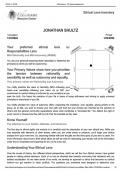
instinctual approach to your values preferences. These preferences determine your placement on the Ethical Lens
Inventory grid, seen on the right side of this page.
The dot on the grid shows which ethical lens you prefer and how strong that preference is. Those who land on or
close to the center point do not have a strong preference for any ethical lens and may instead resonate with an
approach to ethics that is concerned with living authentically in the world rather than one that privileges one set of
values over another.
Each of the paragraphs below describes an ethical trait—a personal characteristic or quality that defines how you
begin to approach ethical problems. For each of the categories, the trait describes the values you believe are the
most important as well as the reasons you give for why you make particular ethical decisions.
To see how other people might look at the world differently, read the descriptions of the different ethical lenses under
the tab Ethical Lenses on the menu bar. The “Overview of the Four Ethical Lenses” can be printed to give you a
quick reference document. Finally, you can compare and contrast each ethical trait by reading the description of the
trait found under the Traits menu. Comparing the traits of your perspective to others helps you understand how
people might emphasize different values and approach ethical dilemmas differently.
As you read your ethical profile and study the different approaches, you'll have a better sense of what we mean
when we use the word “ethics.” You'll also have some insight into how human beings determine what actions are—
or are not—ethical.
The Snapshot gives you a quick overview of your ethical lens.
Your snapshot shows you living responsibly into your principles.
This ethical lens is called the Responsibilities Lens because people with this focus value having the right to choose
how to responsibly live into their principles—even if other people don’t always agree with them. They care primarily
about living into their own core principles, the Truth as they see it.
The Responsibilities Lens represents the family of ethical theories known as deontology, where you consider your
principles—and the duties that come from those principles—to help you determine what is ethical.
Your Ethical Path is the method you use to become ethically aware and
mature.
Your ethical path is the Path of the Thinker.
On the ethical Path of the Thinker, you use your reason to identify the principles—the foundational rules—that you
believe are worthy of adoption and will lead you to the Truth. As a human being, you have the privilege of choosing
how best to live your life. Your preference is determining for yourself the principles that you believe are the most
important. Then you determine how your actions can be true to your guiding principles.
As you walk the Path of the Thinker, you moderate your quest for the truth with considering also what is good. In the
process, you trust that the world will make sense as you ground your principles in human dignity and the right of
every person to use their reason to determine how best to live as a member of the community.
Your Vantage Point describes the overall perspective you take to determine
what behaviors best reflect your values.
The icon that represents your preferred vantage point is a telescope.
Just as a telescope helps you see the farthest points on your journey and gathers all of the available light to help
you see long distances, the Responsibilities Lens helps you take a long view and identify the ideal principles that are
important for human beings.
https:/ffaculty.ethicsgame.com/FacultyResourceCenter//PlayersAssessmentEli/EliText/Print? polarity=top-left&ae=-2&rs=4&dt=1/23/2024 &u=Jonathan ... 2/8
Ethical Lens Invento
Efflé;xGAME Y
Res ource Center
JONATHAN SHULTZ
Completed Printed
1/23/2024 1/23/2024
Your preferred ethical lens is: /g@ . e d/%
Responsibilities Lens P . “ion i
u || || || \" TY
&
Mild Rationality and Mild Autonomy (MRMA)
You use your personal reasoning skills (rationality) to determine the
principles by which you will live (autonomy).
AUTONOMY
ALITYNO3
Your Primary Values show how you prioritize
the tension between rationality and
sensibility as well as autonomy and equality.
Your primary values are Rationality and Autonomy
You mildly prioritize the value of rationality (MR)—following yourofiffi%
head—over sensibility—following your heart. As an MR, your \;3\ R
commitment to careful thinking is informed by your emotions as you
seek the truth. You frame the narrative of your life in terms of being self-aware and striving to apply universal
principles to every facet of your life.
You mildly prioritize the value of autonomy (MA)—respecting the individual—over equality—giving priority to the
group. As an MA, you want to choose your own path and truth but your choices are informed by the opinions of
others and the general community expectations about what constitutes a "principled life." You defend the right of
every human to choose how they will live into their full potential as they seek
Know Yourself
Pay attention to your beliefs, attitudes, and behaviors.
The first step to ethical agility and maturity is to carefully read the description of your own ethical lens. While you
may resonate with elements of other lenses, when you are under stress or pressure, you'll begin your ethical
analysis from your home lens. So, becoming familiar with both the gifts and the blind spots of your lens is useful. For
more information about how to think about ethics as well as hints for interpreting your results, look at the information
under the ELI Essentials and Exploring the ELI on the menu bar.
Understanding Your Ethical Lens
Over the course of history, four different ethical perspectives, which we call the Four Ethical Lenses, have guided
people in making ethical decisions. Each of us has an inherited bias towards community that intersects with our
earliest socialization. As we make sense of our world, we develop an approach to ethics that becomes our ethical
instinct—our gut reaction to value conflicts. The questions you answered were designed to determine your
https://faculty.ethicsgame.com/FacultyResourceCenter//PlayersAssessmentEli/EliText/Print?polarity=top-left&ae=-2&rs=4&dt=1/23/2024&u=Jonathan ... 1/8
, 1/23/24, 1:40 PM - EthicsGame - Eli Players Assessment
instinctual approach to your values preferences. These preferences determine your placement on the Ethical Lens
Inventory grid, seen on the right side of this page.
The dot on the grid shows which ethical lens you prefer and how strong that preference is. Those who land on or
close to the center point do not have a strong preference for any ethical lens and may instead resonate with an
approach to ethics that is concerned with living authentically in the world rather than one that privileges one set of
values over another.
Each of the paragraphs below describes an ethical trait—a personal characteristic or quality that defines how you
begin to approach ethical problems. For each of the categories, the trait describes the values you believe are the
most important as well as the reasons you give for why you make particular ethical decisions.
To see how other people might look at the world differently, read the descriptions of the different ethical lenses under
the tab Ethical Lenses on the menu bar. The “Overview of the Four Ethical Lenses” can be printed to give you a
quick reference document. Finally, you can compare and contrast each ethical trait by reading the description of the
trait found under the Traits menu. Comparing the traits of your perspective to others helps you understand how
people might emphasize different values and approach ethical dilemmas differently.
As you read your ethical profile and study the different approaches, you'll have a better sense of what we mean
when we use the word “ethics.” You'll also have some insight into how human beings determine what actions are—
or are not—ethical.
The Snapshot gives you a quick overview of your ethical lens.
Your snapshot shows you living responsibly into your principles.
This ethical lens is called the Responsibilities Lens because people with this focus value having the right to choose
how to responsibly live into their principles—even if other people don’t always agree with them. They care primarily
about living into their own core principles, the Truth as they see it.
The Responsibilities Lens represents the family of ethical theories known as deontology, where you consider your
principles—and the duties that come from those principles—to help you determine what is ethical.
Your Ethical Path is the method you use to become ethically aware and
mature.
Your ethical path is the Path of the Thinker.
On the ethical Path of the Thinker, you use your reason to identify the principles—the foundational rules—that you
believe are worthy of adoption and will lead you to the Truth. As a human being, you have the privilege of choosing
how best to live your life. Your preference is determining for yourself the principles that you believe are the most
important. Then you determine how your actions can be true to your guiding principles.
As you walk the Path of the Thinker, you moderate your quest for the truth with considering also what is good. In the
process, you trust that the world will make sense as you ground your principles in human dignity and the right of
every person to use their reason to determine how best to live as a member of the community.
Your Vantage Point describes the overall perspective you take to determine
what behaviors best reflect your values.
The icon that represents your preferred vantage point is a telescope.
Just as a telescope helps you see the farthest points on your journey and gathers all of the available light to help
you see long distances, the Responsibilities Lens helps you take a long view and identify the ideal principles that are
important for human beings.
https:/ffaculty.ethicsgame.com/FacultyResourceCenter//PlayersAssessmentEli/EliText/Print? polarity=top-left&ae=-2&rs=4&dt=1/23/2024 &u=Jonathan ... 2/8