

★ A+ ★
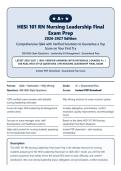
HESI 101 RN Nursing Leadership Final
Exam Prep
2026-2027 Edition
Comprehensive Q&A with Verified Solutions to Guarantee a Top
Score on Your First Try
300 HESI-Style Questions · Leadership & Management · Guaranteed Pass
LATEST 2026-2027 | 100% VERIFIED ANSWERS WITH RATIONALE | GRADED A+ |
300 REAL HESI-STYLE QUESTIONS | RN NURSING LEADERSHIP FINAL EXAM
Instant PDF Download · Guaranteed Top Score
Format: Q&A + Rationales + Why Wrong Grade: A+ / Guaranteed Pass
Questions: 300 HESI-Style Questions Access: Instant PDF Download
100% verified correct answers with detailed Why Wrong sections for every incorrect option
nursing leadership rationales
Covers all major HESI Leadership & Management Includes delegation, prioritization, conflict
content areas resolution, quality improvement, and ethical/legal
issues
Focuses on nurse manager roles, staff Based on the latest HESI 101 RN Nursing
development, and healthcare systems Leadership Final Exam blueprint
High-yield content for nursing students preparing Instant PDF download – start studying
for the leadership final exam immediately
Description
This HESI 101 RN Nursing Leadership Final Exam Prep is the ultimate resource for nursing
students preparing for the HESI Leadership final exam in 2026-2027. Inside, you will find 300
practice questions that closely mirror the actual HESI exam in style, difficulty, and content
distribution. We cover all key leadership topics: delegation and prioritization, conflict resolution,
,quality improvement, patient safety, ethical and legal issues, nurse manager roles, staff
development, healthcare systems, financial management, and evidence-based leadership. Each
question comes with a 100% verified correct answer, a clear nursing leadership rationale, and a
targeted Why Wrong section that explains why the other choices are incorrect. This A+ graded
review will give you the confidence you need to pass your HESI 101 RN Nursing Leadership Final
Exam on the very first attempt.
Abstract
This document provides a complete review of the HESI 101 RN Nursing Leadership Final Exam
through 300 realistic HESI-style questions covering delegation, prioritization, conflict resolution,
quality improvement, patient safety, ethical and legal issues, nurse manager roles, staff
development, healthcare systems, and financial management. Each question is paired with a 100%
verified correct answer, a detailed nursing leadership rationale, and a thorough Why Wrong
breakdown. Based on the latest HESI Leadership exam blueprint, this study guide is designed to
help nursing students achieve a top score and pass the leadership final exam with guaranteed
success.
Content Area Questions Key Topics Weight
Delegation & 1 – 65 Delegation principles, prioritization frameworks, 22%
Prioritization assignment of tasks to UAP/LPN/RN, emergency
prioritization
Conflict Resolution & 66 – 120 Conflict management styles, therapeutic 18%
Communication communication, assertiveness, negotiation,
interprofessional collaboration
Quality Improvement & 121 – 175 QI models, root cause analysis, sentinel events, 18%
Patient Safety safety culture, error prevention, evidence-based
practice
Ethical, Legal & 176 – 220 Ethical principles, legal issues, informed consent, 15%
Regulatory Issues HIPAA, advance directives, professional boundaries
Nurse Manager & Staff 221 – 260 Leadership styles, coaching, mentoring, 14%
Development performance appraisal, staffing, scheduling, staff
retention
Healthcare Systems & 261 – 300 Healthcare delivery systems, budgets, resource 13%
Financial Management allocation, cost containment, healthcare policy,
,Content Area Questions Key Topics Weight
strategic planning
Pass your HESI 101 RN Nursing Leadership Final Exam on your first attempt with this
comprehensive, A+ graded review.
300 HESI-Style Questions with Verified Answers
and Rationales
Q1. The nurse is caring for four clients. Which client should the nurse assess first?
A A. A client with pneumonia who has a fever of 101°F
B B. A client with chest pain who reports a change in the quality of the pain
C C. A client with diabetes who has a blood glucose of 180 mg/dL
D D. A client with a urinary tract infection who is requesting pain medication
Correct Answer: B. A client with chest pain who reports a change in the quality of the pain
Rationale: A change in the quality of chest pain is a priority because it may indicate a
myocardial infarction. The client with chest pain should be assessed first. Fever,
hyperglycemia, and pain medication requests are less urgent.
Why Wrong:
A. A: Fever is less urgent. B: Correct – chest pain change is priority. C: Glucose 180 is
elevated but not critical. D: Pain medication can wait.
References: HESI 101 RN Nursing Leadership Final Exam Blueprint 2026-2027; Sullivan's
Effective Leadership and Management in Nursing; Yoder-Wise's Leading and Managing in
Nursing; Marquis & Huston's Leadership Roles and Management Functions.
Q2. Which task can the nurse delegate to an unlicensed assistive personnel (UAP)?
A A. Assessing a client with new onset chest pain
B B. Administering intravenous antibiotics
C C. Assisting a client with a bed bath
, D D. Educating a client about a new medication
Correct Answer: C. Assisting a client with a bed bath
Rationale: UAPs can perform activities of daily living, including assisting with bed baths.
Assessment, medication administration, and education require licensed nursing staff.
Delegation must follow the principles of right task, right person, right circumstance.
Why Wrong:
A. A: Assessment requires RN. B: IV antibiotics require RN. C: Correct – bed bath is
appropriate for UAP. D: Education requires RN.
References: HESI 101 RN Nursing Leadership Final Exam Blueprint 2026-2027; Sullivan's
Effective Leadership and Management in Nursing; Yoder-Wise's Leading and Managing in
Nursing; Marquis & Huston's Leadership Roles and Management Functions.
Q3. The charge nurse is making assignments for a medical-surgical unit. Which client
should be assigned to the most experienced RN?
A A. A client with a hip fracture who is post-operative day 2
B B. A client with diabetes who needs insulin administration
C C. A client with a new tracheostomy requiring frequent suctioning
D D. A client with pneumonia who is stable and receiving antibiotics
Correct Answer: C. A client with a new tracheostomy requiring frequent suctioning
Rationale: A client with a new tracheostomy requiring frequent suctioning is the most
complex and requires the highest level of skill. The most experienced RN should be assigned
to this client to ensure safe care. The other clients are more stable and less complex.
Why Wrong:
A. A: Hip fracture post-op day 2 is stable. B: Insulin administration can be delegated. C:
Correct – new tracheostomy requires expertise. D: Stable pneumonia is less complex.
References: HESI 101 RN Nursing Leadership Final Exam Blueprint 2026-2027; Sullivan's
Effective Leadership and Management in Nursing; Yoder-Wise's Leading and Managing in
Nursing; Marquis & Huston's Leadership Roles and Management Functions.
Q4. A client is admitted with chest pain and is at risk for a myocardial infarction. Which
action should the nurse take first?
A A. Obtain a 12-lead ECG
B B. Administer aspirin
C C. Start an IV line
HESI 101 RN Nursing Leadership Final
Exam Prep
2026-2027 Edition
Comprehensive Q&A with Verified Solutions to Guarantee a Top
Score on Your First Try
300 HESI-Style Questions · Leadership & Management · Guaranteed Pass
LATEST 2026-2027 | 100% VERIFIED ANSWERS WITH RATIONALE | GRADED A+ |
300 REAL HESI-STYLE QUESTIONS | RN NURSING LEADERSHIP FINAL EXAM
Instant PDF Download · Guaranteed Top Score
Format: Q&A + Rationales + Why Wrong Grade: A+ / Guaranteed Pass
Questions: 300 HESI-Style Questions Access: Instant PDF Download
100% verified correct answers with detailed Why Wrong sections for every incorrect option
nursing leadership rationales
Covers all major HESI Leadership & Management Includes delegation, prioritization, conflict
content areas resolution, quality improvement, and ethical/legal
issues
Focuses on nurse manager roles, staff Based on the latest HESI 101 RN Nursing
development, and healthcare systems Leadership Final Exam blueprint
High-yield content for nursing students preparing Instant PDF download – start studying
for the leadership final exam immediately
Description
This HESI 101 RN Nursing Leadership Final Exam Prep is the ultimate resource for nursing
students preparing for the HESI Leadership final exam in 2026-2027. Inside, you will find 300
practice questions that closely mirror the actual HESI exam in style, difficulty, and content
distribution. We cover all key leadership topics: delegation and prioritization, conflict resolution,
,quality improvement, patient safety, ethical and legal issues, nurse manager roles, staff
development, healthcare systems, financial management, and evidence-based leadership. Each
question comes with a 100% verified correct answer, a clear nursing leadership rationale, and a
targeted Why Wrong section that explains why the other choices are incorrect. This A+ graded
review will give you the confidence you need to pass your HESI 101 RN Nursing Leadership Final
Exam on the very first attempt.
Abstract
This document provides a complete review of the HESI 101 RN Nursing Leadership Final Exam
through 300 realistic HESI-style questions covering delegation, prioritization, conflict resolution,
quality improvement, patient safety, ethical and legal issues, nurse manager roles, staff
development, healthcare systems, and financial management. Each question is paired with a 100%
verified correct answer, a detailed nursing leadership rationale, and a thorough Why Wrong
breakdown. Based on the latest HESI Leadership exam blueprint, this study guide is designed to
help nursing students achieve a top score and pass the leadership final exam with guaranteed
success.
Content Area Questions Key Topics Weight
Delegation & 1 – 65 Delegation principles, prioritization frameworks, 22%
Prioritization assignment of tasks to UAP/LPN/RN, emergency
prioritization
Conflict Resolution & 66 – 120 Conflict management styles, therapeutic 18%
Communication communication, assertiveness, negotiation,
interprofessional collaboration
Quality Improvement & 121 – 175 QI models, root cause analysis, sentinel events, 18%
Patient Safety safety culture, error prevention, evidence-based
practice
Ethical, Legal & 176 – 220 Ethical principles, legal issues, informed consent, 15%
Regulatory Issues HIPAA, advance directives, professional boundaries
Nurse Manager & Staff 221 – 260 Leadership styles, coaching, mentoring, 14%
Development performance appraisal, staffing, scheduling, staff
retention
Healthcare Systems & 261 – 300 Healthcare delivery systems, budgets, resource 13%
Financial Management allocation, cost containment, healthcare policy,
,Content Area Questions Key Topics Weight
strategic planning
Pass your HESI 101 RN Nursing Leadership Final Exam on your first attempt with this
comprehensive, A+ graded review.
300 HESI-Style Questions with Verified Answers
and Rationales
Q1. The nurse is caring for four clients. Which client should the nurse assess first?
A A. A client with pneumonia who has a fever of 101°F
B B. A client with chest pain who reports a change in the quality of the pain
C C. A client with diabetes who has a blood glucose of 180 mg/dL
D D. A client with a urinary tract infection who is requesting pain medication
Correct Answer: B. A client with chest pain who reports a change in the quality of the pain
Rationale: A change in the quality of chest pain is a priority because it may indicate a
myocardial infarction. The client with chest pain should be assessed first. Fever,
hyperglycemia, and pain medication requests are less urgent.
Why Wrong:
A. A: Fever is less urgent. B: Correct – chest pain change is priority. C: Glucose 180 is
elevated but not critical. D: Pain medication can wait.
References: HESI 101 RN Nursing Leadership Final Exam Blueprint 2026-2027; Sullivan's
Effective Leadership and Management in Nursing; Yoder-Wise's Leading and Managing in
Nursing; Marquis & Huston's Leadership Roles and Management Functions.
Q2. Which task can the nurse delegate to an unlicensed assistive personnel (UAP)?
A A. Assessing a client with new onset chest pain
B B. Administering intravenous antibiotics
C C. Assisting a client with a bed bath
, D D. Educating a client about a new medication
Correct Answer: C. Assisting a client with a bed bath
Rationale: UAPs can perform activities of daily living, including assisting with bed baths.
Assessment, medication administration, and education require licensed nursing staff.
Delegation must follow the principles of right task, right person, right circumstance.
Why Wrong:
A. A: Assessment requires RN. B: IV antibiotics require RN. C: Correct – bed bath is
appropriate for UAP. D: Education requires RN.
References: HESI 101 RN Nursing Leadership Final Exam Blueprint 2026-2027; Sullivan's
Effective Leadership and Management in Nursing; Yoder-Wise's Leading and Managing in
Nursing; Marquis & Huston's Leadership Roles and Management Functions.
Q3. The charge nurse is making assignments for a medical-surgical unit. Which client
should be assigned to the most experienced RN?
A A. A client with a hip fracture who is post-operative day 2
B B. A client with diabetes who needs insulin administration
C C. A client with a new tracheostomy requiring frequent suctioning
D D. A client with pneumonia who is stable and receiving antibiotics
Correct Answer: C. A client with a new tracheostomy requiring frequent suctioning
Rationale: A client with a new tracheostomy requiring frequent suctioning is the most
complex and requires the highest level of skill. The most experienced RN should be assigned
to this client to ensure safe care. The other clients are more stable and less complex.
Why Wrong:
A. A: Hip fracture post-op day 2 is stable. B: Insulin administration can be delegated. C:
Correct – new tracheostomy requires expertise. D: Stable pneumonia is less complex.
References: HESI 101 RN Nursing Leadership Final Exam Blueprint 2026-2027; Sullivan's
Effective Leadership and Management in Nursing; Yoder-Wise's Leading and Managing in
Nursing; Marquis & Huston's Leadership Roles and Management Functions.
Q4. A client is admitted with chest pain and is at risk for a myocardial infarction. Which
action should the nurse take first?
A A. Obtain a 12-lead ECG
B B. Administer aspirin
C C. Start an IV line


