

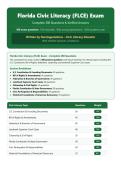
Florida Civic Literacy (FLCE) Exam
Complete 300 Questions & Verified Answers
300 exam questions · Full rationales · Why wrong explanations · 2026 academic year
Written by Nursingsolutions – Civic Literacy Educator
100% Verified Solutions | Graded A+
Florida Civic Literacy (FLCE) Exam – Complete 300 Questions
This comprehensive exam contains 300 practice questions covering all essential civic literacy topics including the
U.S. Constitution, Bill of Rights, federalism, citizenship, and landmark Supreme Court cases.
Section Breakdown
U.S. Constitution & Founding Documents: 50 questions
Bill of Rights & Amendments: 45 questions
Federalism & Branches of Government: 45 questions
Landmark Supreme Court Cases: 40 questions
Citizenship & Civil Rights: 35 questions
Florida Constitution & State Government: 30 questions
Civic Participation & Responsibilities: 30 questions
Historical Foundations of American Democracy: 25 questions
Civic Literacy Topic Questions Weight
U.S. Constitution & Founding Documents 50 17%
Bill of Rights & Amendments 45 15%
Federalism & Branches of Government 45 15%
Landmark Supreme Court Cases 40 13%
Citizenship & Civil Rights 35 12%
Florida Constitution & State Government 30 10%
Civic Participation & Responsibilities 30 10%
Historical Foundations of American Democracy 25 8%
,U.S. Constitution & Founding Documents (282 questions)
Q1. Which of the following is the primary purpose of the U.S. Constitution as stated in the
Preamble?
A To establish justice, ensure domestic tranquility, provide for the common defense, promote the
general welfare, and secure the blessings of liberty
B To establish a monarchy
C To create a system of slavery
D To declare independence from Britain
Correct answer: A. To establish justice, ensure domestic tranquility, provide for the common
defense, promote the general welfare, and secure the blessings of liberty
Rationale: The Preamble to the U.S. Constitution states the primary purposes: to establish justice, ensure
domestic tranquility, provide for the common defense, promote the general welfare, and secure the
blessings of liberty.
Why wrong:
B: The Constitution established a republic, not a monarchy.
C: The Constitution did not create slavery; it was later abolished by amendments.
D: Independence was declared in the Declaration of Independence.
Reference: Florida Civic Literacy Exam · U.S. Constitution · Landmark Supreme Court Cases.
Q2. Which document is considered the first governing document of the United States and
was replaced by the Constitution?
A Articles of Confederation
B Declaration of Independence
C Federalist Papers
D Mayflower Compact
Correct answer: A. Articles of Confederation
Rationale: The Articles of Confederation was the first governing document of the United States, but it was
weak and replaced by the Constitution in 1788.
Why wrong:
B: The Declaration of Independence declared independence from Britain.
C: The Federalist Papers advocated for ratification of the Constitution.
D: The Mayflower Compact was an early agreement among Pilgrims.
Reference: Florida Civic Literacy Exam · U.S. Constitution · Landmark Supreme Court Cases.
,Q3. Who is known as the "Father of the Constitution" for his role in drafting the document?
A James Madison
B Thomas Jefferson
C Alexander Hamilton
D George Washington
Correct answer: A. James Madison
Rationale: James Madison is known as the "Father of the Constitution" for his central role in drafting the
document and promoting its ratification.
Why wrong:
B: Jefferson was not at the Constitutional Convention.
C: Hamilton was a key Federalist but not the primary author.
D: Washington presided over the Constitutional Convention.
Reference: Florida Civic Literacy Exam · U.S. Constitution · Landmark Supreme Court Cases.
Q4. The Federalist Papers were written to encourage ratification of the U.S. Constitution. Who
were the primary authors?
A Alexander Hamilton, James Madison, and John Jay
B Thomas Jefferson, Benjamin Franklin, and John Adams
C George Washington, John Adams, and Thomas Jefferson
D James Monroe, James Madison, and John Marshall
Correct answer: A. Alexander Hamilton, James Madison, and John Jay
Rationale: The Federalist Papers were written by Alexander Hamilton, James Madison, and John Jay
under the pseudonym "Publius" to encourage ratification.
Why wrong:
B: Jefferson and Franklin were in France during the ratification debate.
C: Washington was at the Constitutional Convention but not a Federalist author.
D: Monroe and Marshall were not primary authors.
Reference: Florida Civic Literacy Exam · U.S. Constitution · Landmark Supreme Court Cases.
, Q5. The U.S. Constitution was ratified in which year?
A 1788
B 1776
C 1789
D 1791
Correct answer: A. 1788
Rationale: The U.S. Constitution was ratified in 1788 after being signed in 1787. It went into effect in
1789.
Why wrong:
B: 1776 is the year of the Declaration of Independence.
C: 1789 is the year the Constitution went into effect.
D: 1791 is the year the Bill of Rights was ratified.
Reference: Florida Civic Literacy Exam · U.S. Constitution · Landmark Supreme Court Cases.
Q6. The U.S. Constitution was ratified in which year?
A 1788
B 1776
C 1789
D 1791
Correct answer: A. 1788
Rationale: The U.S. Constitution was ratified in 1788 after being signed in 1787. It went into effect in
1789.
Why wrong:
B: 1776 is the year of the Declaration of Independence.
C: 1789 is the year the Constitution went into effect.
D: 1791 is the year the Bill of Rights was ratified.
Reference: Florida Civic Literacy Exam · U.S. Constitution · Landmark Supreme Court Cases.
Complete 300 Questions & Verified Answers
300 exam questions · Full rationales · Why wrong explanations · 2026 academic year
Written by Nursingsolutions – Civic Literacy Educator
100% Verified Solutions | Graded A+
Florida Civic Literacy (FLCE) Exam – Complete 300 Questions
This comprehensive exam contains 300 practice questions covering all essential civic literacy topics including the
U.S. Constitution, Bill of Rights, federalism, citizenship, and landmark Supreme Court cases.
Section Breakdown
U.S. Constitution & Founding Documents: 50 questions
Bill of Rights & Amendments: 45 questions
Federalism & Branches of Government: 45 questions
Landmark Supreme Court Cases: 40 questions
Citizenship & Civil Rights: 35 questions
Florida Constitution & State Government: 30 questions
Civic Participation & Responsibilities: 30 questions
Historical Foundations of American Democracy: 25 questions
Civic Literacy Topic Questions Weight
U.S. Constitution & Founding Documents 50 17%
Bill of Rights & Amendments 45 15%
Federalism & Branches of Government 45 15%
Landmark Supreme Court Cases 40 13%
Citizenship & Civil Rights 35 12%
Florida Constitution & State Government 30 10%
Civic Participation & Responsibilities 30 10%
Historical Foundations of American Democracy 25 8%
,U.S. Constitution & Founding Documents (282 questions)
Q1. Which of the following is the primary purpose of the U.S. Constitution as stated in the
Preamble?
A To establish justice, ensure domestic tranquility, provide for the common defense, promote the
general welfare, and secure the blessings of liberty
B To establish a monarchy
C To create a system of slavery
D To declare independence from Britain
Correct answer: A. To establish justice, ensure domestic tranquility, provide for the common
defense, promote the general welfare, and secure the blessings of liberty
Rationale: The Preamble to the U.S. Constitution states the primary purposes: to establish justice, ensure
domestic tranquility, provide for the common defense, promote the general welfare, and secure the
blessings of liberty.
Why wrong:
B: The Constitution established a republic, not a monarchy.
C: The Constitution did not create slavery; it was later abolished by amendments.
D: Independence was declared in the Declaration of Independence.
Reference: Florida Civic Literacy Exam · U.S. Constitution · Landmark Supreme Court Cases.
Q2. Which document is considered the first governing document of the United States and
was replaced by the Constitution?
A Articles of Confederation
B Declaration of Independence
C Federalist Papers
D Mayflower Compact
Correct answer: A. Articles of Confederation
Rationale: The Articles of Confederation was the first governing document of the United States, but it was
weak and replaced by the Constitution in 1788.
Why wrong:
B: The Declaration of Independence declared independence from Britain.
C: The Federalist Papers advocated for ratification of the Constitution.
D: The Mayflower Compact was an early agreement among Pilgrims.
Reference: Florida Civic Literacy Exam · U.S. Constitution · Landmark Supreme Court Cases.
,Q3. Who is known as the "Father of the Constitution" for his role in drafting the document?
A James Madison
B Thomas Jefferson
C Alexander Hamilton
D George Washington
Correct answer: A. James Madison
Rationale: James Madison is known as the "Father of the Constitution" for his central role in drafting the
document and promoting its ratification.
Why wrong:
B: Jefferson was not at the Constitutional Convention.
C: Hamilton was a key Federalist but not the primary author.
D: Washington presided over the Constitutional Convention.
Reference: Florida Civic Literacy Exam · U.S. Constitution · Landmark Supreme Court Cases.
Q4. The Federalist Papers were written to encourage ratification of the U.S. Constitution. Who
were the primary authors?
A Alexander Hamilton, James Madison, and John Jay
B Thomas Jefferson, Benjamin Franklin, and John Adams
C George Washington, John Adams, and Thomas Jefferson
D James Monroe, James Madison, and John Marshall
Correct answer: A. Alexander Hamilton, James Madison, and John Jay
Rationale: The Federalist Papers were written by Alexander Hamilton, James Madison, and John Jay
under the pseudonym "Publius" to encourage ratification.
Why wrong:
B: Jefferson and Franklin were in France during the ratification debate.
C: Washington was at the Constitutional Convention but not a Federalist author.
D: Monroe and Marshall were not primary authors.
Reference: Florida Civic Literacy Exam · U.S. Constitution · Landmark Supreme Court Cases.
, Q5. The U.S. Constitution was ratified in which year?
A 1788
B 1776
C 1789
D 1791
Correct answer: A. 1788
Rationale: The U.S. Constitution was ratified in 1788 after being signed in 1787. It went into effect in
1789.
Why wrong:
B: 1776 is the year of the Declaration of Independence.
C: 1789 is the year the Constitution went into effect.
D: 1791 is the year the Bill of Rights was ratified.
Reference: Florida Civic Literacy Exam · U.S. Constitution · Landmark Supreme Court Cases.
Q6. The U.S. Constitution was ratified in which year?
A 1788
B 1776
C 1789
D 1791
Correct answer: A. 1788
Rationale: The U.S. Constitution was ratified in 1788 after being signed in 1787. It went into effect in
1789.
Why wrong:
B: 1776 is the year of the Declaration of Independence.
C: 1789 is the year the Constitution went into effect.
D: 1791 is the year the Bill of Rights was ratified.
Reference: Florida Civic Literacy Exam · U.S. Constitution · Landmark Supreme Court Cases.


