

1
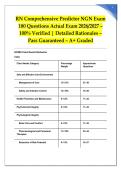
RN Comprehensive Predictor NGN Exam
180 Questions Actual Exam 2026/2027 –
100% Verified | Detailed Rationales –
Pass Guaranteed – A+ Graded
NCSBN Client Needs Distribution
Table
Client Needs Category Percentage Approximate
Weight Questions
Safe and Effective Care Environment
Management of Care 15–21% 27–38
Safety and Infection Control 10–16% 18–29
Health Promotion and Maintenance 6–12% 11–22
Psychosocial Integrity 6–12% 11–22
Physiological Integrity
Basic Care and Comfort 6–12% 11–22
Pharmacological and Parenteral 13–19% 23–34
Therapies
Reduction of Risk Potential 9–15% 16–27
, 2
Client Needs Category Percentage Approximate
Weight Questions
Physiological Adaptation 11–17% 20–31
TOTAL 100% 180
Note: 165 items are scored; 15 items are embedded pretest/unscored items. Three 6-item
unfolding case studies (18 total) are distributed throughout the exam.
SECTION 1: QUESTIONS 1–45
Q1 (Management of Care — Delegation/Prioritization)
A registered nurse is caring for four clients on a medical-surgical unit. Which task is most
appropriate to delegate to an unlicensed assistive personnel (UAP)?
A. Assessing a postoperative client's incision for signs of infection
B. Administering oral medications to a client with heart failure
C. Assisting a client who had a stroke with ambulation to the bathroom [CORRECT]
D. Teaching a newly diagnosed diabetic client about insulin administration
Correct Answer: C
Rationale: The nurse can delegate basic care activities such as ambulation assistance to
UAP. Assessment, medication administration, and initial client education require licensed
nurse judgment and cannot be delegated to UAP.
Q2 (Safety and Infection Control — Extended Multiple Response)
A client is admitted with suspected Clostridioides difficile infection. Which infection control
measures should the nurse implement? Select all that apply.
A. Place the client in a private room with the door closed
B. Wear a gown and gloves when entering the room
C. Use an N95 respirator when providing direct care
D. Place a dedicated commode in the room
E. Wash hands with soap and water after removing gloves
F. Place the client on droplet precautions
Correct Answers: A, B, D, E
Rationale: C. difficile requires contact precautions, including a private room, gown and
gloves, dedicated equipment, and handwashing with soap and water (alcohol-based
, 3
sanitizers are ineffective against C. difficile spores). N95 respirators and droplet precautions
are not indicated.
Q3 (Health Promotion and Maintenance — Recognizing Cues)
A client at 32 weeks gestation calls the clinic and reports sudden onset of severe headache
and visual changes. What is the nurse's best response?
A. "Lie down on your left side and drink water."
B. "These are normal third-trimester symptoms."
C. "Come to the clinic immediately for evaluation." [CORRECT]
D. "Take acetaminophen and call back if symptoms persist."
Correct Answer: C
Rationale: Severe headache and visual changes at 32 weeks gestation are warning signs of
preeclampsia, a potentially life-threatening condition requiring immediate medical evaluation.
Delaying care could result in maternal or fetal complications.
Q4 (Management of Care — Extended Drag-and-Drop: Prioritization)
A nurse receives report on four clients at the beginning of the shift. Place the following
actions in the order of priority.
1. Administer scheduled antibiotics to a stable client
2. Assess a client reporting chest pain
3. Document vital signs on all clients
4. Assist a client to the bathroom who is requesting help
Correct Order: 2 → 4 → 1 → 3
Rationale: The nurse must first address life-threatening situations (chest pain assessment),
then immediate physical needs (bathroom assistance), then scheduled treatments
(antibiotics), and finally documentation. This follows the ABCs and Maslow's hierarchy
prioritization framework.
Q5 (Psychosocial Integrity — Therapeutic Communication)
A client with major depressive disorder states, "I don't see the point in trying anymore.
Nothing matters." What is the nurse's best response?
A. "You have so much to live for."
B. "Have you thought about hurting yourself?" [CORRECT]
C. "Things will get better soon."
D. "Why do you feel that way?"
, 4
Correct Answer: B
Rationale: When a client expresses hopelessness, the nurse's priority is to assess suicide
risk directly and without judgment. This follows therapeutic communication principles and
ensures client safety, which is the highest nursing priority.
Q6 (Pharmacological and Parenteral Therapies — Cloze/Drop-Down)
A client weighs 154 lb and is prescribed heparin at 80 units/kg subcutaneously every 12
hours. The available heparin is 5,000 units/mL. The nurse should administer _____ mL per
dose.
Drop-down options: [1....0]
Correct Answer: 1.12
Rationale: First convert 154 lb to kg (154 ÷ 2.2 = 70 kg). Then calculate the dose: 80 units/kg ×
70 kg = 5,600 units. Finally, calculate volume: 5,600 units ÷ 5,000 units/mL = 1.12 mL.
Q7 (Basic Care and Comfort — Prioritizing Hypotheses)
A postoperative client reports pain rated 8/10 and refuses to ambulate. Which action should
the nurse take first?
A. Document the client's refusal in the medical record
B. Explain the risks of immobility to the client
C. Administer the prescribed analgesic and reassess in 30 minutes [CORRECT]
D. Notify the surgeon of the client's refusal
Correct Answer: C
Rationale: Unrelieved pain is the barrier to ambulation. The nurse should first address the
pain using the prescribed analgesic, then reassess and reattempt ambulation. This follows
the nursing process of addressing the underlying cause before expecting compliance.
Q8 (Safety and Infection Control — Matrix/Grid)
For each client below, identify the appropriate transmission-based precautions. Select one
option for each row.
Table
RN Comprehensive Predictor NGN Exam
180 Questions Actual Exam 2026/2027 –
100% Verified | Detailed Rationales –
Pass Guaranteed – A+ Graded
NCSBN Client Needs Distribution
Table
Client Needs Category Percentage Approximate
Weight Questions
Safe and Effective Care Environment
Management of Care 15–21% 27–38
Safety and Infection Control 10–16% 18–29
Health Promotion and Maintenance 6–12% 11–22
Psychosocial Integrity 6–12% 11–22
Physiological Integrity
Basic Care and Comfort 6–12% 11–22
Pharmacological and Parenteral 13–19% 23–34
Therapies
Reduction of Risk Potential 9–15% 16–27
, 2
Client Needs Category Percentage Approximate
Weight Questions
Physiological Adaptation 11–17% 20–31
TOTAL 100% 180
Note: 165 items are scored; 15 items are embedded pretest/unscored items. Three 6-item
unfolding case studies (18 total) are distributed throughout the exam.
SECTION 1: QUESTIONS 1–45
Q1 (Management of Care — Delegation/Prioritization)
A registered nurse is caring for four clients on a medical-surgical unit. Which task is most
appropriate to delegate to an unlicensed assistive personnel (UAP)?
A. Assessing a postoperative client's incision for signs of infection
B. Administering oral medications to a client with heart failure
C. Assisting a client who had a stroke with ambulation to the bathroom [CORRECT]
D. Teaching a newly diagnosed diabetic client about insulin administration
Correct Answer: C
Rationale: The nurse can delegate basic care activities such as ambulation assistance to
UAP. Assessment, medication administration, and initial client education require licensed
nurse judgment and cannot be delegated to UAP.
Q2 (Safety and Infection Control — Extended Multiple Response)
A client is admitted with suspected Clostridioides difficile infection. Which infection control
measures should the nurse implement? Select all that apply.
A. Place the client in a private room with the door closed
B. Wear a gown and gloves when entering the room
C. Use an N95 respirator when providing direct care
D. Place a dedicated commode in the room
E. Wash hands with soap and water after removing gloves
F. Place the client on droplet precautions
Correct Answers: A, B, D, E
Rationale: C. difficile requires contact precautions, including a private room, gown and
gloves, dedicated equipment, and handwashing with soap and water (alcohol-based
, 3
sanitizers are ineffective against C. difficile spores). N95 respirators and droplet precautions
are not indicated.
Q3 (Health Promotion and Maintenance — Recognizing Cues)
A client at 32 weeks gestation calls the clinic and reports sudden onset of severe headache
and visual changes. What is the nurse's best response?
A. "Lie down on your left side and drink water."
B. "These are normal third-trimester symptoms."
C. "Come to the clinic immediately for evaluation." [CORRECT]
D. "Take acetaminophen and call back if symptoms persist."
Correct Answer: C
Rationale: Severe headache and visual changes at 32 weeks gestation are warning signs of
preeclampsia, a potentially life-threatening condition requiring immediate medical evaluation.
Delaying care could result in maternal or fetal complications.
Q4 (Management of Care — Extended Drag-and-Drop: Prioritization)
A nurse receives report on four clients at the beginning of the shift. Place the following
actions in the order of priority.
1. Administer scheduled antibiotics to a stable client
2. Assess a client reporting chest pain
3. Document vital signs on all clients
4. Assist a client to the bathroom who is requesting help
Correct Order: 2 → 4 → 1 → 3
Rationale: The nurse must first address life-threatening situations (chest pain assessment),
then immediate physical needs (bathroom assistance), then scheduled treatments
(antibiotics), and finally documentation. This follows the ABCs and Maslow's hierarchy
prioritization framework.
Q5 (Psychosocial Integrity — Therapeutic Communication)
A client with major depressive disorder states, "I don't see the point in trying anymore.
Nothing matters." What is the nurse's best response?
A. "You have so much to live for."
B. "Have you thought about hurting yourself?" [CORRECT]
C. "Things will get better soon."
D. "Why do you feel that way?"
, 4
Correct Answer: B
Rationale: When a client expresses hopelessness, the nurse's priority is to assess suicide
risk directly and without judgment. This follows therapeutic communication principles and
ensures client safety, which is the highest nursing priority.
Q6 (Pharmacological and Parenteral Therapies — Cloze/Drop-Down)
A client weighs 154 lb and is prescribed heparin at 80 units/kg subcutaneously every 12
hours. The available heparin is 5,000 units/mL. The nurse should administer _____ mL per
dose.
Drop-down options: [1....0]
Correct Answer: 1.12
Rationale: First convert 154 lb to kg (154 ÷ 2.2 = 70 kg). Then calculate the dose: 80 units/kg ×
70 kg = 5,600 units. Finally, calculate volume: 5,600 units ÷ 5,000 units/mL = 1.12 mL.
Q7 (Basic Care and Comfort — Prioritizing Hypotheses)
A postoperative client reports pain rated 8/10 and refuses to ambulate. Which action should
the nurse take first?
A. Document the client's refusal in the medical record
B. Explain the risks of immobility to the client
C. Administer the prescribed analgesic and reassess in 30 minutes [CORRECT]
D. Notify the surgeon of the client's refusal
Correct Answer: C
Rationale: Unrelieved pain is the barrier to ambulation. The nurse should first address the
pain using the prescribed analgesic, then reassess and reattempt ambulation. This follows
the nursing process of addressing the underlying cause before expecting compliance.
Q8 (Safety and Infection Control — Matrix/Grid)
For each client below, identify the appropriate transmission-based precautions. Select one
option for each row.
Table


