

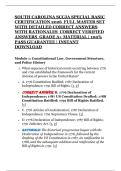
SOUTH CAROLINA SCCJA SPECIAL BASIC
CERTIFICATION 2026 FULL MASTER SET
WITH DETAILED CORRECT ANSWERS
WITH RATIONALES CORRECT VERIFIED
ANSWERS GRADE A+ MATERIAL | 100%
PASS GUARANTEE | INSTANT
DOWNLOAD
Module 1: Constitutional Law, Government Structure,
and Police History
1. What sequence of historical events occurring between 1776
and 1791 established the framework for the current
division of powers in the United States?
• A. 1776 Constitution Ratified; 1787 Declaration of
Independence; 1791 Bill of Rights. [1, 2]
• Correct Answer: B. 1776 Declaration of
Independence; 1787 US Constitution Drafted; 1788
Constitution Ratified; 1791 Bill of Rights Ratified.
[1]
• C. 1776 Articles of Confederation; 1787 Declaration of
Independence; 1791 Supremacy Clause. [1]
• D. 1776 Declaration of Independence; 1787 Bill of Rights;
1791 Judiciary Act. [1, 2]
• Rationale: The historical progression began with the
Declaration of Independence in 1776, followed by the
drafting of the US Constitution in 1787, its ratification in
1788, and the subsequent addition and ratification of the
Bill of Rights in 1791. [1]
,2. Under the concept of the separation of powers established
by the United States Constitution, which branch of
government does law enforcement belong to, and what is
its core responsibility?
• A. Legislative Branch; writing and enacting statutes.
• B. Judicial Branch; interpreting codes and resolving trial
motions.
• Correct Answer: C. Executive Branch;
enforcing the laws of the jurisdiction.
• D. Administrative Branch; issuing professional
certifications.
• Rationale: The division of government splits
responsibilities among three distinct branches:
Legislative (makes laws), Executive (enforces laws), and
Judicial (interprets laws). Law enforcement officers
function directly under the Executive Branch. [1, 2, 3]
3. Article VI of the United States Constitution contains the
Supremacy Clause. What does this clause mandate
regarding conflicts between state laws and federal
constitutional provisions?
• Correct Answer: A. The United States
Constitution and federal laws are the supreme law
of the land, rendering conflicting state laws
invalid.
• B. State supreme court decisions override federal appellate
circuit choices within their geographic boundaries.
• C. Municipal ordinances take complete operational
priority over federal administrative rules.
• D. Constitutional amendments must be approved by all
county sheriffs prior to execution.
,• Rationale: The Supremacy Clause in Article VI
establishes that the federal Constitution and federal
statutes supersede any conflicting state constitutions or
state statutory provisions. [1]
, Sir Robert Peel established the Principles of Modern Law
Enforcement. Which of the following represents the
CERTIFICATION 2026 FULL MASTER SET
WITH DETAILED CORRECT ANSWERS
WITH RATIONALES CORRECT VERIFIED
ANSWERS GRADE A+ MATERIAL | 100%
PASS GUARANTEE | INSTANT
DOWNLOAD
Module 1: Constitutional Law, Government Structure,
and Police History
1. What sequence of historical events occurring between 1776
and 1791 established the framework for the current
division of powers in the United States?
• A. 1776 Constitution Ratified; 1787 Declaration of
Independence; 1791 Bill of Rights. [1, 2]
• Correct Answer: B. 1776 Declaration of
Independence; 1787 US Constitution Drafted; 1788
Constitution Ratified; 1791 Bill of Rights Ratified.
[1]
• C. 1776 Articles of Confederation; 1787 Declaration of
Independence; 1791 Supremacy Clause. [1]
• D. 1776 Declaration of Independence; 1787 Bill of Rights;
1791 Judiciary Act. [1, 2]
• Rationale: The historical progression began with the
Declaration of Independence in 1776, followed by the
drafting of the US Constitution in 1787, its ratification in
1788, and the subsequent addition and ratification of the
Bill of Rights in 1791. [1]
,2. Under the concept of the separation of powers established
by the United States Constitution, which branch of
government does law enforcement belong to, and what is
its core responsibility?
• A. Legislative Branch; writing and enacting statutes.
• B. Judicial Branch; interpreting codes and resolving trial
motions.
• Correct Answer: C. Executive Branch;
enforcing the laws of the jurisdiction.
• D. Administrative Branch; issuing professional
certifications.
• Rationale: The division of government splits
responsibilities among three distinct branches:
Legislative (makes laws), Executive (enforces laws), and
Judicial (interprets laws). Law enforcement officers
function directly under the Executive Branch. [1, 2, 3]
3. Article VI of the United States Constitution contains the
Supremacy Clause. What does this clause mandate
regarding conflicts between state laws and federal
constitutional provisions?
• Correct Answer: A. The United States
Constitution and federal laws are the supreme law
of the land, rendering conflicting state laws
invalid.
• B. State supreme court decisions override federal appellate
circuit choices within their geographic boundaries.
• C. Municipal ordinances take complete operational
priority over federal administrative rules.
• D. Constitutional amendments must be approved by all
county sheriffs prior to execution.
,• Rationale: The Supremacy Clause in Article VI
establishes that the federal Constitution and federal
statutes supersede any conflicting state constitutions or
state statutory provisions. [1]
, Sir Robert Peel established the Principles of Modern Law
Enforcement. Which of the following represents the


