

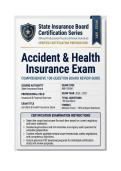
,Accident & Health Insurance Exam – Licensing &
State Regulations – Q&A (2026/2027) | PSI
1. The primary purpose of health insurance is to:
A) Transfer the financial risk of medical expenses from the insured to the insurer
B) Eliminate all possibility of illness
C) Guarantee a profit for the insured
D) Replace lost earnings during retirement
Correct Answer: A) Transfer the financial risk of medical expenses from the
insured to the insurer
Rationale: Health insurance shifts the burden of unpredictable medical costs
from the individual to a larger pool, allowing the insurer to pay covered
expenses. It does not eliminate risk and is not a retirement income product.
2. Which of the following is NOT a requirement of an insurable risk?
A) The loss must be definite and measurable
B) The loss must be intentionally caused by the insured
C) The loss must be due to chance
D) The loss must not be catastrophic to the insurer
Correct Answer: B) The loss must be intentionally caused by the insured
,Rationale: An insurable risk must be accidental (due to chance), definite,
measurable, and not catastrophic. Intentional acts are excluded because they
violate the principle of fortuity and would encourage moral hazard.
3. The principle that prevents an insured from profiting from a loss is known as:
A) Subrogation
B) Adhesion
C) Indemnity
D) Utmost good faith
Correct Answer: C) Indemnity
Rationale: Indemnity restores the insured to approximately the same financial
position they were in before the loss, no better and no worse. This prevents the
insured from gaining financially from a covered event.
4. An insurer's right to recover a claim payment from a responsible third party is
called:
A) Indemnity
B) Coinsurance
C) Coordination of benefits
D) Subrogation
Correct Answer: D) Subrogation
, Rationale: Subrogation allows the insurer to seek reimbursement from the party
that caused the loss, after paying the insured's claim. This prevents the insured
from collecting twice and helps control premiums.
5. The tendency of higher-risk individuals to seek insurance more eagerly than
lower-risk individuals is known as:
A) Adverse selection
B) Risk pooling
C) Underwriting
D) Reinsurance
Correct Answer: A) Adverse selection
Rationale: Adverse selection occurs when those with greater-than-average loss
exposure are more likely to apply for insurance, potentially leading to higher
claims costs. Underwriting and waiting periods are used to mitigate this.
6. An HMO plan typically requires members to:
A) See any provider without a referral
B) Select a primary care physician and obtain referrals to see specialists
C) Pay all costs out-of-pocket until a high deductible is met
D) Purchase a separate prescription drug plan
Correct Answer: B) Select a primary care physician and obtain referrals to see
specialists
State Regulations – Q&A (2026/2027) | PSI
1. The primary purpose of health insurance is to:
A) Transfer the financial risk of medical expenses from the insured to the insurer
B) Eliminate all possibility of illness
C) Guarantee a profit for the insured
D) Replace lost earnings during retirement
Correct Answer: A) Transfer the financial risk of medical expenses from the
insured to the insurer
Rationale: Health insurance shifts the burden of unpredictable medical costs
from the individual to a larger pool, allowing the insurer to pay covered
expenses. It does not eliminate risk and is not a retirement income product.
2. Which of the following is NOT a requirement of an insurable risk?
A) The loss must be definite and measurable
B) The loss must be intentionally caused by the insured
C) The loss must be due to chance
D) The loss must not be catastrophic to the insurer
Correct Answer: B) The loss must be intentionally caused by the insured
,Rationale: An insurable risk must be accidental (due to chance), definite,
measurable, and not catastrophic. Intentional acts are excluded because they
violate the principle of fortuity and would encourage moral hazard.
3. The principle that prevents an insured from profiting from a loss is known as:
A) Subrogation
B) Adhesion
C) Indemnity
D) Utmost good faith
Correct Answer: C) Indemnity
Rationale: Indemnity restores the insured to approximately the same financial
position they were in before the loss, no better and no worse. This prevents the
insured from gaining financially from a covered event.
4. An insurer's right to recover a claim payment from a responsible third party is
called:
A) Indemnity
B) Coinsurance
C) Coordination of benefits
D) Subrogation
Correct Answer: D) Subrogation
, Rationale: Subrogation allows the insurer to seek reimbursement from the party
that caused the loss, after paying the insured's claim. This prevents the insured
from collecting twice and helps control premiums.
5. The tendency of higher-risk individuals to seek insurance more eagerly than
lower-risk individuals is known as:
A) Adverse selection
B) Risk pooling
C) Underwriting
D) Reinsurance
Correct Answer: A) Adverse selection
Rationale: Adverse selection occurs when those with greater-than-average loss
exposure are more likely to apply for insurance, potentially leading to higher
claims costs. Underwriting and waiting periods are used to mitigate this.
6. An HMO plan typically requires members to:
A) See any provider without a referral
B) Select a primary care physician and obtain referrals to see specialists
C) Pay all costs out-of-pocket until a high deductible is met
D) Purchase a separate prescription drug plan
Correct Answer: B) Select a primary care physician and obtain referrals to see
specialists


