

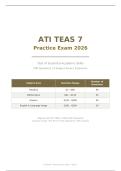
ATI TEAS 7
Practice Exam 2026
Test of Essential Academic Skills
200 Questions | 4 Subject Areas | 8 Sections
Number of
Subject Area Question Range
Questions
Reading Q1 - Q80 80
Mathematics Q81 - Q130 50
Science Q131 - Q180 50
English & Language Usage Q181 - Q200 20
Aligned with ATI TEAS 7 2026-2027 Blueprint
Cognitive Levels: 35% Recall | 45% Application | 20% Analysis
ATI TEAS 7 Practice Exam 2026 | Page 1
,Exam Instructions
This practice exam consists of 200 multiple-choice questions across four subject areas: Reading (80 questions), Mathematics
(50 questions), Science (50 questions), and English and Language Usage (20 questions).
Each question has four answer choices (A, B, C, D). Select the ONE best answer for each question.
The correct answer and a detailed rationale are provided after each question. Use these rationales to understand the reasoning
behind the correct answer and to identify areas for further study.
Questions are designed to assess three cognitive levels: Recall (remembering facts and concepts), Application (using
knowledge in practical scenarios), and Analysis (breaking down information and evaluating relationships).
There is no time limit for this practice exam. In the actual ATI TEAS 7 exam, you will have 209 minutes to complete all 170
questions.
Use this exam to identify your strengths and weaknesses across all four subject areas. Focus additional study time on the
sections and question types where you encounter difficulty.
An answer key with all correct answers is provided at the end of each section for quick reference during review.
Scoring
To calculate your score, divide the number of correct answers by the total number of questions in each section, then multiply
by 100. The ATI TEAS 7 exam uses a composite score and sub-content area scores. Academic preparedness levels
(Developmental, Basic, Proficient, Advanced, Exemplary) are determined by your performance relative to national norms.
ATI TEAS 7 Practice Exam 2026 | Page 2
,SECTION 1: READING - Key Ideas and Details
Identify main ideas, locate key details, summarize, draw conclusions, and comprehend
functional texts.
Questions Q1 - Q20 | Total: 20 questions
Question 1
A student is researching the causes of the American Revolution for a history paper. She finds a primary source
document written by Thomas Paine in 1776. Which of the following best describes the type of source this document
represents?
A. A secondary source that analyzes events after they occurred
B. A primary source created during the period being studied
C. A tertiary source that summarizes multiple historical accounts
D. A peer-reviewed academic journal article
Correct Answer: B
Rationale: A primary source is a document or artifact created during the time period under study. Thomas Paine wrote Common Sense
in 1776, which is contemporaneous with the American Revolution, making it a primary source. The TEAS Reading section tests the
ability to distinguish between primary, secondary, and tertiary sources, a foundational skill for evaluating evidence in academic reading.
Question 2
Read the following passage: 'The water cycle is a continuous process driven by solar energy. Water evaporates from
oceans, lakes, and rivers, rises into the atmosphere, condenses into clouds, and returns to Earth as precipitation. This
cycle is essential for sustaining life on our planet.' What is the main idea of this passage?
A. Solar energy is the most important form of energy on Earth
B. Precipitation is the final step in a process that has no beginning
C. The water cycle is a continuous, solar-driven process essential for life
D. Oceans are the primary source of water for the water cycle
Correct Answer: C
Rationale: The main idea of a passage is the central point the author wants to convey. This passage describes the water cycle as a
'continuous process driven by solar energy' and states it is 'essential for sustaining life.' While the other options contain details from the
passage, only option C captures the complete main idea. Identifying main ideas is a key TEAS Reading skill.
Question 3
A nutrition label on a cereal box lists the following information: Serving Size: 1 cup (30g), Calories: 120 per serving,
Total Fat: 2g, Dietary Fiber: 3g, Sugars: 5g, Protein: 3g. If a person eats 2.5 servings of this cereal, how many calories
does that person consume?
A. 240 calories
B. 300 calories
C. 360 calories
D. 150 calories
Correct Answer: B
Rationale: This question tests the ability to locate and use information from a functional text (a nutrition label). At 120 calories per
serving, 2.5 servings would be 120 x 2.5 = 300 calories. TEAS Reading often includes questions that require performing calculations
based on information presented in charts, labels, or tables. Option B is correct.
ATI TEAS 7 Practice Exam 2026 | Page 3
, Question 4
Read the following sentence: 'Although the experiment yielded unexpected results, the researchers remained
optimistic about the potential applications of their findings.' Which of the following best describes the meaning of the
word 'yielded' as used in this sentence?
A. To produce or generate
B. To surrender or give up
C. To bend or become flexible
D. To decrease in value
Correct Answer: A
Rationale: Context clues are essential for determining word meanings on the TEAS. In this scientific context, 'yielded' means
'produced' or 'generated,' referring to the results produced by the experiment. While 'yield' can mean 'surrender' in other contexts, the
scientific setting and the pairing with 'results' makes option A the correct interpretation. TEAS Reading tests context-dependent
vocabulary frequently.
Question 5
A passage describes the following sequence of events: (1) A storm approaches the coastline, (2) Residents board up
windows and evacuate, (3) The storm makes landfall, (4) Emergency crews assess damage, (5) Residents return to
begin cleanup. Which event represents the climax of this narrative sequence?
A. Residents board up windows and evacuate
B. The storm makes landfall
C. Emergency crews assess damage
D. Residents return to begin cleanup
Correct Answer: B
Rationale: The climax of a narrative is the point of maximum tension or the turning point. In this sequence, the storm making landfall
represents the moment of greatest intensity and the pivotal event around which all other actions revolve. The events before it build
tension (preparation and evacuation), and the events after it represent the falling action (assessment and recovery). TEAS Reading tests
understanding of narrative structure and plot elements.
Question 6
Read the following passage: 'The invention of the printing press by Johannes Gutenberg around 1440 revolutionized
the distribution of information. Before its invention, books were copied by hand, making them expensive and rare.
The printing press allowed for the mass production of books, leading to increased literacy rates and the spread of new
ideas across Europe.' Which of the following is a cause described in this passage?
A. Increased literacy rates across Europe
B. The spread of new ideas across Europe
C. Books being copied by hand before 1440
D. The mass production of books made possible by the printing press
Correct Answer: D
Rationale: This question tests the ability to identify cause-and-effect relationships in informational text. The passage presents a chain:
the invention of the printing press (cause) led to mass production of books (effect/intermediate cause), which led to increased literacy
and spread of ideas (effects). Option D identifies the printing press as the cause that enabled mass production. Options A and B are
effects, not causes.
Question 7
A student reads the following sentence in a science textbook: 'Photosynthesis is the process by which green plants and
certain other organisms transform light energy into chemical energy.' What type of definition is being provided in this
sentence?
A. A persuasive definition intended to convince the reader
ATI TEAS 7 Practice Exam 2026 | Page 4
Practice Exam 2026
Test of Essential Academic Skills
200 Questions | 4 Subject Areas | 8 Sections
Number of
Subject Area Question Range
Questions
Reading Q1 - Q80 80
Mathematics Q81 - Q130 50
Science Q131 - Q180 50
English & Language Usage Q181 - Q200 20
Aligned with ATI TEAS 7 2026-2027 Blueprint
Cognitive Levels: 35% Recall | 45% Application | 20% Analysis
ATI TEAS 7 Practice Exam 2026 | Page 1
,Exam Instructions
This practice exam consists of 200 multiple-choice questions across four subject areas: Reading (80 questions), Mathematics
(50 questions), Science (50 questions), and English and Language Usage (20 questions).
Each question has four answer choices (A, B, C, D). Select the ONE best answer for each question.
The correct answer and a detailed rationale are provided after each question. Use these rationales to understand the reasoning
behind the correct answer and to identify areas for further study.
Questions are designed to assess three cognitive levels: Recall (remembering facts and concepts), Application (using
knowledge in practical scenarios), and Analysis (breaking down information and evaluating relationships).
There is no time limit for this practice exam. In the actual ATI TEAS 7 exam, you will have 209 minutes to complete all 170
questions.
Use this exam to identify your strengths and weaknesses across all four subject areas. Focus additional study time on the
sections and question types where you encounter difficulty.
An answer key with all correct answers is provided at the end of each section for quick reference during review.
Scoring
To calculate your score, divide the number of correct answers by the total number of questions in each section, then multiply
by 100. The ATI TEAS 7 exam uses a composite score and sub-content area scores. Academic preparedness levels
(Developmental, Basic, Proficient, Advanced, Exemplary) are determined by your performance relative to national norms.
ATI TEAS 7 Practice Exam 2026 | Page 2
,SECTION 1: READING - Key Ideas and Details
Identify main ideas, locate key details, summarize, draw conclusions, and comprehend
functional texts.
Questions Q1 - Q20 | Total: 20 questions
Question 1
A student is researching the causes of the American Revolution for a history paper. She finds a primary source
document written by Thomas Paine in 1776. Which of the following best describes the type of source this document
represents?
A. A secondary source that analyzes events after they occurred
B. A primary source created during the period being studied
C. A tertiary source that summarizes multiple historical accounts
D. A peer-reviewed academic journal article
Correct Answer: B
Rationale: A primary source is a document or artifact created during the time period under study. Thomas Paine wrote Common Sense
in 1776, which is contemporaneous with the American Revolution, making it a primary source. The TEAS Reading section tests the
ability to distinguish between primary, secondary, and tertiary sources, a foundational skill for evaluating evidence in academic reading.
Question 2
Read the following passage: 'The water cycle is a continuous process driven by solar energy. Water evaporates from
oceans, lakes, and rivers, rises into the atmosphere, condenses into clouds, and returns to Earth as precipitation. This
cycle is essential for sustaining life on our planet.' What is the main idea of this passage?
A. Solar energy is the most important form of energy on Earth
B. Precipitation is the final step in a process that has no beginning
C. The water cycle is a continuous, solar-driven process essential for life
D. Oceans are the primary source of water for the water cycle
Correct Answer: C
Rationale: The main idea of a passage is the central point the author wants to convey. This passage describes the water cycle as a
'continuous process driven by solar energy' and states it is 'essential for sustaining life.' While the other options contain details from the
passage, only option C captures the complete main idea. Identifying main ideas is a key TEAS Reading skill.
Question 3
A nutrition label on a cereal box lists the following information: Serving Size: 1 cup (30g), Calories: 120 per serving,
Total Fat: 2g, Dietary Fiber: 3g, Sugars: 5g, Protein: 3g. If a person eats 2.5 servings of this cereal, how many calories
does that person consume?
A. 240 calories
B. 300 calories
C. 360 calories
D. 150 calories
Correct Answer: B
Rationale: This question tests the ability to locate and use information from a functional text (a nutrition label). At 120 calories per
serving, 2.5 servings would be 120 x 2.5 = 300 calories. TEAS Reading often includes questions that require performing calculations
based on information presented in charts, labels, or tables. Option B is correct.
ATI TEAS 7 Practice Exam 2026 | Page 3
, Question 4
Read the following sentence: 'Although the experiment yielded unexpected results, the researchers remained
optimistic about the potential applications of their findings.' Which of the following best describes the meaning of the
word 'yielded' as used in this sentence?
A. To produce or generate
B. To surrender or give up
C. To bend or become flexible
D. To decrease in value
Correct Answer: A
Rationale: Context clues are essential for determining word meanings on the TEAS. In this scientific context, 'yielded' means
'produced' or 'generated,' referring to the results produced by the experiment. While 'yield' can mean 'surrender' in other contexts, the
scientific setting and the pairing with 'results' makes option A the correct interpretation. TEAS Reading tests context-dependent
vocabulary frequently.
Question 5
A passage describes the following sequence of events: (1) A storm approaches the coastline, (2) Residents board up
windows and evacuate, (3) The storm makes landfall, (4) Emergency crews assess damage, (5) Residents return to
begin cleanup. Which event represents the climax of this narrative sequence?
A. Residents board up windows and evacuate
B. The storm makes landfall
C. Emergency crews assess damage
D. Residents return to begin cleanup
Correct Answer: B
Rationale: The climax of a narrative is the point of maximum tension or the turning point. In this sequence, the storm making landfall
represents the moment of greatest intensity and the pivotal event around which all other actions revolve. The events before it build
tension (preparation and evacuation), and the events after it represent the falling action (assessment and recovery). TEAS Reading tests
understanding of narrative structure and plot elements.
Question 6
Read the following passage: 'The invention of the printing press by Johannes Gutenberg around 1440 revolutionized
the distribution of information. Before its invention, books were copied by hand, making them expensive and rare.
The printing press allowed for the mass production of books, leading to increased literacy rates and the spread of new
ideas across Europe.' Which of the following is a cause described in this passage?
A. Increased literacy rates across Europe
B. The spread of new ideas across Europe
C. Books being copied by hand before 1440
D. The mass production of books made possible by the printing press
Correct Answer: D
Rationale: This question tests the ability to identify cause-and-effect relationships in informational text. The passage presents a chain:
the invention of the printing press (cause) led to mass production of books (effect/intermediate cause), which led to increased literacy
and spread of ideas (effects). Option D identifies the printing press as the cause that enabled mass production. Options A and B are
effects, not causes.
Question 7
A student reads the following sentence in a science textbook: 'Photosynthesis is the process by which green plants and
certain other organisms transform light energy into chemical energy.' What type of definition is being provided in this
sentence?
A. A persuasive definition intended to convince the reader
ATI TEAS 7 Practice Exam 2026 | Page 4


