

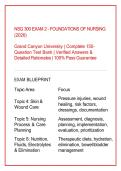
NSG 300 EXAM 2 – FOUNDATIONS OF NURSING
(2026)
Grand Canyon University | Complete 150-
Question Test Bank | Verified Answers &
Detailed Rationales | 100% Pass Guarantee
EXAM BLUEPRINT
Topic Area Focus
Pressure injuries, wound
Topic 4: Skin &
healing, risk factors,
Wound Care
dressings, documentation
Topic 5: Nursing Assessment, diagnosis,
Process & Care planning, implementation,
Planning evaluation, prioritization
Topic 6: Nutrition, Therapeutic diets, hydration,
Fluids, Electrolytes elimination, bowel/bladder
& Elimination management
,SECTION 1: SKIN & WOUND CARE (Questions 1–
50)
1. A nurse is assessing a patient who is
immobile and has been in bed for several days.
Which factor places this patient at highest risk
for impaired skin integrity?
A) Advanced age and decreased skin elasticity
B) Adequate dietary intake and hydration
C) Use of a pressure-reducing mattress
D) Frequent repositioning by the nursing staff
Answer: A) Advanced age and decreased skin
elasticity
Rationale: Aging skin has reduced elasticity,
decreased collagen, and thinning of underlying
muscle and tissues, making it more
susceptible to tears and pressure injuries.
Adequate nutrition (B), pressure-reducing
surfaces (C), and repositioning (D) are
protective factors .
,2. A patient has a reddened area over the
coccyx that does not blanch when the nurse
applies fingertip pressure. How should the
nurse document this finding?
A) Reactive hyperemia
B) Stage 1 pressure injury
C) Stage 2 pressure injury
D) Deep tissue injury
Answer: B) Stage 1 pressure injury
Rationale: Non-blanchable erythema of intact
skin indicates a Stage 1 pressure injury.
Reactive hyperemia (A) would blanch with
pressure. Stage 2 (C) involves partial-
thickness skin loss with exposed dermis. Deep
tissue injury (D) presents as a purple or
maroon localized area of discolored intact
skin .
3. A patient has a sacral wound with visible
adipose tissue, granulation tissue, and rolled
edges. No muscle, tendon, or bone is exposed.
How should the nurse stage this pressure
injury?
A) Stage 2
, B) Stage 3
C) Stage 4
D) Unstageable
Answer: B) Stage 3
Rationale: Stage 3 pressure injuriesinvolve full-
thicknessskinlosswithvisible adipose (fat)
tissue, granulation tissue, and often epibole
(rolled edges). Stage 2 (A) ispartialthickness.
Stage 4 (C) involves exposed fascia, muscle,
tendon, orbone. Unstageable (D) occurs when
slough orescharobscures the wound base .
4. A patient hasawound withthick, yellow,
odorous drainage. How should the nurse
document thisdrainage?
A) Serous
B) Serosanguineous
C) Sanguineous
D) Purulent
Answer: D) Purulent
Rationale: Purulent drainage isthick, yellow,
green, tan, orbrown and often hasafoul odor,
indicating infection. Serous (A) isclear and
watery. Serosanguineous (B) is pale, pink, and
(2026)
Grand Canyon University | Complete 150-
Question Test Bank | Verified Answers &
Detailed Rationales | 100% Pass Guarantee
EXAM BLUEPRINT
Topic Area Focus
Pressure injuries, wound
Topic 4: Skin &
healing, risk factors,
Wound Care
dressings, documentation
Topic 5: Nursing Assessment, diagnosis,
Process & Care planning, implementation,
Planning evaluation, prioritization
Topic 6: Nutrition, Therapeutic diets, hydration,
Fluids, Electrolytes elimination, bowel/bladder
& Elimination management
,SECTION 1: SKIN & WOUND CARE (Questions 1–
50)
1. A nurse is assessing a patient who is
immobile and has been in bed for several days.
Which factor places this patient at highest risk
for impaired skin integrity?
A) Advanced age and decreased skin elasticity
B) Adequate dietary intake and hydration
C) Use of a pressure-reducing mattress
D) Frequent repositioning by the nursing staff
Answer: A) Advanced age and decreased skin
elasticity
Rationale: Aging skin has reduced elasticity,
decreased collagen, and thinning of underlying
muscle and tissues, making it more
susceptible to tears and pressure injuries.
Adequate nutrition (B), pressure-reducing
surfaces (C), and repositioning (D) are
protective factors .
,2. A patient has a reddened area over the
coccyx that does not blanch when the nurse
applies fingertip pressure. How should the
nurse document this finding?
A) Reactive hyperemia
B) Stage 1 pressure injury
C) Stage 2 pressure injury
D) Deep tissue injury
Answer: B) Stage 1 pressure injury
Rationale: Non-blanchable erythema of intact
skin indicates a Stage 1 pressure injury.
Reactive hyperemia (A) would blanch with
pressure. Stage 2 (C) involves partial-
thickness skin loss with exposed dermis. Deep
tissue injury (D) presents as a purple or
maroon localized area of discolored intact
skin .
3. A patient has a sacral wound with visible
adipose tissue, granulation tissue, and rolled
edges. No muscle, tendon, or bone is exposed.
How should the nurse stage this pressure
injury?
A) Stage 2
, B) Stage 3
C) Stage 4
D) Unstageable
Answer: B) Stage 3
Rationale: Stage 3 pressure injuriesinvolve full-
thicknessskinlosswithvisible adipose (fat)
tissue, granulation tissue, and often epibole
(rolled edges). Stage 2 (A) ispartialthickness.
Stage 4 (C) involves exposed fascia, muscle,
tendon, orbone. Unstageable (D) occurs when
slough orescharobscures the wound base .
4. A patient hasawound withthick, yellow,
odorous drainage. How should the nurse
document thisdrainage?
A) Serous
B) Serosanguineous
C) Sanguineous
D) Purulent
Answer: D) Purulent
Rationale: Purulent drainage isthick, yellow,
green, tan, orbrown and often hasafoul odor,
indicating infection. Serous (A) isclear and
watery. Serosanguineous (B) is pale, pink, and


