

Page 1 of 84
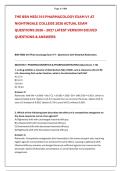
THE BSN HESI 315 PHARMACOLOGY EXAM V1 AT
NIGHTINGALE COLLEGE 2026 ACTUAL EXAM
QUESTIONS 2026 – 2027 LATEST VERSION SOLVED
QUESTIONS & ANSWERS
BSN HESI 315 Pharmacology Exam V1 - Questions with Detailed Rationales
SECTION 1: PHARMACOKINETICS & PHARMACODYNAMICS (Questions 1-10)
1. A drug exhibits a volume of distribution (Vd) of 500 L and a clearance (CL) of 50
L/h. Assuming first-order kinetics, what is its elimination half-life?
A) 3.5 h
B) 5.0 h
C) 6.9 h
D) 10.0 h
Answer: C
Rationale: Half-life = (0.693 × Vd) / CL = (0.693 × 500) / 50 = 346.5/50 = 6.93 h, which is
approximately 6.9 h. Option A (3.5 h) results from an incorrect formula. Option B (5 h)
uses 0.5 instead of 0.693. Option D (10 h) uses Vd/CL without 0.693.
2. Which of the following best describes the effect of a competitive antagonist on
the dose-response curve of an agonist?
A) Rightward shift with unchanged maximal efficacy
B) Leftward shift with increased maximal efficacy
C) Downward shift with decreased maximal efficacy
D) Rightward shift with decreased maximal efficacy
Answer: A
Rationale: Competitive antagonists bind reversibly to the same receptor site, requiring
higher agonist concentrations to achieve the same effect, causing a rightward shift.
Maximal efficacy remains unchanged because sufficient agonist can overcome the
blockade. Option B describes sensitization; C and D describe noncompetitive
antagonism.
, Page 2 of 84
3. A patient with hepatic cirrhosis has reduced CYP3A4 activity. For a drug primarily
metabolized by CYP3A4 with high first-pass metabolism, which change is most
likely?
A) Decreased oral bioavailability and increased clearance
B) Increased oral bioavailability and decreased clearance
C) Decreased volume of distribution and increased half-life
D) Increased volume of distribution and decreased half-life
Answer: B
Rationale: CYP3A4 is crucial for metabolism in the liver. Reduced activity means more
drug reaches systemic circulation (increased bioavailability) and is eliminated more
slowly (decreased clearance). Option C refers to volume of distribution; Option D is
incorrect as half-life would increase, not decrease.
4. A drug follows a two-compartment model. After IV bolus, the plasma
concentration-time curve shows a rapid initial decline followed by a slower
terminal phase. Which parameter is most affected by the distribution phase?
A) Clearance
B) Volume of distribution at steady state (Vss)
C) Half-life of the terminal phase
D) Area under the curve (AUC)
Answer: B
Rationale: In a two-compartment model, Vss accounts for distribution into peripheral
compartments; it is influenced by the extent of distribution. Clearance and AUC are
determined by elimination, not distribution. Terminal half-life is influenced by both but
primarily by elimination.
5. A drug is a weak acid with pKa = 4.5. In the stomach (pH 1.5), what fraction of the
drug is in the nonionized (absorbable) form?
A) 0.001
B) 0.01
C) 0.99
D) 0.999
Answer: D
Rationale: Using Henderson-Hasselbalch: pH = pKa + log([A-]/[HA]). For a weak acid,
log([A-]/[HA]) = 1.5 - 4.5 = -3, so [A-]/[HA] = 0.001. Fraction nonionized = [HA]/([HA]+[A-])
= 1/(1+0.001) ≈ 0.999. Option A is the fraction ionized.
, Page 3 of 84
6. A client is prescribed a medication with a narrow therapeutic index. Which
nursing action is most important?
A) Administer the medication with food
B) Monitor serum drug levels closely
C) Increase the dosage to achieve therapeutic effect
D) Administer the medication at bedtime
Answer: B
Rationale: Drugs with a narrow therapeutic index have a small margin between
therapeutic and toxic doses. Close monitoring of serum drug levels is essential to
ensure the medication remains within the therapeutic range and to prevent toxicity.
7. Which of the following describes the term "half-life"?
A) The time required for the drug to reach peak plasma concentration
B) The time required for the drug to be completely eliminated from the body
C) The time required for the plasma concentration of the drug to decrease by 50%
D) The time required for the drug to be absorbed into the bloodstream
Answer: C
Rationale: The half-life of a drug is the time required for the plasma concentration to
decrease by 50%. This determines the dosing interval needed to maintain therapeutic
levels and avoid toxicity.
8. The nurse is administering a medication that prevents receptor activation. Which
term describes this drug?
A) Agonist
B) Antagonist
C) Potentiator
D) Synergist
Answer: B
Rationale: An antagonist binds to a receptor and prevents its activation, blocking the
response. An agonist activates the receptor, a potentiator enhances another drug's
effect, and a synergist works with another drug to produce a combined effect greater
than the sum of their individual effects.
9. A client asks the nurse, "What does it mean when a drug has a high first-pass
effect?" Which response is correct?
, Page 4 of 84
A) The drug is rapidly excreted by the kidneys
B) The drug is metabolized in the liver before reaching systemic circulation
C) The drug is absorbed quickly through the gastrointestinal tract
D) The drug binds extensively to plasma proteins
Answer: B
Rationale: The first-pass effect refers to the metabolism of a drug in the liver before it
reaches systemic circulation. Drugs with high first-pass effect require higher oral doses
to achieve therapeutic levels or may need to be administered via routes that bypass the
liver.
10. Which route of medication administration provides the most rapid onset of
action?
A) Oral
B) Subcutaneous
C) Intramuscular
D) Intravenous
Answer: D
Rationale: Intravenous (IV) administration provides the most rapid onset of action
because the medication is delivered directly into the bloodstream, bypassing
absorption barriers. This route allows for immediate therapeutic effects but also carries
the highest risk for adverse reactions.
SECTION 2: CARDIOVASCULAR & RENAL PHARMACOLOGY (Questions 11-25)
11. A nurse is administering furosemide (Lasix) to a client with congestive heart
failure. Which assessment finding is most important to check before giving the
dose?
A) Blood glucose
B) Serum potassium
C) Respiratory rate
D) Liver enzymes
Answer: B
Rationale: Furosemide is a loop diuretic that causes significant potassium loss through
the kidneys, leading to hypokalemia. Hypokalemia increases the risk of cardiac
arrhythmias, especially in patients taking digitalis. Serum potassium should be
monitored before and during therapy.
THE BSN HESI 315 PHARMACOLOGY EXAM V1 AT
NIGHTINGALE COLLEGE 2026 ACTUAL EXAM
QUESTIONS 2026 – 2027 LATEST VERSION SOLVED
QUESTIONS & ANSWERS
BSN HESI 315 Pharmacology Exam V1 - Questions with Detailed Rationales
SECTION 1: PHARMACOKINETICS & PHARMACODYNAMICS (Questions 1-10)
1. A drug exhibits a volume of distribution (Vd) of 500 L and a clearance (CL) of 50
L/h. Assuming first-order kinetics, what is its elimination half-life?
A) 3.5 h
B) 5.0 h
C) 6.9 h
D) 10.0 h
Answer: C
Rationale: Half-life = (0.693 × Vd) / CL = (0.693 × 500) / 50 = 346.5/50 = 6.93 h, which is
approximately 6.9 h. Option A (3.5 h) results from an incorrect formula. Option B (5 h)
uses 0.5 instead of 0.693. Option D (10 h) uses Vd/CL without 0.693.
2. Which of the following best describes the effect of a competitive antagonist on
the dose-response curve of an agonist?
A) Rightward shift with unchanged maximal efficacy
B) Leftward shift with increased maximal efficacy
C) Downward shift with decreased maximal efficacy
D) Rightward shift with decreased maximal efficacy
Answer: A
Rationale: Competitive antagonists bind reversibly to the same receptor site, requiring
higher agonist concentrations to achieve the same effect, causing a rightward shift.
Maximal efficacy remains unchanged because sufficient agonist can overcome the
blockade. Option B describes sensitization; C and D describe noncompetitive
antagonism.
, Page 2 of 84
3. A patient with hepatic cirrhosis has reduced CYP3A4 activity. For a drug primarily
metabolized by CYP3A4 with high first-pass metabolism, which change is most
likely?
A) Decreased oral bioavailability and increased clearance
B) Increased oral bioavailability and decreased clearance
C) Decreased volume of distribution and increased half-life
D) Increased volume of distribution and decreased half-life
Answer: B
Rationale: CYP3A4 is crucial for metabolism in the liver. Reduced activity means more
drug reaches systemic circulation (increased bioavailability) and is eliminated more
slowly (decreased clearance). Option C refers to volume of distribution; Option D is
incorrect as half-life would increase, not decrease.
4. A drug follows a two-compartment model. After IV bolus, the plasma
concentration-time curve shows a rapid initial decline followed by a slower
terminal phase. Which parameter is most affected by the distribution phase?
A) Clearance
B) Volume of distribution at steady state (Vss)
C) Half-life of the terminal phase
D) Area under the curve (AUC)
Answer: B
Rationale: In a two-compartment model, Vss accounts for distribution into peripheral
compartments; it is influenced by the extent of distribution. Clearance and AUC are
determined by elimination, not distribution. Terminal half-life is influenced by both but
primarily by elimination.
5. A drug is a weak acid with pKa = 4.5. In the stomach (pH 1.5), what fraction of the
drug is in the nonionized (absorbable) form?
A) 0.001
B) 0.01
C) 0.99
D) 0.999
Answer: D
Rationale: Using Henderson-Hasselbalch: pH = pKa + log([A-]/[HA]). For a weak acid,
log([A-]/[HA]) = 1.5 - 4.5 = -3, so [A-]/[HA] = 0.001. Fraction nonionized = [HA]/([HA]+[A-])
= 1/(1+0.001) ≈ 0.999. Option A is the fraction ionized.
, Page 3 of 84
6. A client is prescribed a medication with a narrow therapeutic index. Which
nursing action is most important?
A) Administer the medication with food
B) Monitor serum drug levels closely
C) Increase the dosage to achieve therapeutic effect
D) Administer the medication at bedtime
Answer: B
Rationale: Drugs with a narrow therapeutic index have a small margin between
therapeutic and toxic doses. Close monitoring of serum drug levels is essential to
ensure the medication remains within the therapeutic range and to prevent toxicity.
7. Which of the following describes the term "half-life"?
A) The time required for the drug to reach peak plasma concentration
B) The time required for the drug to be completely eliminated from the body
C) The time required for the plasma concentration of the drug to decrease by 50%
D) The time required for the drug to be absorbed into the bloodstream
Answer: C
Rationale: The half-life of a drug is the time required for the plasma concentration to
decrease by 50%. This determines the dosing interval needed to maintain therapeutic
levels and avoid toxicity.
8. The nurse is administering a medication that prevents receptor activation. Which
term describes this drug?
A) Agonist
B) Antagonist
C) Potentiator
D) Synergist
Answer: B
Rationale: An antagonist binds to a receptor and prevents its activation, blocking the
response. An agonist activates the receptor, a potentiator enhances another drug's
effect, and a synergist works with another drug to produce a combined effect greater
than the sum of their individual effects.
9. A client asks the nurse, "What does it mean when a drug has a high first-pass
effect?" Which response is correct?
, Page 4 of 84
A) The drug is rapidly excreted by the kidneys
B) The drug is metabolized in the liver before reaching systemic circulation
C) The drug is absorbed quickly through the gastrointestinal tract
D) The drug binds extensively to plasma proteins
Answer: B
Rationale: The first-pass effect refers to the metabolism of a drug in the liver before it
reaches systemic circulation. Drugs with high first-pass effect require higher oral doses
to achieve therapeutic levels or may need to be administered via routes that bypass the
liver.
10. Which route of medication administration provides the most rapid onset of
action?
A) Oral
B) Subcutaneous
C) Intramuscular
D) Intravenous
Answer: D
Rationale: Intravenous (IV) administration provides the most rapid onset of action
because the medication is delivered directly into the bloodstream, bypassing
absorption barriers. This route allows for immediate therapeutic effects but also carries
the highest risk for adverse reactions.
SECTION 2: CARDIOVASCULAR & RENAL PHARMACOLOGY (Questions 11-25)
11. A nurse is administering furosemide (Lasix) to a client with congestive heart
failure. Which assessment finding is most important to check before giving the
dose?
A) Blood glucose
B) Serum potassium
C) Respiratory rate
D) Liver enzymes
Answer: B
Rationale: Furosemide is a loop diuretic that causes significant potassium loss through
the kidneys, leading to hypokalemia. Hypokalemia increases the risk of cardiac
arrhythmias, especially in patients taking digitalis. Serum potassium should be
monitored before and during therapy.


