

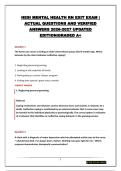
Question 1
The home care nurse is visiting an older client whose spouse died 6 months ago. Which
behavior by the client indicates ineffective coping?
1. Neglecting personal grooming
2. Looking at old snapshots of family
3. Participating in a senior citizens' program
4. Visiting their spouse's grave once a month
CORRECT ANSWER
1. Neglecting personal grooming
Rational:
Coping mechanisms are behaviors used to decrease stress and anxiety. In response to a
death, ineffective coping is manifested by an extreme behavior that in some cases may
be harmful to the individual physically or psychologically. The correct option is indicative
of a behavior that identifies an ineffective coping behavior in the grieving process.
Question 2
A client with a diagnosis of major depression who has attempted suicide says to the nurse,
"I should have died. I've always been a failure. Nothing ever goes right for me." Which
response demonstrates therapeutic communication?
1
@THE STUDY VAULT
,1. "You have everything to live for."
2. "Why do you see yourself as a failure?"
3. "Feeling like this is all part of being depressed."
4. "You've been feeling like a failure for a while?"
CORRECT ANSWER
4. "You've been feeling like a failure for a while?"
Rationale:
Responding to the feelings expressed by a client is an effective therapeutic
communication technique. The correct option is an example of the use of restating. The
remaining options block communication because they minimize the client's experience
and do not facilitate exploration of the client's expressed feelings. In addition, use of the
word "why" is nontherapeutic.
Question 3
When the mental health nurse visits a client at home, the client states, "I haven't slept at
all the last couple of nights." Which response by the nurse illustrates a therapeutic
communication response to this client?
1. "I see."
2. "Really?"
3. "You're having difficulty sleeping?"
4. "Sometimes, I have trouble sleeping too."
CORRECT ANSWER
3. "You're having difficulty sleeping?"
Rationale:
The correct option uses the therapeutic communication technique of restatement.
Although restatement is a technique that has a prompting component to it, it repeats the
2
@THE STUDY VAULT
, client's major theme, which assists the nurse to obtain a more specific perception of the
problem from the client. The remaining options are not therapeutic responses since none
encourage the client to expand on the problem. Offering personal experiences moves the
focus away from the client and onto the nurse.
Question 4
A client experiencing disturbed thought processes believes that his food is being poisoned.
Which communication technique should the nurse use to encourage the client to eat?
1. Using open-ended questions and silence
2. Sharing personal preference regarding food choices
3. Documenting reasons why the client does not want to eat
4. Offering opinions about the necessity of adequate nutrition
CORRECT ANSWER
1. Using open-ended questions and silence
Rationale:
Open-ended questions and silence are strategies used to encourage clients to discuss
their problems. Sharing personal food preferences is not a client-centered intervention.
The remaining options are not helpful to the client because they do not encourage the
client to express feelings. The nurse should not offer opinions and should encourage the
client to identify the reasons for the behavior.
Question 5
A client admitted to a mental health unit for treatment of psychotic behavior spends hours
at the locked exit door shouting, "Let me out. There's nothing wrong with me. I don't
belong here." What defense mechanism is the client implementing?
3
@THE STUDY VAULT
, 1. Denial
2. Projection
3. Regression
4. Rationalization
CORRECT ANSWER
1. Denial
Rationale:
Denial is refusal to admit to a painful reality, which is treated as if it does not exist. In
projection, a person unconsciously rejects emotionally unacceptable features and
attributes them to other persons, objects, or situations. Regression allows the client to
return to an earlier, more comforting, although less mature, way of behaving.
Rationalization is justifying illogical or unreasonable ideas, actions, or feelings by
developing acceptable explanations that satisfy the teller and the listener.
Question 6
A client diagnosed with terminal cancer says to the nurse, "I'm going to die, and I wish my
family would stop hoping for a cure! I get so angry when they carry on like this. After all,
I'm the one who's dying." Which response by the nurse is therapeutic?
1. "Have you shared your feelings with your family?"
2. "I think we should talk more about your anger with your family."
3. "You're feeling angry that your family continues to hope for you to be cured?"
4. "You are probably very depressed, which is understandable with such a diagnosis."
CORRECT ANSWER
3. "You're feeling angry that your family continues to hope for you to be cured?"
Rationale:
4
@THE STUDY VAULT
The home care nurse is visiting an older client whose spouse died 6 months ago. Which
behavior by the client indicates ineffective coping?
1. Neglecting personal grooming
2. Looking at old snapshots of family
3. Participating in a senior citizens' program
4. Visiting their spouse's grave once a month
CORRECT ANSWER
1. Neglecting personal grooming
Rational:
Coping mechanisms are behaviors used to decrease stress and anxiety. In response to a
death, ineffective coping is manifested by an extreme behavior that in some cases may
be harmful to the individual physically or psychologically. The correct option is indicative
of a behavior that identifies an ineffective coping behavior in the grieving process.
Question 2
A client with a diagnosis of major depression who has attempted suicide says to the nurse,
"I should have died. I've always been a failure. Nothing ever goes right for me." Which
response demonstrates therapeutic communication?
1
@THE STUDY VAULT
,1. "You have everything to live for."
2. "Why do you see yourself as a failure?"
3. "Feeling like this is all part of being depressed."
4. "You've been feeling like a failure for a while?"
CORRECT ANSWER
4. "You've been feeling like a failure for a while?"
Rationale:
Responding to the feelings expressed by a client is an effective therapeutic
communication technique. The correct option is an example of the use of restating. The
remaining options block communication because they minimize the client's experience
and do not facilitate exploration of the client's expressed feelings. In addition, use of the
word "why" is nontherapeutic.
Question 3
When the mental health nurse visits a client at home, the client states, "I haven't slept at
all the last couple of nights." Which response by the nurse illustrates a therapeutic
communication response to this client?
1. "I see."
2. "Really?"
3. "You're having difficulty sleeping?"
4. "Sometimes, I have trouble sleeping too."
CORRECT ANSWER
3. "You're having difficulty sleeping?"
Rationale:
The correct option uses the therapeutic communication technique of restatement.
Although restatement is a technique that has a prompting component to it, it repeats the
2
@THE STUDY VAULT
, client's major theme, which assists the nurse to obtain a more specific perception of the
problem from the client. The remaining options are not therapeutic responses since none
encourage the client to expand on the problem. Offering personal experiences moves the
focus away from the client and onto the nurse.
Question 4
A client experiencing disturbed thought processes believes that his food is being poisoned.
Which communication technique should the nurse use to encourage the client to eat?
1. Using open-ended questions and silence
2. Sharing personal preference regarding food choices
3. Documenting reasons why the client does not want to eat
4. Offering opinions about the necessity of adequate nutrition
CORRECT ANSWER
1. Using open-ended questions and silence
Rationale:
Open-ended questions and silence are strategies used to encourage clients to discuss
their problems. Sharing personal food preferences is not a client-centered intervention.
The remaining options are not helpful to the client because they do not encourage the
client to express feelings. The nurse should not offer opinions and should encourage the
client to identify the reasons for the behavior.
Question 5
A client admitted to a mental health unit for treatment of psychotic behavior spends hours
at the locked exit door shouting, "Let me out. There's nothing wrong with me. I don't
belong here." What defense mechanism is the client implementing?
3
@THE STUDY VAULT
, 1. Denial
2. Projection
3. Regression
4. Rationalization
CORRECT ANSWER
1. Denial
Rationale:
Denial is refusal to admit to a painful reality, which is treated as if it does not exist. In
projection, a person unconsciously rejects emotionally unacceptable features and
attributes them to other persons, objects, or situations. Regression allows the client to
return to an earlier, more comforting, although less mature, way of behaving.
Rationalization is justifying illogical or unreasonable ideas, actions, or feelings by
developing acceptable explanations that satisfy the teller and the listener.
Question 6
A client diagnosed with terminal cancer says to the nurse, "I'm going to die, and I wish my
family would stop hoping for a cure! I get so angry when they carry on like this. After all,
I'm the one who's dying." Which response by the nurse is therapeutic?
1. "Have you shared your feelings with your family?"
2. "I think we should talk more about your anger with your family."
3. "You're feeling angry that your family continues to hope for you to be cured?"
4. "You are probably very depressed, which is understandable with such a diagnosis."
CORRECT ANSWER
3. "You're feeling angry that your family continues to hope for you to be cured?"
Rationale:
4
@THE STUDY VAULT


