

Chapter 1 : Introduction to Public Health Nutrition
1. Health
1.1 Definition
A state of complete physical, mental and social wellbeing and not merely an absence of disease of infirmity.
It is not straight forward wat it means to be health or sick, it is a spectrum. Health is not dichotomy.
For example: Solastalgia = the pain cause of losing comfort in your environment.
1.2 Result
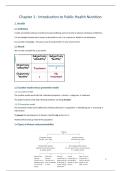
We can look at health like a 2x2 matrix.
1.3 Curative model versus preventive model
1.3.1 Curative model
The curative model works like this: Individual symptoms → doctor → diagnosis → treatment
The patient actively seeks help. Medical problems are being treaded.
1.3.2 Preventive model
The preventive model works differently: Health professional → population → identifying risk → screening →
intervention
To prevent the development of diseases. Identify risk and act on it.
Health professionals go toward the population.
1.4 Types of disease and preventability
1
,1.4.1 Risk factors
• External environment
o General: pollution, traffic, social capital
o Specific: smoking, physical activity, diet
• Internal environment
o Genetics
For the burden of disease we use DALYs= disability adjusted life years).
1.4.2 Classification of risk factors for NCD
2. Public health
2.1 Public health impact in the 20th century
The public health has dramatically improved life expectancy and reduced mortality. Also burden of disease has
shifted from mortality due to infectious disease to mortality due to NCD.
Top ten achievement in public health :
1. Fluoridation of drinking water
2. Control of infectious diseases
3. Immunization
4. Motor vehicle safety
5. Safer workplaces
6. Safer and healthier foods
7. Healthier mothers and babies
8. Recognition of tobacco as a health hazard
9. Family planning
10. Decline in coronary heart disease and stroke deaths
2.2 Definition
2.2.1 The classic definition by CEA Winslow
Public health is the science and art of preventing disease, prolonging life and promoting health through the
organized efforts and informed choices of society, organizations, public and private communities, and
individuals.
2.2.2 Definition by WHO
Public health is the science and art of preventing disease, prolonging life and promoting health through the
organized efforts of society.
2
,2.2.3 Breakdown of the definition
• It is a science
Public health uses scientific knowledge such as epidemiology, statistics, surveillance and evidence-based policy.
• It is an art
Public health needs to be translated into implementation or real-life actions. There is a need of ethical decision
making, cultural adaptations etc.
• Prolonging life
We do not only want a longer life but also a better quality and healthy life.
• Organized effectors of society
Public health is not the sole responsibility of doctors or scientist. We need collaborations between a large
variation of partners.
2.3 Public health fundamentals
The 5 Ps of Public Health. We expanded these from the 3 Ps (prevention, promotion, prolonged).
• Prevention
o Individual and community focused
• Promotion
o Voluntary, education and advocacy
• Protection
o Policies and regulation enforcement
• Population-based
o Communities and groups
• Preparedness
o Bioterrorism, natural disasters and pandemics
2.4 Public health conceptual frameworks
Public health can be broken up into 3 broad areas:
1. Health improvement / health promotion
1. Campaigns, programs
2. Health protection
1. Vaccine and food safety
3. Health services / health systems
1. Screening programs, access to healthcare
To look at health we need do go through data and research and also government system management. And to
do so we need these 3 areas.
2.4.1 Public health cycle
The public health cycle is a repeated process.
1. Assessment: What is the problem, cause?
2. Policy development: What are the actions we will take?
3. Assurance: Did the intervention work?
3
, 2.4.2 UK Public health conceptual model
The model is built like a house:
• Fondation: principles, research and
evidence.
• Health intelligence uses data and
surveillance to understand population
health needs.
• Based on this, action are organized
into 3 main areas.
• These are coordinated by system
leadership, which ensures effective
implementation across sectors.
PH needs evidence, data, action domains and leadership. Without evidence and health intelligence,
interventions may be poorly targeted and without leadership, the system cannot act effectively.
2.5 Determinants of health
2.5.1 Health field concept (Lalonde)
2.5.2 Dahlgren and Whitehead
The Dahlgren and Whitehead model, often shown as layers around the individual, is called the policy rainbow.
Health is determined by more than biological factors, it is not only the result of an individuals choices.
Layers of determinants:
• layer 1: Individual factors
o age, sex and genetics
• layer 2: Individual lifestyle factors
o diet, smoking, PA, alcohol
• layer 3: Social and community networks
o family, friends, social support
• layer 4: Living and working conditions
o work, housing, education, healthcare
• layer 5: Socio-economics, culture and environmental conditions
o income inequality, economies, laws, culture, climate
4
1. Health
1.1 Definition
A state of complete physical, mental and social wellbeing and not merely an absence of disease of infirmity.
It is not straight forward wat it means to be health or sick, it is a spectrum. Health is not dichotomy.
For example: Solastalgia = the pain cause of losing comfort in your environment.
1.2 Result
We can look at health like a 2x2 matrix.
1.3 Curative model versus preventive model
1.3.1 Curative model
The curative model works like this: Individual symptoms → doctor → diagnosis → treatment
The patient actively seeks help. Medical problems are being treaded.
1.3.2 Preventive model
The preventive model works differently: Health professional → population → identifying risk → screening →
intervention
To prevent the development of diseases. Identify risk and act on it.
Health professionals go toward the population.
1.4 Types of disease and preventability
1
,1.4.1 Risk factors
• External environment
o General: pollution, traffic, social capital
o Specific: smoking, physical activity, diet
• Internal environment
o Genetics
For the burden of disease we use DALYs= disability adjusted life years).
1.4.2 Classification of risk factors for NCD
2. Public health
2.1 Public health impact in the 20th century
The public health has dramatically improved life expectancy and reduced mortality. Also burden of disease has
shifted from mortality due to infectious disease to mortality due to NCD.
Top ten achievement in public health :
1. Fluoridation of drinking water
2. Control of infectious diseases
3. Immunization
4. Motor vehicle safety
5. Safer workplaces
6. Safer and healthier foods
7. Healthier mothers and babies
8. Recognition of tobacco as a health hazard
9. Family planning
10. Decline in coronary heart disease and stroke deaths
2.2 Definition
2.2.1 The classic definition by CEA Winslow
Public health is the science and art of preventing disease, prolonging life and promoting health through the
organized efforts and informed choices of society, organizations, public and private communities, and
individuals.
2.2.2 Definition by WHO
Public health is the science and art of preventing disease, prolonging life and promoting health through the
organized efforts of society.
2
,2.2.3 Breakdown of the definition
• It is a science
Public health uses scientific knowledge such as epidemiology, statistics, surveillance and evidence-based policy.
• It is an art
Public health needs to be translated into implementation or real-life actions. There is a need of ethical decision
making, cultural adaptations etc.
• Prolonging life
We do not only want a longer life but also a better quality and healthy life.
• Organized effectors of society
Public health is not the sole responsibility of doctors or scientist. We need collaborations between a large
variation of partners.
2.3 Public health fundamentals
The 5 Ps of Public Health. We expanded these from the 3 Ps (prevention, promotion, prolonged).
• Prevention
o Individual and community focused
• Promotion
o Voluntary, education and advocacy
• Protection
o Policies and regulation enforcement
• Population-based
o Communities and groups
• Preparedness
o Bioterrorism, natural disasters and pandemics
2.4 Public health conceptual frameworks
Public health can be broken up into 3 broad areas:
1. Health improvement / health promotion
1. Campaigns, programs
2. Health protection
1. Vaccine and food safety
3. Health services / health systems
1. Screening programs, access to healthcare
To look at health we need do go through data and research and also government system management. And to
do so we need these 3 areas.
2.4.1 Public health cycle
The public health cycle is a repeated process.
1. Assessment: What is the problem, cause?
2. Policy development: What are the actions we will take?
3. Assurance: Did the intervention work?
3
, 2.4.2 UK Public health conceptual model
The model is built like a house:
• Fondation: principles, research and
evidence.
• Health intelligence uses data and
surveillance to understand population
health needs.
• Based on this, action are organized
into 3 main areas.
• These are coordinated by system
leadership, which ensures effective
implementation across sectors.
PH needs evidence, data, action domains and leadership. Without evidence and health intelligence,
interventions may be poorly targeted and without leadership, the system cannot act effectively.
2.5 Determinants of health
2.5.1 Health field concept (Lalonde)
2.5.2 Dahlgren and Whitehead
The Dahlgren and Whitehead model, often shown as layers around the individual, is called the policy rainbow.
Health is determined by more than biological factors, it is not only the result of an individuals choices.
Layers of determinants:
• layer 1: Individual factors
o age, sex and genetics
• layer 2: Individual lifestyle factors
o diet, smoking, PA, alcohol
• layer 3: Social and community networks
o family, friends, social support
• layer 4: Living and working conditions
o work, housing, education, healthcare
• layer 5: Socio-economics, culture and environmental conditions
o income inequality, economies, laws, culture, climate
4


