

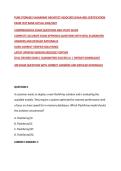
PURE STORAGE FLASHARRAY ARCHITECT ASSOCIATE (FAAA-005) CERTIFICATION
EXAM TEST BANK ACTUAL 2026/2027
COMPREHENSIVE EXAM QUESTIONS AND STUDY GUIDE
COMPLETE ACCURATE EXAM APPROVED QUESTIONS WITH WELL ELABORATED
ANSWERS AND DETAILED RATIONALES
(100% CORRECT VERIFIED SOLUTIONS)
LATEST UPDATED VERSION 2026/2027 EDITION
[FULL REVISED EXAM | GUARANTEED SUCCESS A+ | INSTANT DOWNLOAD]
200 EXAM QUESTIONS WITH CORRECT ANSWERS AND DETAILED RATIONALES
QUESTION 1
A customer wants to deploy a new FlashArray solution and is evaluating the
available models. They require a system optimized for extreme performance with
a focus on sheer speed for in-memory databases. Which FlashArray model should
the architect recommend?
A. FlashArray//X
B. FlashArray//C
C. FlashArray//ST
D. FlashArray//XL
CORRECT ANSWER: C
,Rationale: The FlashArray//ST is specifically engineered for extreme performance,
delivering up to 10 million IOPS with ultra-low latency for the most demanding
applications like in-memory databases, real-time applications, and large OLTP
databases . Other FlashArray models like the //X provide balanced performance,
while the //C is optimized for capacity and hybrid workloads.
QUESTION 2
Which two features are specific to the Evergreen//Forever Program and are NOT
included with Evergreen//Foundation? (Choose two.)
A. Controller Upgrades
B. Pro Deployment
C. Capacity Consolidation
D. Upgrade Always
CORRECT ANSWER: A, D
Rationale: Evergreen//Forever provides continuous innovation with controller
upgrades and the "Upgrade Always" benefit that ensures customers always run on
the latest technology. Evergreen//Foundation does not include these upgrade
features. While Pro Deployment and Capacity Consolidation are related to Pure
services, they are not the exclusive features that differentiate Evergreen//Forever
from the Foundation program. Controller upgrades and Upgrade Always are the
specific benefits tied to the Forever program.
QUESTION 3
,A company is planning to deploy a FlashArray at a greenfield site. They need 100
Gbps of consistent raw network throughput between the FlashArray and their
dedicated SAN switches, which support 25 Gbps per port. What is the minimum
number of Ethernet ports they should connect from the FlashArray to ensure both
throughput and resiliency?
A. 2
B. 4
C. 8
D. 16
CORRECT ANSWER: C
Rationale: To achieve 100 Gbps throughput with 25 Gbps ports, four ports are
required for the throughput alone. To ensure resiliency with redundant paths, this
number must be doubled to eight total ports. Two ports would only provide 50
Gbps with no redundancy, four ports would lack redundancy, and sixteen ports
would exceed the requirement unnecessarily.
QUESTION 4
A customer is running a FlashArray and wants to add a 46 TiB SQL workload with
an expected Data Reduction Ratio (DRR) of 3.85. How much physical capacity will
this SQL workload consume on the array after data reduction?
A. 12 TiB
B. 28 TiB
, C. 46 TiB
D. 177 TiB
CORRECT ANSWER: A
Rationale: The physical capacity consumed is calculated by dividing the logical
data size by the Data Reduction Ratio. 46 TiB ÷ 3.85 = approximately 11.95 TiB,
which rounds to 12 TiB . Data Reduction Ratio measures the effectiveness of
deduplication and compression in reducing the storage footprint, and the physical
capacity is what matters for array sizing.
QUESTION 5
What is the fastest way to duplicate volume data for a test/dev environment on a
FlashArray?
A. Mount the snapshot to a development host
B. Use a backup copy
C. Make a volume copy
D. Restore from a volume snapshot
CORRECT ANSWER: A
Rationale: Mounting a snapshot to a development host is the fastest way to
duplicate volume data for test/dev environments. This approach leverages space-
efficient snapshots without requiring additional storage or time-consuming copy
operations. Snapshots provide immediate access to point-in-time copies without
the overhead of copying or restoring data .
EXAM TEST BANK ACTUAL 2026/2027
COMPREHENSIVE EXAM QUESTIONS AND STUDY GUIDE
COMPLETE ACCURATE EXAM APPROVED QUESTIONS WITH WELL ELABORATED
ANSWERS AND DETAILED RATIONALES
(100% CORRECT VERIFIED SOLUTIONS)
LATEST UPDATED VERSION 2026/2027 EDITION
[FULL REVISED EXAM | GUARANTEED SUCCESS A+ | INSTANT DOWNLOAD]
200 EXAM QUESTIONS WITH CORRECT ANSWERS AND DETAILED RATIONALES
QUESTION 1
A customer wants to deploy a new FlashArray solution and is evaluating the
available models. They require a system optimized for extreme performance with
a focus on sheer speed for in-memory databases. Which FlashArray model should
the architect recommend?
A. FlashArray//X
B. FlashArray//C
C. FlashArray//ST
D. FlashArray//XL
CORRECT ANSWER: C
,Rationale: The FlashArray//ST is specifically engineered for extreme performance,
delivering up to 10 million IOPS with ultra-low latency for the most demanding
applications like in-memory databases, real-time applications, and large OLTP
databases . Other FlashArray models like the //X provide balanced performance,
while the //C is optimized for capacity and hybrid workloads.
QUESTION 2
Which two features are specific to the Evergreen//Forever Program and are NOT
included with Evergreen//Foundation? (Choose two.)
A. Controller Upgrades
B. Pro Deployment
C. Capacity Consolidation
D. Upgrade Always
CORRECT ANSWER: A, D
Rationale: Evergreen//Forever provides continuous innovation with controller
upgrades and the "Upgrade Always" benefit that ensures customers always run on
the latest technology. Evergreen//Foundation does not include these upgrade
features. While Pro Deployment and Capacity Consolidation are related to Pure
services, they are not the exclusive features that differentiate Evergreen//Forever
from the Foundation program. Controller upgrades and Upgrade Always are the
specific benefits tied to the Forever program.
QUESTION 3
,A company is planning to deploy a FlashArray at a greenfield site. They need 100
Gbps of consistent raw network throughput between the FlashArray and their
dedicated SAN switches, which support 25 Gbps per port. What is the minimum
number of Ethernet ports they should connect from the FlashArray to ensure both
throughput and resiliency?
A. 2
B. 4
C. 8
D. 16
CORRECT ANSWER: C
Rationale: To achieve 100 Gbps throughput with 25 Gbps ports, four ports are
required for the throughput alone. To ensure resiliency with redundant paths, this
number must be doubled to eight total ports. Two ports would only provide 50
Gbps with no redundancy, four ports would lack redundancy, and sixteen ports
would exceed the requirement unnecessarily.
QUESTION 4
A customer is running a FlashArray and wants to add a 46 TiB SQL workload with
an expected Data Reduction Ratio (DRR) of 3.85. How much physical capacity will
this SQL workload consume on the array after data reduction?
A. 12 TiB
B. 28 TiB
, C. 46 TiB
D. 177 TiB
CORRECT ANSWER: A
Rationale: The physical capacity consumed is calculated by dividing the logical
data size by the Data Reduction Ratio. 46 TiB ÷ 3.85 = approximately 11.95 TiB,
which rounds to 12 TiB . Data Reduction Ratio measures the effectiveness of
deduplication and compression in reducing the storage footprint, and the physical
capacity is what matters for array sizing.
QUESTION 5
What is the fastest way to duplicate volume data for a test/dev environment on a
FlashArray?
A. Mount the snapshot to a development host
B. Use a backup copy
C. Make a volume copy
D. Restore from a volume snapshot
CORRECT ANSWER: A
Rationale: Mounting a snapshot to a development host is the fastest way to
duplicate volume data for test/dev environments. This approach leverages space-
efficient snapshots without requiring additional storage or time-consuming copy
operations. Snapshots provide immediate access to point-in-time copies without
the overhead of copying or restoring data .


