Air Force Emergency Management Program Test with Answers Rated A
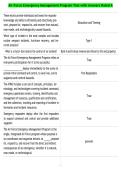
These ettorts provide individuals and teams the requisite
knowledge and skills to eflciently and ettectively pre-
Education and Training
vent, prepare for, respond to, and recover from natural,
man-made, and technologically-caused hazards.
Which type of incident is the most complex and includes
nuclear weapons incidents, hurricane recovery, and ter- Type 1
rorist attacks?
What is a factor that attects the control of an incident? Both A and B (Area involved and threat to life and property)
The Air Force Emergency Management Program relies on
True
everyone's participation for it to be successful.
deploy immediately to the scene to
provide initial command and control, to save lives, and to First Responders
suppress and control hazards.
The AFIMS includes a core set of concepts, principles, ter-
minology, and technologies covering incident command,
emergency operations centers, training, identification and
True
management of resources, qualification and certification,
and the collection, tracking and reporting of incident in-
formation and incident resources.
Emergency responders deploy after the first responders
to expand command and control and provide additional True
support.
The Air Force Emergency Management Program is the
single, integrated Air Force program whose purpose is
to coordinate and organize ettorts to , prepare
prevent
for, respond to, and recover from the direct and indirect
consequences of an emergency; whether it is natural,
man-made, or technological.
1/6
, Air Force Emergency Management Program Test with Answers Rated A
Originally created to help manage large numbers of peo-
ple and resources during wildfires in the 1970s, the
Incident Command System
was the system used throughout the United
States to organize emergency response.
This function of your installation's DRF is a command and
control node that assists in directing installation emer- Command Post
gency management and response actions.
The active and passive measures taken to protect the area,
population and infrastructure of the United States and its Homeland defense and civil support operations
possessions and territories.
The phases of the AFIMS are response, recovery, and
Mitigation
.
This function of your installation's planning and man-
agement statt collaborates with the installation's Oflce
of Emergency Management to ensure they have the ap-
Unit Emergency Management Representative
propriate information, products, and support needed to
execute and maintain a successful unit emergency man-
agement program.
National, DOD, and Air Force guidance requires the use of
True
ICS for all incident responses.
Led by the mission support group commander, this func-
tion is the integrator of your installation's strategic plan- Emergency Management Working Group
ning and management statt and the DRF elements.
Upon taking command of a unit, senior leaders are pro-
vided an AFEM immersion briefing on the installation's Installation's Oflce of Emergency Management
emergency management program by the .
The strategic planning and management statt at your
installation is comprised of four functions; the Oflce of Wing Inspection Team
Emergency Management, the Unit Emergency Manage-
2/6
These ettorts provide individuals and teams the requisite
knowledge and skills to eflciently and ettectively pre-
Education and Training
vent, prepare for, respond to, and recover from natural,
man-made, and technologically-caused hazards.
Which type of incident is the most complex and includes
nuclear weapons incidents, hurricane recovery, and ter- Type 1
rorist attacks?
What is a factor that attects the control of an incident? Both A and B (Area involved and threat to life and property)
The Air Force Emergency Management Program relies on
True
everyone's participation for it to be successful.
deploy immediately to the scene to
provide initial command and control, to save lives, and to First Responders
suppress and control hazards.
The AFIMS includes a core set of concepts, principles, ter-
minology, and technologies covering incident command,
emergency operations centers, training, identification and
True
management of resources, qualification and certification,
and the collection, tracking and reporting of incident in-
formation and incident resources.
Emergency responders deploy after the first responders
to expand command and control and provide additional True
support.
The Air Force Emergency Management Program is the
single, integrated Air Force program whose purpose is
to coordinate and organize ettorts to , prepare
prevent
for, respond to, and recover from the direct and indirect
consequences of an emergency; whether it is natural,
man-made, or technological.
1/6
, Air Force Emergency Management Program Test with Answers Rated A
Originally created to help manage large numbers of peo-
ple and resources during wildfires in the 1970s, the
Incident Command System
was the system used throughout the United
States to organize emergency response.
This function of your installation's DRF is a command and
control node that assists in directing installation emer- Command Post
gency management and response actions.
The active and passive measures taken to protect the area,
population and infrastructure of the United States and its Homeland defense and civil support operations
possessions and territories.
The phases of the AFIMS are response, recovery, and
Mitigation
.
This function of your installation's planning and man-
agement statt collaborates with the installation's Oflce
of Emergency Management to ensure they have the ap-
Unit Emergency Management Representative
propriate information, products, and support needed to
execute and maintain a successful unit emergency man-
agement program.
National, DOD, and Air Force guidance requires the use of
True
ICS for all incident responses.
Led by the mission support group commander, this func-
tion is the integrator of your installation's strategic plan- Emergency Management Working Group
ning and management statt and the DRF elements.
Upon taking command of a unit, senior leaders are pro-
vided an AFEM immersion briefing on the installation's Installation's Oflce of Emergency Management
emergency management program by the .
The strategic planning and management statt at your
installation is comprised of four functions; the Oflce of Wing Inspection Team
Emergency Management, the Unit Emergency Manage-
2/6