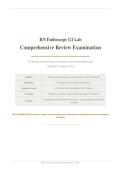
RN Endoscopy GI Lab
Comprehensive Review Examination
75 Original Clinical-Practice Questions with Detailed Rationales
2026/2027 Academic Year
Subject Gastroenterology Nursing - Endoscopy & GI Lab Procedures
Questions 75 Multiple-Choice (Single Best Answer)
Cognitive Level 30% Recall | 50% Application | 20% Analysis
Includes 3 Scenarios | 2 Mini-Cases | 2 Data Interpretation Questions
All questions include bold answer choices, correct answer, and detailed
Format
rationale
BOLD FORMATTING: All answer choices, correct answers, and rationales are displayed in bold text for emphasis
and clarity.
RN Endoscopy GI Lab Comprehensive Review | Page 1
,1. A patient is scheduled for an outpatient colonoscopy at 8:00 AM. The nurse instructs the
patient on nothing-by-mouth (NPO) guidelines. According to current pre-procedure
standards, which instruction is most accurate regarding oral intake before the procedure?
A. Clear liquids are permitted up to 4 hours before the scheduled procedure time
B. Solid foods must be stopped 8 hours before the procedure; clear liquids up to 2 hours
before [CORRECT]
C. A full liquid diet is acceptable until 6 hours before the scheduled procedure
D. NPO status should begin at midnight the night before with no exceptions
Correct Answer: B
Rationale: Correct because current American Society of Anesthesiologists (ASA) guidelines permit clear
liquids up to 2 hours before procedures requiring sedation, while solid foods must be stopped at least 8 hours
before. Priority is reducing aspiration risk while maintaining patient hydration and comfort.
2. A 68-year-old patient with chronic kidney disease stage 3 is scheduled for a screening
colonoscopy. The gastroenterologist prescribes a bowel preparation regimen. The nurse
should anticipate which bowel prep agent may be contraindicated for this patient?
A. Polyethylene glycol 3350 (PEG) with electrolytes (Golytely)
B. Sodium phosphate (NaP) oral solution [CORRECT]
C. Polyethylene glycol 3350 with ascorbic acid (MoviPrep)
D. Sulfate-free polyethylene glycol (Plenvu)
Correct Answer: B
Rationale: Correct because sodium phosphate bowel preparations carry a risk of acute phosphate
nephropathy, especially in patients with preexisting renal impairment. This matches the FDA black box
warning against using NaP preparations in patients with chronic kidney disease. Priority is selecting the
safest bowel prep for the patient's renal function.
3. A nurse is caring for a patient 4 hours post-endoscopic retrograde
cholangiopancreatography (ERCP) with sphincterotomy. The patient reports new-onset
epigastric pain radiating to the back, rated 7/10, and has a temperature of 38.2 degrees C
(100.8 degrees F). Which interpretation by the nurse is most appropriate?
A. The patient is experiencing expected post-procedure discomfort and should receive
prescribed analgesics
B. The findings suggest potential post-ERCP pancreatitis, and the nurse should notify the
physician immediately [CORRECT]
C. The temperature elevation indicates a mild infection that can be monitored with
acetaminophen
D. The pain is likely from residual air insufflation and positional changes should relieve it
Correct Answer: B
Rationale: Correct because new-onset epigastric pain radiating to the back combined with low-grade fever
following ERCP with sphincterotomy are classic signs of post-ERCP pancreatitis, the most common major
complication. This matches the requirement for immediate physician notification and potential intervention
RN Endoscopy GI Lab Comprehensive Review | Page 2
, with aggressive IV fluid resuscitation. Priority is recognizing early signs of a potentially life-threatening
complication.
4. During a moderate sedation protocol for an upper endoscopy, the nurse administers
midazolam (Versed) and fentanyl as ordered. Which medication characteristic makes
midazolam the preferred benzodiazepine for procedural sedation in the GI lab?
A. It has a slower onset of action than diazepam, allowing for gradual titration
B. It produces predictable amnesia with a shorter half-life than diazepam [CORRECT]
C. It provides deeper analgesic effects than fentanyl when combined
D. It has no effect on respiratory drive, making it the safest sedative agent
Correct Answer: B
Rationale: Correct because midazolam has a shorter elimination half-life (1-4 hours) compared to diazepam
(20-50 hours) and produces reliable anterograde amnesia, which is desirable for procedural sedation. This
matches pharmacologic principles guiding sedation selection in the endoscopy setting. Priority is selecting
agents that provide effective sedation with rapid recovery.
5. A 72-year-old patient taking rivaroxaban (Xarelto) 20 mg daily for atrial fibrillation is
scheduled for a colonoscopy with anticipated polypectomy. The gastroenterologist plans to
perform the polypectomy during the procedure. The nurse reviews the anticoagulation
management plan. Which timing for holding rivaroxaban is most consistent with current
guidelines?
A. Hold rivaroxaban for 24 hours before the procedure; resume 6 hours post-procedure if
hemostasis is achieved [CORRECT]
B. Hold rivaroxaban for 48 hours before the procedure; resume 24 hours post-procedure
regardless of bleeding
C. Continue rivaroxaban without interruption as the procedure is low risk for bleeding
D. Hold rivaroxaban for 5-7 days before the procedure and bridge with heparin
Correct Answer: A
Rationale: Correct because for high bleeding risk procedures such as polypectomy, current GI society
guidelines recommend holding direct oral anticoagulants (DOACs) like rivaroxaban for 24-48 hours
depending on renal function and bleeding risk. This matches consensus guidelines from ASGE and ACG for
antithrombotic management before endoscopic procedures. Priority is balancing thromboembolic risk
against procedural bleeding risk.
6. During an esophagogastroduodenoscopy (EGD), the endoscopist advances the scope and
visualizes the greater curvature of the stomach. The nurse assisting with the procedure
understands that the greater curvature of the stomach is located on which side of the
stomach body?
A. The right side of the stomach when viewed from the front of the patient
B. The left side of the stomach when viewed from the front of the patient [CORRECT]
C. The anterior wall of the stomach
RN Endoscopy GI Lab Comprehensive Review | Page 3
, D. The posterior wall of the stomach
Correct Answer: B
Rationale: Correct because the greater curvature forms the left (lateral) border of the stomach when viewed
anatomically from the anterior perspective. This matches standard GI anatomy essential for the endoscopy
nurse to understand scope orientation and anatomical landmarks during EGD. Priority is accurate
anatomical knowledge for procedural assistance.
7. A nurse is monitoring a 55-year-old patient undergoing propofol sedation for an ERCP. The
patient's oxygen saturation drops from 98% to 91%, respiratory rate decreases to 8 breaths
per minute, and the capnography waveform shows a flattened end-tidal CO2 tracing. Which
nursing intervention should the nurse perform FIRST?
A. Administer flumazenil (Romazicon) intravenously as reversal agent
B. Perform chin-lift maneuver, apply supplemental oxygen, and prepare for assisted
ventilation [CORRECT]
C. Increase the propofol infusion rate to deepen sedation and reduce patient movement
D. Document the findings and continue monitoring at 5-minute intervals
Correct Answer: B
Rationale: Correct because the patient demonstrates signs of respiratory depression during deep sedation
with propofol. The airway should be opened with a chin-lift, oxygen supplemented immediately, and
equipment for assisted ventilation readied. This matches the basic airway management algorithm used in
procedural sedation. Priority is maintaining adequate oxygenation and ventilation as the first-line response.
8. The GI lab nurse is responsible for ensuring proper reprocessing of endoscopes between
patients. According to current guidelines for endoscope reprocessing, which step must
immediately follow the cleaning phase in the reprocessing workflow?
A. Drying the endoscope with forced air and storing in a vertical position
B. Performing high-level disinfection (HLD) using an approved chemical agent [CORRECT]
C. Inspecting the endoscope channels for residual organic material
D. Placing the endoscope in a protective storage cabinet for 24 hours
Correct Answer: B
Rationale: Correct because the mandatory sequence for endoscope reprocessing is: precleaning at bedside,
leakage testing, manual cleaning with enzymatic detergent, then high-level disinfection (HLD). This matches
current multi-society guidelines for flexible endoscope reprocessing from SGNA, ASGE, and the CDC.
Priority is following the correct reprocessing sequence to prevent cross-contamination.
9. A 45-year-old man presents to the emergency department after ingesting a chicken bone 2
hours ago. He reports odynophagia and the sensation of something stuck in his throat. An
X-ray reveals a radiopaque foreign body in the upper esophagus. Which nursing intervention
is most appropriate while preparing for urgent endoscopic removal?
A. Encourage the patient to drink water and eat bread to help push the bone through the GI
tract
RN Endoscopy GI Lab Comprehensive Review | Page 4
Comprehensive Review Examination
75 Original Clinical-Practice Questions with Detailed Rationales
2026/2027 Academic Year
Subject Gastroenterology Nursing - Endoscopy & GI Lab Procedures
Questions 75 Multiple-Choice (Single Best Answer)
Cognitive Level 30% Recall | 50% Application | 20% Analysis
Includes 3 Scenarios | 2 Mini-Cases | 2 Data Interpretation Questions
All questions include bold answer choices, correct answer, and detailed
Format
rationale
BOLD FORMATTING: All answer choices, correct answers, and rationales are displayed in bold text for emphasis
and clarity.
RN Endoscopy GI Lab Comprehensive Review | Page 1
,1. A patient is scheduled for an outpatient colonoscopy at 8:00 AM. The nurse instructs the
patient on nothing-by-mouth (NPO) guidelines. According to current pre-procedure
standards, which instruction is most accurate regarding oral intake before the procedure?
A. Clear liquids are permitted up to 4 hours before the scheduled procedure time
B. Solid foods must be stopped 8 hours before the procedure; clear liquids up to 2 hours
before [CORRECT]
C. A full liquid diet is acceptable until 6 hours before the scheduled procedure
D. NPO status should begin at midnight the night before with no exceptions
Correct Answer: B
Rationale: Correct because current American Society of Anesthesiologists (ASA) guidelines permit clear
liquids up to 2 hours before procedures requiring sedation, while solid foods must be stopped at least 8 hours
before. Priority is reducing aspiration risk while maintaining patient hydration and comfort.
2. A 68-year-old patient with chronic kidney disease stage 3 is scheduled for a screening
colonoscopy. The gastroenterologist prescribes a bowel preparation regimen. The nurse
should anticipate which bowel prep agent may be contraindicated for this patient?
A. Polyethylene glycol 3350 (PEG) with electrolytes (Golytely)
B. Sodium phosphate (NaP) oral solution [CORRECT]
C. Polyethylene glycol 3350 with ascorbic acid (MoviPrep)
D. Sulfate-free polyethylene glycol (Plenvu)
Correct Answer: B
Rationale: Correct because sodium phosphate bowel preparations carry a risk of acute phosphate
nephropathy, especially in patients with preexisting renal impairment. This matches the FDA black box
warning against using NaP preparations in patients with chronic kidney disease. Priority is selecting the
safest bowel prep for the patient's renal function.
3. A nurse is caring for a patient 4 hours post-endoscopic retrograde
cholangiopancreatography (ERCP) with sphincterotomy. The patient reports new-onset
epigastric pain radiating to the back, rated 7/10, and has a temperature of 38.2 degrees C
(100.8 degrees F). Which interpretation by the nurse is most appropriate?
A. The patient is experiencing expected post-procedure discomfort and should receive
prescribed analgesics
B. The findings suggest potential post-ERCP pancreatitis, and the nurse should notify the
physician immediately [CORRECT]
C. The temperature elevation indicates a mild infection that can be monitored with
acetaminophen
D. The pain is likely from residual air insufflation and positional changes should relieve it
Correct Answer: B
Rationale: Correct because new-onset epigastric pain radiating to the back combined with low-grade fever
following ERCP with sphincterotomy are classic signs of post-ERCP pancreatitis, the most common major
complication. This matches the requirement for immediate physician notification and potential intervention
RN Endoscopy GI Lab Comprehensive Review | Page 2
, with aggressive IV fluid resuscitation. Priority is recognizing early signs of a potentially life-threatening
complication.
4. During a moderate sedation protocol for an upper endoscopy, the nurse administers
midazolam (Versed) and fentanyl as ordered. Which medication characteristic makes
midazolam the preferred benzodiazepine for procedural sedation in the GI lab?
A. It has a slower onset of action than diazepam, allowing for gradual titration
B. It produces predictable amnesia with a shorter half-life than diazepam [CORRECT]
C. It provides deeper analgesic effects than fentanyl when combined
D. It has no effect on respiratory drive, making it the safest sedative agent
Correct Answer: B
Rationale: Correct because midazolam has a shorter elimination half-life (1-4 hours) compared to diazepam
(20-50 hours) and produces reliable anterograde amnesia, which is desirable for procedural sedation. This
matches pharmacologic principles guiding sedation selection in the endoscopy setting. Priority is selecting
agents that provide effective sedation with rapid recovery.
5. A 72-year-old patient taking rivaroxaban (Xarelto) 20 mg daily for atrial fibrillation is
scheduled for a colonoscopy with anticipated polypectomy. The gastroenterologist plans to
perform the polypectomy during the procedure. The nurse reviews the anticoagulation
management plan. Which timing for holding rivaroxaban is most consistent with current
guidelines?
A. Hold rivaroxaban for 24 hours before the procedure; resume 6 hours post-procedure if
hemostasis is achieved [CORRECT]
B. Hold rivaroxaban for 48 hours before the procedure; resume 24 hours post-procedure
regardless of bleeding
C. Continue rivaroxaban without interruption as the procedure is low risk for bleeding
D. Hold rivaroxaban for 5-7 days before the procedure and bridge with heparin
Correct Answer: A
Rationale: Correct because for high bleeding risk procedures such as polypectomy, current GI society
guidelines recommend holding direct oral anticoagulants (DOACs) like rivaroxaban for 24-48 hours
depending on renal function and bleeding risk. This matches consensus guidelines from ASGE and ACG for
antithrombotic management before endoscopic procedures. Priority is balancing thromboembolic risk
against procedural bleeding risk.
6. During an esophagogastroduodenoscopy (EGD), the endoscopist advances the scope and
visualizes the greater curvature of the stomach. The nurse assisting with the procedure
understands that the greater curvature of the stomach is located on which side of the
stomach body?
A. The right side of the stomach when viewed from the front of the patient
B. The left side of the stomach when viewed from the front of the patient [CORRECT]
C. The anterior wall of the stomach
RN Endoscopy GI Lab Comprehensive Review | Page 3
, D. The posterior wall of the stomach
Correct Answer: B
Rationale: Correct because the greater curvature forms the left (lateral) border of the stomach when viewed
anatomically from the anterior perspective. This matches standard GI anatomy essential for the endoscopy
nurse to understand scope orientation and anatomical landmarks during EGD. Priority is accurate
anatomical knowledge for procedural assistance.
7. A nurse is monitoring a 55-year-old patient undergoing propofol sedation for an ERCP. The
patient's oxygen saturation drops from 98% to 91%, respiratory rate decreases to 8 breaths
per minute, and the capnography waveform shows a flattened end-tidal CO2 tracing. Which
nursing intervention should the nurse perform FIRST?
A. Administer flumazenil (Romazicon) intravenously as reversal agent
B. Perform chin-lift maneuver, apply supplemental oxygen, and prepare for assisted
ventilation [CORRECT]
C. Increase the propofol infusion rate to deepen sedation and reduce patient movement
D. Document the findings and continue monitoring at 5-minute intervals
Correct Answer: B
Rationale: Correct because the patient demonstrates signs of respiratory depression during deep sedation
with propofol. The airway should be opened with a chin-lift, oxygen supplemented immediately, and
equipment for assisted ventilation readied. This matches the basic airway management algorithm used in
procedural sedation. Priority is maintaining adequate oxygenation and ventilation as the first-line response.
8. The GI lab nurse is responsible for ensuring proper reprocessing of endoscopes between
patients. According to current guidelines for endoscope reprocessing, which step must
immediately follow the cleaning phase in the reprocessing workflow?
A. Drying the endoscope with forced air and storing in a vertical position
B. Performing high-level disinfection (HLD) using an approved chemical agent [CORRECT]
C. Inspecting the endoscope channels for residual organic material
D. Placing the endoscope in a protective storage cabinet for 24 hours
Correct Answer: B
Rationale: Correct because the mandatory sequence for endoscope reprocessing is: precleaning at bedside,
leakage testing, manual cleaning with enzymatic detergent, then high-level disinfection (HLD). This matches
current multi-society guidelines for flexible endoscope reprocessing from SGNA, ASGE, and the CDC.
Priority is following the correct reprocessing sequence to prevent cross-contamination.
9. A 45-year-old man presents to the emergency department after ingesting a chicken bone 2
hours ago. He reports odynophagia and the sensation of something stuck in his throat. An
X-ray reveals a radiopaque foreign body in the upper esophagus. Which nursing intervention
is most appropriate while preparing for urgent endoscopic removal?
A. Encourage the patient to drink water and eat bread to help push the bone through the GI
tract
RN Endoscopy GI Lab Comprehensive Review | Page 4