

Written by students who passed Immediately available after payment Read online or as PDF Wrong document? Swap it for free 4.6 TrustPilot
logo-home
Document preview thumbnail
Preview 2 out of 9 pages
Exam (elaborations)

NURS 1020 Nutrition Exam 2026/2027 | 30+ Questions & Answers | GERD, PUD, H. pylori & Enteral/Parenteral Nutrition

Document preview thumbnail
Preview 2 out of 9 pages

This NURS 1020 Nutrition Exam 2026/2027 study resource contains 30+ exam questions with answers covering gastrointestinal disorders, nutrition support, pharmacologic management, diagnostic testing, complications, and patient education. Across 9 pages, the document concentrates on gastroesophageal reflux disease (GERD), peptic ulcer disease (PUD), gastric and duodenal ulcers, Helicobacter pylori, enteral feeding, and parenteral nutrition, making it particularly useful for nursing students preparing for nutrition, gastrointestinal, or medical-surgical nursing examinations. The GERD section reviews pathophysiology, risk factors, clinical manifestations, diagnostic studies, complications, lifestyle interventions, medications, and surgical treatment. Students encounter upper GI endoscopy, barium swallow/esophagram, manometry, pH monitoring, pyrosis, dyspepsia, regurgitation, lower esophageal sphincter dysfunction, esophagitis, Barrett's esophagus, respiratory complications, and dental erosion. Patient-teaching concepts include meal size, dietary fat, caffeine and alcohol avoidance, smoking cessation, remaining upright after meals, weight management, and head-of-bed elevation. The resource also examines GERD treatment through proton pump inhibitors (PPIs), H2-receptor blockers, antacids, and prokinetic agents, including examples such as omeprazole, pantoprazole, famotidine, and Mylanta. Surgical management includes Nissen and Toupet fundoplication and the LINX reflux-management system. This section connects treatment modalities with their mechanisms, such as suppression or neutralization of gastric acid and enhancement of gastrointestinal motility. The PUD and H. pylori section differentiates acute versus chronic peptic ulcer disease and gastric versus duodenal ulcers. It reviews contributing factors such as H. pylori, NSAID exposure, corticosteroids, anticoagulants, smoking, alcohol, caffeine, and psychological distress. Pharmacologic content includes famotidine, omeprazole, sucralfate, metronidazole, amoxicillin, antacids, and prokinetics, with attention to mechanisms of action, administration considerations, and selected adverse effects. Complications covered include perforation and gastric outlet obstruction, along with associated nursing management concepts. The final portion expands beyond gastrointestinal disease into clinical nutrition support. It reviews nasogastric, nasojejunal/nasoduodenal, gastrostomy and jejunostomy feeding routes; indications for longer-term tube feeding; the importance of an intact gastrointestinal tract; and differences between central and peripheral parenteral nutrition (PN). This combination of disease management and nutritional-support concepts makes the document relevant to both nutrition coursework and broader adult-health nursing preparation. Relevant Students: This document is most relevant to NURS 1020 students, undergraduate nursing students, BSN and ADN students, practical nursing students, nutrition students, medical-surgical nursing students, adult-health nursing students, RN students, and nursing students reviewing gastrointestinal disorders and clinical nutrition support. No university or college is identified in the uploaded document, so adding a specific institution to the title would be inaccurate. Referenced Academic/Clinical Material: The document covers established nursing and gastrointestinal concepts involving GERD, PUD, H. pylori, acid-suppressive pharmacotherapy, enteral nutrition, and parenteral nutrition. However, the uploaded material does not provide a complete citation for a textbook, peer-reviewed journal article, or clinical guideline. Therefore, attributing it to a specific book or journal without evidence would be inappropriate. Students should also compare medication regimens, contraindications, and clinical recommendations with their current 2026/2027 course resources because clinical guidance can change. Keywords: NURS 1020 Nutrition Exam, NURS 1020 Nutrition 2026, NURS 1020 Nutrition 2027, NURS 1020 exam questions and answers, NURS 1020 study guide, nursing nutrition exam, nutrition exam questions, GERD nursing, gastroesophageal reflux disease, GERD questions and answers, GERD symptoms, GERD treatment, GERD patient education, GERD diagnostic tests, Barrett esophagus, lower esophageal sphincter, pyrosis, heartburn, peptic ulcer disease, PUD nursing, PUD questions and answers, gastric ulcer, duodenal ulcer, Helicobacter pylori, H pylori treatment, NSAID induced ulcers, proton pump inhibitors, PPIs, omeprazole, pantoprazole, H2 blockers, famotidine, antacids, sucralfate, amoxicillin, metronidazole, prokinetics, Nissen fundoplication, Toupet fundoplication, LINX procedure, gastric perforation, gastric outlet obstruction, enteral nutrition, enteral feeding tubes, nasogastric tube, gastrostomy tube, jejunostomy tube, parenteral nutrition, central parenteral nutrition, peripheral parenteral nutrition, medical surgical nursing, adult health nursing, nursing exam preparation

Content preview

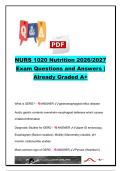
NURS 1020 Nutrition 2026/2027
Exam Questions and Answers |
Already Graded A+


What is GERD? - ANSWER ✔✔gastroesophageal reflux disease


Acidic gastric contents overwhelm esophageal defenses which causes

irritation/inflmmation


Diagnostic Studies for GERD - ANSWER ✔✔Upper GI endoscopy,

Esophagram (Barium swallow), Motility (Manometry) studies, pH

monitor, radionuclide studies


Most common sign of GERD - ANSWER ✔✔Pyrosis (Heartburn)

, Manifestations of Pyrosis - ANSWER ✔✔Burning, tight sensation

over lower sternum that radiates into jaw, mimics signs of angina but is

relieved by antacid


Other common signs of GERD - ANSWER ✔✔Dyspepsia:

pain/discomfort in upper abdomen

Regurgitation: hot, butter, sour liquid in mouth throat

Respiratory issues: wheezing, coughing, dyspnea, nighttime

disturbances, sore throat, lump in throat, choking increased saliva


Primary Risk Factor for GERD - ANSWER ✔✔Incompetent LES

(lower esophageal sphincter)


Complications of GERD (4) - ANSWER ✔✔Esophagitis: Ulcerations

may lead to scar tissue, stricture, dysphasia

Barrett's Esophagus (BE): metaplasia of cells, increase risk for cancer

Respiratory issues (cough, bronchospasm, laryngospasm, can lead to

chronic bronchitis, pneumonia)

Dental Erosion


Recommendations for patient care/teaching - ANSWER

✔✔Encourage changes in diet/lifestyle

Document information

Uploaded on
August 9, 2026
Number of pages
9
Written in
2026/2027
Type
Exam (elaborations)
Contains
Questions & answers
$18.99

Wrong document? Swap it for free Within 14 days of purchase and before downloading, you can choose a different document. You can simply spend the amount again.
Written by students who passed
Immediately available after payment
Read online or as PDF

Seller avatar
Reputation scores are based on the amount of documents a seller has sold for a fee and the reviews they have received for those documents. There are three levels: Bronze, Silver and Gold. The better the reputation, the more your can rely on the quality of the sellers work.
NinjaNerd
3.4
(76)
Sold
395
Followers
6
Items
15309
Last sold
13 hours ago


Why students choose Stuvia

Created by fellow students, verified by reviews

Quality you can trust: written by students who passed their tests and reviewed by others who've used these notes.

Didn't get what you expected? Choose another document

No worries! You can instantly pick a different document that better fits what you're looking for.

Pay as you like, start learning right away

No subscription, no commitments. Pay the way you're used to via credit card and download your PDF document instantly.

Student with book image

“Bought, downloaded, and aced it. It really can be that simple.”

Alisha Student

Working on your references?

Create accurate citations in APA, MLA and Harvard with our free citation generator.

Working on your references?

Frequently asked questions

