

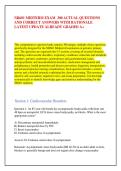
NR601 MIDTERM EXAM 300 ACTUAL QUESTIONS
AND CORRECT ANSWERS WITH RATIONALE
LATEST UPDATE ALREADY GRADED A+
This comprehensive question bank contains 300 unique, multiple-choice questions
specifically designed for the NR601 Midterm Examination in geriatric primary
care. The questions are organized into 15 sections covering all essential domains
including cardiovascular disorders, respiratory conditions, endocrine and metabolic
disorders, geriatric syndromes, genitourinary and gastrointestinal issues,
neuropsychiatric and musculoskeletal disorders, medication management and
polypharmacy, health promotion and disease prevention, diagnostic interpretation,
and advanced practice nursing considerations. Each question includes a correct
answer and a detailed rationale explaining the clinical reasoning. This resource is
ideal for self-assessment, targeted review, and exam preparation. Use this bank
systematically to identify knowledge gaps and reinforce understanding for the
NR601 midterm.
Section 1: Cardiovascular Disorders
Question 1: An 85-year-old female has asymptomatic bradycardia with heart rate
48 bpm on metoprolol. ECG shows sinus bradycardia, no blocks. What is the most
appropriate action?
A) Discontinue metoprolol immediately
B) Reduce metoprolol dose by 50%
C) Insert a pacemaker
D) Continue current dose if asymptomatic
Answer: D) Continue current dose if asymptomatic
Rationale: Asymptomatic sinus bradycardia (HR 40-50) in an older adult on beta-
blockers is generally benign and does not require dose change or pacemaker
,insertion. Older adults often tolerate lower heart rates well, and beta-blocker
therapy is typically continued for its cardioprotective benefits. Routine
discontinuation or reduction could precipitate rebound tachycardia or ischemia .
Question 2: A 72-year-old female with HTN and DM has LDL 190 mg/dL. What
statin intensity is recommended?
A) No statin
B) Low-intensity
C) Moderate-intensity
D) High-intensity
Answer: D) High-intensity
Rationale: LDL ≥190 mg/dL warrants high-intensity statin therapy (atorvastatin
40-80 mg or rosuvastatin 20-40 mg) regardless of risk score. This patient has
multiple risk factors including hypertension and diabetes, putting her at very high
ASCVD risk. High-intensity statins provide approximately 50% or greater LDL
reduction and are the standard of care .
Question 3: A 78-year-old male reports leg pain with walking that resolves after 2
minutes of rest. He has diminished dorsalis pedis pulses. What is the most likely
diagnosis?
A) Spinal stenosis
B) Peripheral artery disease (PAD)
C) Diabetic neuropathy
D) Osteoarthritis
Answer: B) Peripheral artery disease (PAD)
Rationale: Intermittent claudication (pain with walking, relief with rest) with
diminished pulses is classic for PAD. Ankle-brachial index <0.90 confirms the
diagnosis. Unlike spinal stenosis (which often causes pain with extension and relief
with flexion), PAD symptoms are exertional and reproducible. Diabetic neuropathy
typically causes burning or tingling, not exertional pain .
Question 4: A 70-year-old female with HTN has BP 168/94. She has no symptoms.
What is the initial treatment?
,A) Admit to hospital for IV hydralazine
B) Start amlodipine 5 mg daily and follow up in 1 week
C) Start clonidine 0.2 mg stat
D) Recheck BP in 1 month
Answer: B) Start amlodipine 5 mg daily and follow up in 1 week
Rationale: Asymptomatic hypertension (hypertensive urgency) does not require
emergency treatment. Oral antihypertensive with outpatient follow-up is
appropriate. Calcium channel blockers like amlodipine are effective first-line
agents in older adults, particularly those with isolated systolic hypertension.
Clonidine has rebound hypertension risk and should be avoided as first-line
therapy .
Question 5: An 86-year-old female on rivaroxaban for AF has gross hematuria. BP
105/65, Hgb 11.8 (stable from 12.0). What is the most appropriate management?
A) Stop rivaroxaban immediately
B) Continue rivaroxaban, evaluate hematuria cause
C) Administer vitamin K
D) Transfuse 2 units PRBCs
Answer: B) Continue rivaroxaban, evaluate hematuria cause
Rationale: Hematuria without significant bleeding (stable Hgb, stable BP) does not
require stopping DOAC therapy. The appropriate management is to continue the
direct oral anticoagulant and evaluate for UTI, stones, or malignancy. Rivaroxaban
does not require routine monitoring and stopping it could precipitate a thrombotic
event .
Question 6: A 78-year-old male has claudication after 1 block. ABI is 0.55. What
is first-line therapy to improve walking distance?
A) Aspirin and statin
B) Cilostazol
C) Warfarin
D) Surgical bypass
Answer: B) Cilostazol
, Rationale: Cilostazol improves walking distance in PAD by inhibiting platelet
aggregation and vasodilation. Aspirin and statins reduce cardiovascular events but
do not directly improve claudication symptoms. Surgical bypass is reserved for
severe, lifestyle-limiting claudication or critical limb ischemia. Cilostazol is
contraindicated in heart failure due to increased mortality risk .
Question 7: A 77-year-old female has asymptomatic severe aortic stenosis (valve
area 0.7 cm², peak velocity 4.0 m/s). What is the appropriate management?
A) Surgical AVR immediately
B) TAVR immediately
C) Echocardiogram in 6 months with symptom monitoring
D) Medical management with ACE inhibitors
Answer: C) Echocardiogram in 6 months with symptom monitoring
Rationale: Asymptomatic severe aortic stenosis does not require immediate valve
replacement. Close monitoring with serial echocardiograms and symptom
assessment is appropriate. Valve replacement (surgical or TAVR) is indicated
when symptoms develop or ejection fraction decreases. ACE inhibitors are not
indicated and may cause hypotension in aortic stenosis .
Question 8: An 83-year-old male with AF on apixaban presents with a fall and
head strike. He has no neuro deficits. What is the most appropriate action?
A) Discharge home with observation
B) Head CT scan immediately
C) Stop apixaban for 48 hours
D) Administer vitamin K
Answer: B) Head CT scan immediately
Rationale: Any head strike in an anticoagulated patient requires immediate head
CT to rule out intracranial hemorrhage, even if asymptomatic. The risk of delayed
intracranial bleeding is significant in this population. Vitamin K is not indicated for
apixaban reversal in the absence of confirmed bleeding, and stopping apixaban
could precipitate a stroke .
AND CORRECT ANSWERS WITH RATIONALE
LATEST UPDATE ALREADY GRADED A+
This comprehensive question bank contains 300 unique, multiple-choice questions
specifically designed for the NR601 Midterm Examination in geriatric primary
care. The questions are organized into 15 sections covering all essential domains
including cardiovascular disorders, respiratory conditions, endocrine and metabolic
disorders, geriatric syndromes, genitourinary and gastrointestinal issues,
neuropsychiatric and musculoskeletal disorders, medication management and
polypharmacy, health promotion and disease prevention, diagnostic interpretation,
and advanced practice nursing considerations. Each question includes a correct
answer and a detailed rationale explaining the clinical reasoning. This resource is
ideal for self-assessment, targeted review, and exam preparation. Use this bank
systematically to identify knowledge gaps and reinforce understanding for the
NR601 midterm.
Section 1: Cardiovascular Disorders
Question 1: An 85-year-old female has asymptomatic bradycardia with heart rate
48 bpm on metoprolol. ECG shows sinus bradycardia, no blocks. What is the most
appropriate action?
A) Discontinue metoprolol immediately
B) Reduce metoprolol dose by 50%
C) Insert a pacemaker
D) Continue current dose if asymptomatic
Answer: D) Continue current dose if asymptomatic
Rationale: Asymptomatic sinus bradycardia (HR 40-50) in an older adult on beta-
blockers is generally benign and does not require dose change or pacemaker
,insertion. Older adults often tolerate lower heart rates well, and beta-blocker
therapy is typically continued for its cardioprotective benefits. Routine
discontinuation or reduction could precipitate rebound tachycardia or ischemia .
Question 2: A 72-year-old female with HTN and DM has LDL 190 mg/dL. What
statin intensity is recommended?
A) No statin
B) Low-intensity
C) Moderate-intensity
D) High-intensity
Answer: D) High-intensity
Rationale: LDL ≥190 mg/dL warrants high-intensity statin therapy (atorvastatin
40-80 mg or rosuvastatin 20-40 mg) regardless of risk score. This patient has
multiple risk factors including hypertension and diabetes, putting her at very high
ASCVD risk. High-intensity statins provide approximately 50% or greater LDL
reduction and are the standard of care .
Question 3: A 78-year-old male reports leg pain with walking that resolves after 2
minutes of rest. He has diminished dorsalis pedis pulses. What is the most likely
diagnosis?
A) Spinal stenosis
B) Peripheral artery disease (PAD)
C) Diabetic neuropathy
D) Osteoarthritis
Answer: B) Peripheral artery disease (PAD)
Rationale: Intermittent claudication (pain with walking, relief with rest) with
diminished pulses is classic for PAD. Ankle-brachial index <0.90 confirms the
diagnosis. Unlike spinal stenosis (which often causes pain with extension and relief
with flexion), PAD symptoms are exertional and reproducible. Diabetic neuropathy
typically causes burning or tingling, not exertional pain .
Question 4: A 70-year-old female with HTN has BP 168/94. She has no symptoms.
What is the initial treatment?
,A) Admit to hospital for IV hydralazine
B) Start amlodipine 5 mg daily and follow up in 1 week
C) Start clonidine 0.2 mg stat
D) Recheck BP in 1 month
Answer: B) Start amlodipine 5 mg daily and follow up in 1 week
Rationale: Asymptomatic hypertension (hypertensive urgency) does not require
emergency treatment. Oral antihypertensive with outpatient follow-up is
appropriate. Calcium channel blockers like amlodipine are effective first-line
agents in older adults, particularly those with isolated systolic hypertension.
Clonidine has rebound hypertension risk and should be avoided as first-line
therapy .
Question 5: An 86-year-old female on rivaroxaban for AF has gross hematuria. BP
105/65, Hgb 11.8 (stable from 12.0). What is the most appropriate management?
A) Stop rivaroxaban immediately
B) Continue rivaroxaban, evaluate hematuria cause
C) Administer vitamin K
D) Transfuse 2 units PRBCs
Answer: B) Continue rivaroxaban, evaluate hematuria cause
Rationale: Hematuria without significant bleeding (stable Hgb, stable BP) does not
require stopping DOAC therapy. The appropriate management is to continue the
direct oral anticoagulant and evaluate for UTI, stones, or malignancy. Rivaroxaban
does not require routine monitoring and stopping it could precipitate a thrombotic
event .
Question 6: A 78-year-old male has claudication after 1 block. ABI is 0.55. What
is first-line therapy to improve walking distance?
A) Aspirin and statin
B) Cilostazol
C) Warfarin
D) Surgical bypass
Answer: B) Cilostazol
, Rationale: Cilostazol improves walking distance in PAD by inhibiting platelet
aggregation and vasodilation. Aspirin and statins reduce cardiovascular events but
do not directly improve claudication symptoms. Surgical bypass is reserved for
severe, lifestyle-limiting claudication or critical limb ischemia. Cilostazol is
contraindicated in heart failure due to increased mortality risk .
Question 7: A 77-year-old female has asymptomatic severe aortic stenosis (valve
area 0.7 cm², peak velocity 4.0 m/s). What is the appropriate management?
A) Surgical AVR immediately
B) TAVR immediately
C) Echocardiogram in 6 months with symptom monitoring
D) Medical management with ACE inhibitors
Answer: C) Echocardiogram in 6 months with symptom monitoring
Rationale: Asymptomatic severe aortic stenosis does not require immediate valve
replacement. Close monitoring with serial echocardiograms and symptom
assessment is appropriate. Valve replacement (surgical or TAVR) is indicated
when symptoms develop or ejection fraction decreases. ACE inhibitors are not
indicated and may cause hypotension in aortic stenosis .
Question 8: An 83-year-old male with AF on apixaban presents with a fall and
head strike. He has no neuro deficits. What is the most appropriate action?
A) Discharge home with observation
B) Head CT scan immediately
C) Stop apixaban for 48 hours
D) Administer vitamin K
Answer: B) Head CT scan immediately
Rationale: Any head strike in an anticoagulated patient requires immediate head
CT to rule out intracranial hemorrhage, even if asymptomatic. The risk of delayed
intracranial bleeding is significant in this population. Vitamin K is not indicated for
apixaban reversal in the absence of confirmed bleeding, and stopping apixaban
could precipitate a stroke .


