

Science Car test
Science Car test
Study online at https://quizlet.com/_4mtj3z
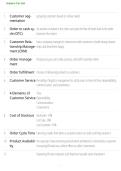
1. Customer seg- grouping customers based on similar needs
mentation
2. Order to cash cy- all activities included in the order cycle plus the flow of funds back to the seller
cle (OTC) based on the invoice
3. Customer Rela- how a company manages its interactions with customers to build strong relation-
tionship Manage- ships and keep them happy.
ment (CRM)
4. Order manage- the process you use to take, process, and fulfill customer orders
ment
5. Order fulfillment Process of delivering products to customers.
6. Customer Service the ability of logistics management to satisfy users in terms of time, dependability,
communication, and convenience
7. 4 Elements of Time
Customer Service Dependability
Communications
Convenience
8. Cost of Stockout Backorder- 70%
Lost Sale- 20%
Lost Customer- 10%
9. Order Cycle Time how long it takes from when a customer places an order until they receive it
10. Product Availabil- the capacity to have inventory present when and where it is desired by a customer.
ity Increasing fill rates has a direct effect on seller's inventories.
11. Improving fill rates improves cash flow but may take some investment
1/5
, Science Car test
Science Car test
Study online at https://quizlet.com/_4mtj3z
Financial Impact
on Product Avail-
ability
12. Logistics Inter- Minimize total cost, given customer service objective, and putting a cost on each
face phase needed to complete order.
13. Marketing Objec- Allocate resources to the marketing mix to maximize long-term profitability of the
tives firm
14. Pull vs. Push The "pull" approach relies on customer orders to move product through a logistics
system, while the "push" approach uses inventory replenishment techniques in
anticipation of demand to move products
15. Economic Order The ideal number of items a company should order at once to keep costs low.
Quantity
16. Limitation of EOC Assumes consumer demand is constant
17. Reorder point The inventory level that signals the need to place a new order
18. Just-In-Time (JIT) An inventory-management approach in which supplies arrive just when needed
for production or resale
19. Materials Re- Begins by determining how much end products customers desire and when they
quirements Plan- are needed
ning (MRP)
20. order interval a fixed time period that passes between inventory reviews
21. Cycle Stocks the items a business keeps in stock for everyday sales
22. Safety Stocks The amount of extra inventory kept on hand to avoid stockouts.
23. Seasonal Stocks produced and stockpiled in anticipation of future demand
2/5
Science Car test
Study online at https://quizlet.com/_4mtj3z
1. Customer seg- grouping customers based on similar needs
mentation
2. Order to cash cy- all activities included in the order cycle plus the flow of funds back to the seller
cle (OTC) based on the invoice
3. Customer Rela- how a company manages its interactions with customers to build strong relation-
tionship Manage- ships and keep them happy.
ment (CRM)
4. Order manage- the process you use to take, process, and fulfill customer orders
ment
5. Order fulfillment Process of delivering products to customers.
6. Customer Service the ability of logistics management to satisfy users in terms of time, dependability,
communication, and convenience
7. 4 Elements of Time
Customer Service Dependability
Communications
Convenience
8. Cost of Stockout Backorder- 70%
Lost Sale- 20%
Lost Customer- 10%
9. Order Cycle Time how long it takes from when a customer places an order until they receive it
10. Product Availabil- the capacity to have inventory present when and where it is desired by a customer.
ity Increasing fill rates has a direct effect on seller's inventories.
11. Improving fill rates improves cash flow but may take some investment
1/5
, Science Car test
Science Car test
Study online at https://quizlet.com/_4mtj3z
Financial Impact
on Product Avail-
ability
12. Logistics Inter- Minimize total cost, given customer service objective, and putting a cost on each
face phase needed to complete order.
13. Marketing Objec- Allocate resources to the marketing mix to maximize long-term profitability of the
tives firm
14. Pull vs. Push The "pull" approach relies on customer orders to move product through a logistics
system, while the "push" approach uses inventory replenishment techniques in
anticipation of demand to move products
15. Economic Order The ideal number of items a company should order at once to keep costs low.
Quantity
16. Limitation of EOC Assumes consumer demand is constant
17. Reorder point The inventory level that signals the need to place a new order
18. Just-In-Time (JIT) An inventory-management approach in which supplies arrive just when needed
for production or resale
19. Materials Re- Begins by determining how much end products customers desire and when they
quirements Plan- are needed
ning (MRP)
20. order interval a fixed time period that passes between inventory reviews
21. Cycle Stocks the items a business keeps in stock for everyday sales
22. Safety Stocks The amount of extra inventory kept on hand to avoid stockouts.
23. Seasonal Stocks produced and stockpiled in anticipation of future demand
2/5


