

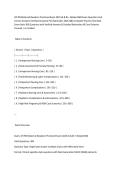
ATI RN Maternal Newborn Proctored Exam 2023 (A & B) + Retake NGN Exam Questions And
Correct Answers (Verified Answers) Plus Rationales 2026 Q&A Complete Practice Test Bank
Exam-Style 300 Questions with Verified Answers & Detailed Rationales All Core Domains
Covered | A+ Graded
Table of Contents
| Section | Topic | Questions |
|---------|-------|-----------|
| 1 | Antepartum Nursing Care | 1–50 |
| 2 | Fetal Assessment & Prenatal Testing | 51–80 |
| 3 | Intrapartum Nursing Care | 81–120 |
| 4 | Fetal Monitoring & Labor Complications | 121–150 |
| 5 | Postpartum Nursing Care | 151–190 |
| 6 | Postpartum Complications | 191–210 |
| 7 | Newborn Nursing Care & Assessment | 211–250 |
| 8 | Newborn Complications & Interventions | 251–280 |
| 9 | High-Risk Pregnancy & NGN Case Scenarios | 281–300 |
---
Exam Overview
Exam: ATI RN Maternal Newborn Proctored Exam 2023 (A & B) + Retake NGN
Total Questions: 300
Question Type: Single-best-answer multiple choice with NGN-style items
Format: Clinical vignette-style questions with Next Generation NCLEX (NGN) elements
,Content Focus: Comprehensive maternal-newborn nursing care across antepartum,
intrapartum, postpartum, and newborn periods
Content Areas Covered:
- Antepartum Nursing Care (prenatal assessment, fetal development, maternal nutrition,
pregnancy complications)
- Fetal Assessment & Prenatal Testing (ultrasound, NST, CST, BPP, genetic screening)
- Intrapartum Nursing Care (labor stages, pain management, delivery complications)
- Fetal Monitoring & Labor Complications (EFM interpretation, oxytocin, shoulder dystocia, cord
prolapse)
- Postpartum Nursing Care (maternal assessment, breastfeeding, wound care, patient
education)
- Postpartum Complications (hemorrhage, infection, DVT, preeclampsia, DIC)
- Newborn Nursing Care & Assessment (Apgar, Ballard, reflexes, transitional period)
- Newborn Complications & Interventions (hypoglycemia, hyperbilirubinemia, respiratory
distress, NAS)
- High-Risk Pregnancy & NGN Case Scenarios (preeclampsia, GDM, placenta previa, preterm
labor)
How to Use This Guide:
1. Read each clinical vignette carefully
2. Select your answer before viewing the correct response
3. Study the bolded answer and detailed rationale
4. Note the key nursing concept and clinical reasoning being tested
5. Pay special attention to NGN-style questions that require prioritization and clinical judgment
---
,SECTION 1: ANTEPARTUM NURSING CARE (Questions 1–50)
Question 1
A nurse is teaching a client who is at 12 weeks of gestation and has HIV. Which of the following
statements should the nurse include in the teaching?
A) "You will be placed in isolation after delivery."
B) "You should abstain from sexual intercourse throughout the pregnancy."
C) "You should breastfeed your newborn to provide passive immunity."
D) "You should continue to take zidovudine throughout the pregnancy."
Answer: D
Rationale: The nurse should inform the client that taking prescription antiviral medication every
day decreases the risk of transmission of HIV to her newborn. HIV can be transmitted through
breastfeeding, so breastfeeding is not recommended. Isolation after delivery is not required,
and sexual activity can continue with barrier protection.
---
Question 2
A nurse is providing teaching to a client who is at 8 weeks of gestation about manifestations to
report to the provider during pregnancy. Which of the following information should the nurse
include in the teaching?
A) Nausea upon awakening
B) Blurred or double vision
C) Increase in white vaginal discharge
, D) Leg cramps when sleeping
Answer: B
Rationale: Blurred or double vision can indicate preeclampsia or other serious conditions and
should be reported immediately. Nausea upon awakening is common in early pregnancy
(morning sickness). Increased vaginal discharge and leg cramps are also common discomforts of
pregnancy.
---
Question 3
A nurse is assessing a pregnant client at 26 weeks of gestation. The client's 1-hour oral glucose
tolerance test (GTT) result is 142 mg/dL. Which of the following actions should the nurse plan to
take?
A) Document the finding as normal and continue routine prenatal monitoring.
B) Instruct the client to immediately begin a carbohydrate-free diet.
C) Schedule the client for a 3-hour oral glucose tolerance test.
D) Administer a dose of regular insulin subcutaneously.
Answer: C
Rationale: A 1-hour oral glucose tolerance test value of 130 mg/dL to 140 mg/dL or higher
constitutes a positive screening result for potential gestational diabetes mellitus. This finding is
not diagnostic on its own but necessitates definitive confirmation via a 3-hour oral glucose
tolerance test. A carbohydrate-free diet is contraindicated during pregnancy due to the risk of
maternal ketosis.
Correct Answers (Verified Answers) Plus Rationales 2026 Q&A Complete Practice Test Bank
Exam-Style 300 Questions with Verified Answers & Detailed Rationales All Core Domains
Covered | A+ Graded
Table of Contents
| Section | Topic | Questions |
|---------|-------|-----------|
| 1 | Antepartum Nursing Care | 1–50 |
| 2 | Fetal Assessment & Prenatal Testing | 51–80 |
| 3 | Intrapartum Nursing Care | 81–120 |
| 4 | Fetal Monitoring & Labor Complications | 121–150 |
| 5 | Postpartum Nursing Care | 151–190 |
| 6 | Postpartum Complications | 191–210 |
| 7 | Newborn Nursing Care & Assessment | 211–250 |
| 8 | Newborn Complications & Interventions | 251–280 |
| 9 | High-Risk Pregnancy & NGN Case Scenarios | 281–300 |
---
Exam Overview
Exam: ATI RN Maternal Newborn Proctored Exam 2023 (A & B) + Retake NGN
Total Questions: 300
Question Type: Single-best-answer multiple choice with NGN-style items
Format: Clinical vignette-style questions with Next Generation NCLEX (NGN) elements
,Content Focus: Comprehensive maternal-newborn nursing care across antepartum,
intrapartum, postpartum, and newborn periods
Content Areas Covered:
- Antepartum Nursing Care (prenatal assessment, fetal development, maternal nutrition,
pregnancy complications)
- Fetal Assessment & Prenatal Testing (ultrasound, NST, CST, BPP, genetic screening)
- Intrapartum Nursing Care (labor stages, pain management, delivery complications)
- Fetal Monitoring & Labor Complications (EFM interpretation, oxytocin, shoulder dystocia, cord
prolapse)
- Postpartum Nursing Care (maternal assessment, breastfeeding, wound care, patient
education)
- Postpartum Complications (hemorrhage, infection, DVT, preeclampsia, DIC)
- Newborn Nursing Care & Assessment (Apgar, Ballard, reflexes, transitional period)
- Newborn Complications & Interventions (hypoglycemia, hyperbilirubinemia, respiratory
distress, NAS)
- High-Risk Pregnancy & NGN Case Scenarios (preeclampsia, GDM, placenta previa, preterm
labor)
How to Use This Guide:
1. Read each clinical vignette carefully
2. Select your answer before viewing the correct response
3. Study the bolded answer and detailed rationale
4. Note the key nursing concept and clinical reasoning being tested
5. Pay special attention to NGN-style questions that require prioritization and clinical judgment
---
,SECTION 1: ANTEPARTUM NURSING CARE (Questions 1–50)
Question 1
A nurse is teaching a client who is at 12 weeks of gestation and has HIV. Which of the following
statements should the nurse include in the teaching?
A) "You will be placed in isolation after delivery."
B) "You should abstain from sexual intercourse throughout the pregnancy."
C) "You should breastfeed your newborn to provide passive immunity."
D) "You should continue to take zidovudine throughout the pregnancy."
Answer: D
Rationale: The nurse should inform the client that taking prescription antiviral medication every
day decreases the risk of transmission of HIV to her newborn. HIV can be transmitted through
breastfeeding, so breastfeeding is not recommended. Isolation after delivery is not required,
and sexual activity can continue with barrier protection.
---
Question 2
A nurse is providing teaching to a client who is at 8 weeks of gestation about manifestations to
report to the provider during pregnancy. Which of the following information should the nurse
include in the teaching?
A) Nausea upon awakening
B) Blurred or double vision
C) Increase in white vaginal discharge
, D) Leg cramps when sleeping
Answer: B
Rationale: Blurred or double vision can indicate preeclampsia or other serious conditions and
should be reported immediately. Nausea upon awakening is common in early pregnancy
(morning sickness). Increased vaginal discharge and leg cramps are also common discomforts of
pregnancy.
---
Question 3
A nurse is assessing a pregnant client at 26 weeks of gestation. The client's 1-hour oral glucose
tolerance test (GTT) result is 142 mg/dL. Which of the following actions should the nurse plan to
take?
A) Document the finding as normal and continue routine prenatal monitoring.
B) Instruct the client to immediately begin a carbohydrate-free diet.
C) Schedule the client for a 3-hour oral glucose tolerance test.
D) Administer a dose of regular insulin subcutaneously.
Answer: C
Rationale: A 1-hour oral glucose tolerance test value of 130 mg/dL to 140 mg/dL or higher
constitutes a positive screening result for potential gestational diabetes mellitus. This finding is
not diagnostic on its own but necessitates definitive confirmation via a 3-hour oral glucose
tolerance test. A carbohydrate-free diet is contraindicated during pregnancy due to the risk of
maternal ketosis.


