

Page 1 of 120
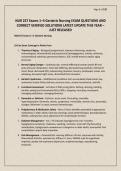
NUR 257 Exams 1–4 Geriatric Nursing EXAM QUESTIONS AND
CORRECT VERIFIED SOLUTIONS LATEST UPDATE THIS YEAR –
JUST RELEASED
NUR 257 Exams 1–4: Geriatric Nursing
10-Line Exam Coverage in Points Form
1. Theories of Aging – Biological (programmed, telomere shortening, endocrine,
immunological, mitochondrial) and psychosocial (disengagement, activity, continuity,
socioemotional selectivity, gerotranscendence, SOC model) theories explain aging
processes .
2. Normal Aging Changes – Cardiovascular: arterial stiffening increases systolic BP and
pulse pressure; Respiratory: chest wall stiffening, decreased lung elasticity, mild barrel
chest; Renal: decreased GFR, reduced drug clearance; Sensory: presbyopia, miosis, lens
yellowing, decreased night vision, diminished thirst sensation .
3. Geriatric Syndromes – Multifactorial conditions from accumulated impairments; key
syndromes include frailty, delirium, pressure ulcers, urinary incontinence, and falls .
4. Functional Assessment – Activities of Daily Living (ADLs: bathing, dressing, toileting,
transfer, eating) and Instrumental ADLs (IADLs: shopping, meal prep, housework,
managing medications, managing finances) .
5. Dementia vs. Delirium – Delirium: acute onset, fluctuating, reversible,
hyper/hypoactive; Dementia: chronic, progressive, irreversible, memory loss, personality
changes; Alzheimer's is most common dementia type .
6. Polypharmacy & Medication Safety – Beers Criteria identifies potentially inappropriate
medications in older adults; black box warnings; avoid anticholinergics, benzodiazepines,
NSAIDs, sulfonylureas; dose adjustments for renal/hepatic function .
7. Diabetes Management – A1C >7% indicates hyperglycemia over 3 months;
hypoglycemia symptoms: shakiness, sweating, confusion; treat with 15g fast-acting
carbohydrate; hypoglycemia unawareness is dangerous in older adults; neuropathic foot
complications require daily inspection .
8. Pain Management – Osteoarthritis: morning stiffness <30 min, improves with activity;
Rheumatoid Arthritis: symmetrical, stiffness >1 hour; PAINAD scale for cognitively
impaired; opioids risk respiratory depression; nonpharmacologic: repositioning,
heat/cold .
, Page 2 of 120
9. End-of-Life/Palliative – Pain control is priority in dying patients; disenfranchised grief;
hospice focuses on comfort; advance directives; culturally competent care for diverse
populations .
10. Elder Abuse & Safety – Cognitive impairment increases abuse risk; fall prevention:
remove rugs, improve lighting, handrails, medication review; Morse/Hendrich II fall risk
assessment .
100 MCQs with Rationales
1. An 81-year-old client with type 2 diabetes is admitted with pneumonia. The client reports
feeling "too sick to eat," has had vomiting twice this morning, and says, "I didn't take my
diabetes pills today because I figured I didn't need them." Which nursing action is the
priority?
A) Encourage the client to take small sips of clear liquids as tolerated
B) Reinforce the importance of daily foot inspections while hospitalized
C) Notify the provider about the missed diabetes medication and inability to tolerate PO intake
D) Educate the client on the importance of annual influenza and pneumonia vaccines
Answer: C
Rationale: The client is unable to take oral medications and has been vomiting, increasing the
risk of hypoglycemia or diabetic ketoacidosis. The provider must be notified immediately to
adjust the diabetes regimen. This is a safety priority over education or routine foot care .
2. A nurse is reinforcing teaching about hypoglycemia management with an older adult who
lives alone and has type 2 diabetes. Which client statement indicates correct understanding?
A) "If I feel shaky and sweaty, I'll drink a cup of fat-free milk and check my sugar again in about
, Page 3 of 120
15 minutes."
B) "If I get confused or dizzy, I'll just lay down and rest. It usually passes by itself."
C) "If my blood sugar is low, I'll take my diabetes pill with orange juice so it works faster."
D) "If I'm not hungry, I should avoid treating low blood sugar so I don't gain weight."
Answer: A
Rationale: Hypoglycemia requires immediate treatment with 15g fast-acting carbohydrate. Fat-
free milk is an appropriate choice. Ignoring symptoms (B) is dangerous; diabetes pills do not
treat acute hypoglycemia (C); delaying treatment due to appetite concerns (D) is incorrect .
3. A nurse reviews laboratory results for a 77-year-old client with diabetes. The hemoglobin
A1C is 7%. Which interpretation is most accurate?
A) Average blood glucose has been around 126 mg/dL over the past 3 months, indicating
excellent control
B) Average blood glucose has been around 154 mg/dL, which reflects moderate control
C) The result only reflects blood glucose over the last 24 hours and is therefore not clinically
useful
D) The result is expected in older adults and requires no further evaluation or teaching
Answer: B
Rationale: A1C of 7% corresponds to an estimated average glucose of approximately 154
mg/dL. This reflects moderate hyperglycemia. While this may be an acceptable target for some
older adults, it still requires evaluation and education, not dismissal .
, Page 4 of 120
4. An older adult with long-standing type 2 diabetes reports "pins and needles" in both feet
and difficulty feeling the floor when walking. Which interventions should the nurse prioritize?
(Select all that apply)
A) Encourage the client to walk barefoot indoors to increase sensory stimulation
B) Instruct the client to inspect feet daily using a mirror for areas they cannot see
C) Recommend well-fitting shoes and avoidance of tight socks or shoes
D) Advise the client to soak feet in hot water daily to improve circulation
E) Reinforce the need to notify the provider about any non-healing foot wounds
Answer: B, C, E
Rationale: Daily foot inspection with a mirror, well-fitting shoes, and prompt notification of non-
healing wounds are essential for preventing diabetic foot complications. Barefoot walking (A)
increases injury risk with neuropathy; hot water (D) increases burn risk with decreased
sensation .
5. An 84-year-old client with diabetes is newly experiencing urinary incontinence. The client
says, "I never had bladder problems before. Why is this happening now?" Which explanation
by the nurse is most appropriate?
A) "This is just a normal part of aging and unrelated to your diabetes."
B) "High levels of sugar in your urine can irritate the bladder, and nerve damage from diabetes
can also affect bladder control."
C) "Your incontinence is caused only by weak pelvic floor muscles and has nothing to do with
your blood sugar."
D) "It means your kidneys are shutting down and dialysis may soon be necessary."
NUR 257 Exams 1–4 Geriatric Nursing EXAM QUESTIONS AND
CORRECT VERIFIED SOLUTIONS LATEST UPDATE THIS YEAR –
JUST RELEASED
NUR 257 Exams 1–4: Geriatric Nursing
10-Line Exam Coverage in Points Form
1. Theories of Aging – Biological (programmed, telomere shortening, endocrine,
immunological, mitochondrial) and psychosocial (disengagement, activity, continuity,
socioemotional selectivity, gerotranscendence, SOC model) theories explain aging
processes .
2. Normal Aging Changes – Cardiovascular: arterial stiffening increases systolic BP and
pulse pressure; Respiratory: chest wall stiffening, decreased lung elasticity, mild barrel
chest; Renal: decreased GFR, reduced drug clearance; Sensory: presbyopia, miosis, lens
yellowing, decreased night vision, diminished thirst sensation .
3. Geriatric Syndromes – Multifactorial conditions from accumulated impairments; key
syndromes include frailty, delirium, pressure ulcers, urinary incontinence, and falls .
4. Functional Assessment – Activities of Daily Living (ADLs: bathing, dressing, toileting,
transfer, eating) and Instrumental ADLs (IADLs: shopping, meal prep, housework,
managing medications, managing finances) .
5. Dementia vs. Delirium – Delirium: acute onset, fluctuating, reversible,
hyper/hypoactive; Dementia: chronic, progressive, irreversible, memory loss, personality
changes; Alzheimer's is most common dementia type .
6. Polypharmacy & Medication Safety – Beers Criteria identifies potentially inappropriate
medications in older adults; black box warnings; avoid anticholinergics, benzodiazepines,
NSAIDs, sulfonylureas; dose adjustments for renal/hepatic function .
7. Diabetes Management – A1C >7% indicates hyperglycemia over 3 months;
hypoglycemia symptoms: shakiness, sweating, confusion; treat with 15g fast-acting
carbohydrate; hypoglycemia unawareness is dangerous in older adults; neuropathic foot
complications require daily inspection .
8. Pain Management – Osteoarthritis: morning stiffness <30 min, improves with activity;
Rheumatoid Arthritis: symmetrical, stiffness >1 hour; PAINAD scale for cognitively
impaired; opioids risk respiratory depression; nonpharmacologic: repositioning,
heat/cold .
, Page 2 of 120
9. End-of-Life/Palliative – Pain control is priority in dying patients; disenfranchised grief;
hospice focuses on comfort; advance directives; culturally competent care for diverse
populations .
10. Elder Abuse & Safety – Cognitive impairment increases abuse risk; fall prevention:
remove rugs, improve lighting, handrails, medication review; Morse/Hendrich II fall risk
assessment .
100 MCQs with Rationales
1. An 81-year-old client with type 2 diabetes is admitted with pneumonia. The client reports
feeling "too sick to eat," has had vomiting twice this morning, and says, "I didn't take my
diabetes pills today because I figured I didn't need them." Which nursing action is the
priority?
A) Encourage the client to take small sips of clear liquids as tolerated
B) Reinforce the importance of daily foot inspections while hospitalized
C) Notify the provider about the missed diabetes medication and inability to tolerate PO intake
D) Educate the client on the importance of annual influenza and pneumonia vaccines
Answer: C
Rationale: The client is unable to take oral medications and has been vomiting, increasing the
risk of hypoglycemia or diabetic ketoacidosis. The provider must be notified immediately to
adjust the diabetes regimen. This is a safety priority over education or routine foot care .
2. A nurse is reinforcing teaching about hypoglycemia management with an older adult who
lives alone and has type 2 diabetes. Which client statement indicates correct understanding?
A) "If I feel shaky and sweaty, I'll drink a cup of fat-free milk and check my sugar again in about
, Page 3 of 120
15 minutes."
B) "If I get confused or dizzy, I'll just lay down and rest. It usually passes by itself."
C) "If my blood sugar is low, I'll take my diabetes pill with orange juice so it works faster."
D) "If I'm not hungry, I should avoid treating low blood sugar so I don't gain weight."
Answer: A
Rationale: Hypoglycemia requires immediate treatment with 15g fast-acting carbohydrate. Fat-
free milk is an appropriate choice. Ignoring symptoms (B) is dangerous; diabetes pills do not
treat acute hypoglycemia (C); delaying treatment due to appetite concerns (D) is incorrect .
3. A nurse reviews laboratory results for a 77-year-old client with diabetes. The hemoglobin
A1C is 7%. Which interpretation is most accurate?
A) Average blood glucose has been around 126 mg/dL over the past 3 months, indicating
excellent control
B) Average blood glucose has been around 154 mg/dL, which reflects moderate control
C) The result only reflects blood glucose over the last 24 hours and is therefore not clinically
useful
D) The result is expected in older adults and requires no further evaluation or teaching
Answer: B
Rationale: A1C of 7% corresponds to an estimated average glucose of approximately 154
mg/dL. This reflects moderate hyperglycemia. While this may be an acceptable target for some
older adults, it still requires evaluation and education, not dismissal .
, Page 4 of 120
4. An older adult with long-standing type 2 diabetes reports "pins and needles" in both feet
and difficulty feeling the floor when walking. Which interventions should the nurse prioritize?
(Select all that apply)
A) Encourage the client to walk barefoot indoors to increase sensory stimulation
B) Instruct the client to inspect feet daily using a mirror for areas they cannot see
C) Recommend well-fitting shoes and avoidance of tight socks or shoes
D) Advise the client to soak feet in hot water daily to improve circulation
E) Reinforce the need to notify the provider about any non-healing foot wounds
Answer: B, C, E
Rationale: Daily foot inspection with a mirror, well-fitting shoes, and prompt notification of non-
healing wounds are essential for preventing diabetic foot complications. Barefoot walking (A)
increases injury risk with neuropathy; hot water (D) increases burn risk with decreased
sensation .
5. An 84-year-old client with diabetes is newly experiencing urinary incontinence. The client
says, "I never had bladder problems before. Why is this happening now?" Which explanation
by the nurse is most appropriate?
A) "This is just a normal part of aging and unrelated to your diabetes."
B) "High levels of sugar in your urine can irritate the bladder, and nerve damage from diabetes
can also affect bladder control."
C) "Your incontinence is caused only by weak pelvic floor muscles and has nothing to do with
your blood sugar."
D) "It means your kidneys are shutting down and dialysis may soon be necessary."


