

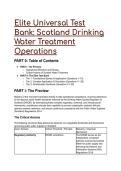
Elite Universal Test
Bank: Scotland Drinking
Water Treatment
Operations
PART 0: Table of Contents
● PART I: The Preview
○ Operational Directives and Scope
○ Critical Axioms of Scottish Water Treatment
● PART II: The Elite Test Bank
○ Tier 1: Foundational Syntax & Application (Questions 1–10)
○ Tier 2: Complex Application & Simulation (Questions 11–20)
○ Tier 3: Grandmaster Synthesis (Questions 21–30)
PART I: The Preview
Mastery of this test bank translates directly to elite operational competence, ensuring adherence
to the rigorous public health standards enforced by the Drinking Water Quality Regulator for
Scotland (DWQR). By internalizing these complex regulatory, chemical, and infrastructural
frameworks, practitioners elevate their capability to prevent catastrophic systemic failures,
optimize network resilience, and ensure continuous compliance with the Public Water Supplies
(Scotland) Regulations 2014.
The Critical Axioms
The following structured data defines the absolute non-negotiable thresholds and frameworks
governing public water supplies in Scotland:
Axiom Domain Critical Threshold / Principle Statutory / Chemical
Mechanism
Regulatory Authority DWQR Jurisdiction The DWQR serves as the
independent competent
authority overseeing Scottish
Water for public supply and
enforcing the Network and
Information Systems (NIS)
Regulations 2018.
,Axiom Domain Critical Threshold / Principle Statutory / Chemical
Mechanism
Chemical PCVs Lead, Iron, Manganese Compliance at the consumer
tap mandates absolute limits:
Lead (10 µg/l), Iron (200 µg/l),
and Manganese (50 µg/l).
Pathogen Barriers Cryptosporidium Defense Oocysts resist standard
chlorination. Defense relies on
physical removal (turbidity
strictly <1.0 NTU) and
Ultra-Violet (UV) irradiation.
Network Disinfection Chloramination Ratio Secondary disinfection requires
an optimal chlorine-to-ammonia
weight ratio of 5:1 to maximize
monochloramine and suppress
nitrification.
Coagulation Dynamics Alum vs. Ferric Sulphate Aluminium operates in a narrow
pH band (6–8); Ferric operates
across a broader acidic
spectrum and generates denser
flocs, but requires
corrosion-resistant assets.
PART II: The Elite Test Bank
Tier 1 - Foundational Syntax & Application
Q1: A newly commissioned Water Treatment Works (WTW) in the Scottish Highlands is
establishing its compliance framework for the distribution network. Based on the principles of
the Public Water Supplies (Scotland) Regulations 2014, which entity holds the statutory
authority to monitor Scottish Water's compliance and issue enforcement notices for breaches in
public drinking water standards? A) The Scottish Environment Protection Agency (SEPA) B) The
local authority's Environmental Health Department C) The Drinking Water Quality Regulator for
Scotland (DWQR) D) Food Standards Scotland (FSS)
● Answer: C (The Drinking Water Quality Regulator for Scotland (DWQR))
● Distractor Analysis:
○ A is incorrect: The Scottish Environment Protection Agency (SEPA) strictly
regulates environmental protection protocols, including raw water abstraction
licensing and wastewater discharge limits. It holds no statutory jurisdiction over the
wholesomeness of the treated public drinking water supply.
○ B is incorrect: Local authorities are statutorily responsible for monitoring and
enforcing standards for private water supplies. They do not regulate the public
supplies managed by Scottish Water, though they work in tandem during health
events.
○ D is incorrect: While Food Standards Scotland (FSS) provides advice regarding the
impact of water quality on food production and marketing, they do not hold statutory
enforcement powers over Scottish Water's operational drinking water quality.
The Mentor's Analysis: The fundamental architecture of Scottish water regulation delineates
, public from private oversight. When facing compliance issues within the public network, the
immediate priority is understanding that the DWQR possesses the statutory power of entry,
inspection, and enforcement action over Scottish Water under the 2002 Act. By utilizing
statutory definitions, the practitioner bypasses the common trap of confusing environmental
regulation with drinking water regulation. Professional/Academic Intuition: The DWQR is the
sole independent regulator and competent authority for Scottish Water's drinking water
quality and NIS compliance; local authorities exclusively manage private supplies.
Q2: A shift operator at a surface water treatment plant notes a sudden increase in raw water
organics. The plant utilizes chloramination for secondary disinfection to protect the distribution
network. Based on the principles of chloramine chemistry, what is the MOST ACCURATE target
weight ratio of chlorine to ammonia to maximize monochloramine formation and prevent
microbiological instability? A) 3:1 B) 5:1 C) 7.6:1 D) 10:1
● Answer: B (5:1)
● Distractor Analysis:
○ A is incorrect: A 3:1 ratio was historically utilized by some utilities but leaves
excessive free ammonia unreacted in the network. This excess ammonia serves as
a primary nutrient source, creating a severe risk of biological nitrification.
○ C is incorrect: A ratio of 7.6:1 or greater represents the breakpoint where
chloramines are chemically destroyed to leave a free chlorine residual, completely
defeating the purpose of intentional chloramination.
○ D is incorrect: A 10:1 ratio heavily exceeds breakpoint chlorination limits, destroying
the ammonia entirely and driving the rapid formation of high levels of halogenated
disinfection by-products.
The Mentor's Analysis: Optimizing secondary disinfection requires precise stoichiometric
control. When facing chloramination dosing, the immediate priority is maximizing
monochloramine yield while starving autotrophic nitrifying bacteria. By utilizing a strict 5:1 weight
ratio, the practitioner bypasses the common trap of leaving free ammonia in the system, which
acts as a nutrient for expansive biofilm growth. Professional/Academic Intuition: A 5:1
chlorine-to-ammonia ratio is the hard deck for stable monochloramine residuals;
downward deviation feeds nitrification, while upward deviation risks breakpoint
destruction.
Q3: During routine compliance sampling at a consumer's tap in a Regulatory Supply Zone
(RSZ), laboratory analysis returns a manganese concentration of 65 µg/l. Based on the
principles of the Public Water Supplies (Scotland) Regulations 2014, which conclusion is the
MOST ACCURATE regarding this regulatory sample? A) The sample exceeds the Prescribed
Concentration or Value (PCV) of 50 µg/l and represents a formal regulatory failure. B) The
sample is compliant, as the PCV for manganese allows up to 200 µg/l before a failure is
recorded. C) The sample exceeds the PCV, but fails only an aesthetic parameter that does not
require statutory reporting to the DWQR. D) The sample is compliant, provided the associated
iron levels remain below the 50 µg/l threshold.
● Answer: A (The sample exceeds the Prescribed Concentration or Value (PCV) of 50 µg/l
and represents a formal regulatory failure.)
● Distractor Analysis:
○ B is incorrect: The PCV for iron is 200 µg/l; the PCV for manganese is strictly 50
µg/l. Confusing these two transition metals is a critical compliance error.
○ C is incorrect: While manganese primarily causes aesthetic issues such as
discolouration and laundry staining at this concentration, any breach of a PCV listed
in the Regulations constitutes a statutory failure that must be investigated,
Bank: Scotland Drinking
Water Treatment
Operations
PART 0: Table of Contents
● PART I: The Preview
○ Operational Directives and Scope
○ Critical Axioms of Scottish Water Treatment
● PART II: The Elite Test Bank
○ Tier 1: Foundational Syntax & Application (Questions 1–10)
○ Tier 2: Complex Application & Simulation (Questions 11–20)
○ Tier 3: Grandmaster Synthesis (Questions 21–30)
PART I: The Preview
Mastery of this test bank translates directly to elite operational competence, ensuring adherence
to the rigorous public health standards enforced by the Drinking Water Quality Regulator for
Scotland (DWQR). By internalizing these complex regulatory, chemical, and infrastructural
frameworks, practitioners elevate their capability to prevent catastrophic systemic failures,
optimize network resilience, and ensure continuous compliance with the Public Water Supplies
(Scotland) Regulations 2014.
The Critical Axioms
The following structured data defines the absolute non-negotiable thresholds and frameworks
governing public water supplies in Scotland:
Axiom Domain Critical Threshold / Principle Statutory / Chemical
Mechanism
Regulatory Authority DWQR Jurisdiction The DWQR serves as the
independent competent
authority overseeing Scottish
Water for public supply and
enforcing the Network and
Information Systems (NIS)
Regulations 2018.
,Axiom Domain Critical Threshold / Principle Statutory / Chemical
Mechanism
Chemical PCVs Lead, Iron, Manganese Compliance at the consumer
tap mandates absolute limits:
Lead (10 µg/l), Iron (200 µg/l),
and Manganese (50 µg/l).
Pathogen Barriers Cryptosporidium Defense Oocysts resist standard
chlorination. Defense relies on
physical removal (turbidity
strictly <1.0 NTU) and
Ultra-Violet (UV) irradiation.
Network Disinfection Chloramination Ratio Secondary disinfection requires
an optimal chlorine-to-ammonia
weight ratio of 5:1 to maximize
monochloramine and suppress
nitrification.
Coagulation Dynamics Alum vs. Ferric Sulphate Aluminium operates in a narrow
pH band (6–8); Ferric operates
across a broader acidic
spectrum and generates denser
flocs, but requires
corrosion-resistant assets.
PART II: The Elite Test Bank
Tier 1 - Foundational Syntax & Application
Q1: A newly commissioned Water Treatment Works (WTW) in the Scottish Highlands is
establishing its compliance framework for the distribution network. Based on the principles of
the Public Water Supplies (Scotland) Regulations 2014, which entity holds the statutory
authority to monitor Scottish Water's compliance and issue enforcement notices for breaches in
public drinking water standards? A) The Scottish Environment Protection Agency (SEPA) B) The
local authority's Environmental Health Department C) The Drinking Water Quality Regulator for
Scotland (DWQR) D) Food Standards Scotland (FSS)
● Answer: C (The Drinking Water Quality Regulator for Scotland (DWQR))
● Distractor Analysis:
○ A is incorrect: The Scottish Environment Protection Agency (SEPA) strictly
regulates environmental protection protocols, including raw water abstraction
licensing and wastewater discharge limits. It holds no statutory jurisdiction over the
wholesomeness of the treated public drinking water supply.
○ B is incorrect: Local authorities are statutorily responsible for monitoring and
enforcing standards for private water supplies. They do not regulate the public
supplies managed by Scottish Water, though they work in tandem during health
events.
○ D is incorrect: While Food Standards Scotland (FSS) provides advice regarding the
impact of water quality on food production and marketing, they do not hold statutory
enforcement powers over Scottish Water's operational drinking water quality.
The Mentor's Analysis: The fundamental architecture of Scottish water regulation delineates
, public from private oversight. When facing compliance issues within the public network, the
immediate priority is understanding that the DWQR possesses the statutory power of entry,
inspection, and enforcement action over Scottish Water under the 2002 Act. By utilizing
statutory definitions, the practitioner bypasses the common trap of confusing environmental
regulation with drinking water regulation. Professional/Academic Intuition: The DWQR is the
sole independent regulator and competent authority for Scottish Water's drinking water
quality and NIS compliance; local authorities exclusively manage private supplies.
Q2: A shift operator at a surface water treatment plant notes a sudden increase in raw water
organics. The plant utilizes chloramination for secondary disinfection to protect the distribution
network. Based on the principles of chloramine chemistry, what is the MOST ACCURATE target
weight ratio of chlorine to ammonia to maximize monochloramine formation and prevent
microbiological instability? A) 3:1 B) 5:1 C) 7.6:1 D) 10:1
● Answer: B (5:1)
● Distractor Analysis:
○ A is incorrect: A 3:1 ratio was historically utilized by some utilities but leaves
excessive free ammonia unreacted in the network. This excess ammonia serves as
a primary nutrient source, creating a severe risk of biological nitrification.
○ C is incorrect: A ratio of 7.6:1 or greater represents the breakpoint where
chloramines are chemically destroyed to leave a free chlorine residual, completely
defeating the purpose of intentional chloramination.
○ D is incorrect: A 10:1 ratio heavily exceeds breakpoint chlorination limits, destroying
the ammonia entirely and driving the rapid formation of high levels of halogenated
disinfection by-products.
The Mentor's Analysis: Optimizing secondary disinfection requires precise stoichiometric
control. When facing chloramination dosing, the immediate priority is maximizing
monochloramine yield while starving autotrophic nitrifying bacteria. By utilizing a strict 5:1 weight
ratio, the practitioner bypasses the common trap of leaving free ammonia in the system, which
acts as a nutrient for expansive biofilm growth. Professional/Academic Intuition: A 5:1
chlorine-to-ammonia ratio is the hard deck for stable monochloramine residuals;
downward deviation feeds nitrification, while upward deviation risks breakpoint
destruction.
Q3: During routine compliance sampling at a consumer's tap in a Regulatory Supply Zone
(RSZ), laboratory analysis returns a manganese concentration of 65 µg/l. Based on the
principles of the Public Water Supplies (Scotland) Regulations 2014, which conclusion is the
MOST ACCURATE regarding this regulatory sample? A) The sample exceeds the Prescribed
Concentration or Value (PCV) of 50 µg/l and represents a formal regulatory failure. B) The
sample is compliant, as the PCV for manganese allows up to 200 µg/l before a failure is
recorded. C) The sample exceeds the PCV, but fails only an aesthetic parameter that does not
require statutory reporting to the DWQR. D) The sample is compliant, provided the associated
iron levels remain below the 50 µg/l threshold.
● Answer: A (The sample exceeds the Prescribed Concentration or Value (PCV) of 50 µg/l
and represents a formal regulatory failure.)
● Distractor Analysis:
○ B is incorrect: The PCV for iron is 200 µg/l; the PCV for manganese is strictly 50
µg/l. Confusing these two transition metals is a critical compliance error.
○ C is incorrect: While manganese primarily causes aesthetic issues such as
discolouration and laundry staining at this concentration, any breach of a PCV listed
in the Regulations constitutes a statutory failure that must be investigated,


