

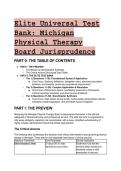
Elite Universal Test
Bank: Michigan
Physical Therapy
Board Jurisprudence
PART 0: THE TABLE OF CONTENTS
● PART I: THE PREVIEW
○ The Mission & Administrative Synthesis
○ The Critical Axioms (Structured Data Table)
● PART II: THE ELITE TEST BANK
○ Tier 1 (Questions 1–10): Foundational Syntax & Application
■ Core Focus: Statutory definitions, delegation ratios, absolute prescription
timelines, and baseline continuing competence requirements.
○ Tier 2 (Questions 11–20): Complex Application & Simulation
■ Core Focus: Relicensure lapses, overlapping supervisory frameworks,
criminal reporting mandates, and direct access limitations.
○ Tier 3 (Questions 21–30): Grandmaster Synthesis
■ Core Focus: High-stakes clinical audits, multi-variable administrative failures,
interstate compact legislation, and immediate hazard mitigation.
PART I: THE PREVIEW
Mastering the Michigan Physical Therapy Board Jurisprudence framework is the ultimate
safeguard of clinical autonomy and professional survival. This elite test bank is engineered to
strip away ambiguity, replacing rote memorization with a deep, simplified understanding of
highly complex administrative topics that dictate legal practice.
The Critical Axioms
The following table synthesizes the absolute most critical administrative laws governing physical
therapy in Michigan. These are the non-negotiable hard decks of clinical practice.
Statutory Framework Core Parameter Clinical Implication
Direct Access Limits 21 days OR 10 visits Treatment must halt the
(whichever occurs first) moment either threshold is
breached unless a valid
prescription is secured.
,Statutory Framework Core Parameter Clinical Implication
Prescription Lifespan 90 Days from the date written The countdown begins on the
date of the prescriber's
signature, independent of the
clinical evaluation date.
Delegation: PTAs Maximum of 4 licensed PTAs Physical therapists may provide
per physical therapist general supervision (continuous
telecommunication availability)
to PTAs.
Delegation: Aides Maximum of 3 unlicensed aides Unlicensed personnel require
per physical therapist strict direct supervision
(physical presence and
immediate availability).
Criminal Reporting 30 Days from the date of Licensees must report any
conviction criminal conviction to LARA
within 30 days of the conviction
(plea/verdict), not the
sentencing date.
PART II: THE ELITE TEST BANK
Tier 1: Foundational Syntax & Application
Q1: A physical therapist receives a prescription for outpatient rehabilitation signed by an
advanced practice registered nurse (APRN). The prescription is dated February 1. The patient
schedules their initial evaluation for April 15. Based on the principles of the Michigan Public
Health Code, which conclusion regarding this prescription is the MOST ACCURATE?
A) The prescription is invalid because APRNs are not authorized to prescribe physical therapy
in Michigan. B) The prescription is valid, as it remains active for 6 months from the date of
issuance. C) The prescription is valid, and the 90-day expiration countdown begins on the date
of the initial evaluation. D) The prescription is valid, but it will expire in approximately two weeks,
requiring a new prescription to continue care.
● Answer: D (The prescription is valid, but it will expire in approximately two weeks,
requiring a new prescription to continue care.)
● Distractor Analysis:
○ A is incorrect: The Michigan Public Health Code explicitly authorizes advanced
practice registered nurses (APRNs), alongside physicians, dentists, and podiatrists,
to issue valid physical therapy prescriptions.
○ B is incorrect: Prescriptions do not possess a six-month lifespan; they are strictly
limited by statute to 90 days unless the prescriber explicitly writes a different
termination date.
○ C is incorrect: This represents a catastrophic administrative assumption. The
statutory clock initiates precisely on the date the prescription was written, entirely
independent of when the patient initiates clinical care.
The Mentor's Analysis: Administrative timelines in healthcare do not bend to patient
convenience or scheduling delays. The validity of a clinical order is anchored exclusively to the
prescriber's signature date, establishing a rigid temporal boundary for care. By strictly auditing
the date written, practitioners bypass the severe liability of providing unauthorized treatment.
, Professional/Academic Intuition: The 90-Day Anchor Rule: A prescription's lifespan is
exactly 90 days from the pen stroke, remaining entirely unaffected by clinical start dates.
Q2: A physical therapist delegates the application of a cold pack and routine equipment
sanitization to an unlicensed rehabilitation technician. Based on the principles of delegation in
the Michigan Public Health Code, which standard of supervision is strictly required for this
unlicensed individual?
A) General supervision, meaning the PT must be reachable by telecommunication. B) Direct
supervision, meaning the PT must be physically present and immediately available. C) Indirect
supervision, provided the PT has examined the patient earlier in the week. D) Intermittent
supervision, requiring the PT to be on-site for at least 50% of the patient's visit.
● Answer: B (Direct supervision, meaning the PT must be physically present and
immediately available.)
● Distractor Analysis:
○ A is incorrect: General supervision (telecommunication availability) is a privilege
reserved exclusively for licensed Physical Therapist Assistants (PTAs), strictly
forbidden for unlicensed personnel.
○ C is incorrect: While examining the patient beforehand is a prerequisite for
delegation, it does not legally downgrade the requirement for the physical
therapist's continuous physical presence during the intervention.
○ D is incorrect: There is no legal provision in Michigan administrative law for
fractional or intermittent presence. Supervision of unlicensed aides demands
absolute, unbroken physical proximity.
The Mentor's Analysis: Unlicensed personnel possess zero independent clinical liability;
therefore, the physical therapist absorbs one hundred percent of the risk associated with their
actions. The legislature demands physical proximity to ensure the licensed provider can
instantly mitigate harm if a delegated task causes unexpected patient distress.
Professional/Academic Intuition: The Proximity Mandate: Delegation to any unlicensed
individual requires absolute physical presence within the facility—telephonic loopholes
do not exist.
Q3: A physical therapist is renewing their Michigan license and is currently auditing their
Professional Development Requirement (PDR) credits. They completed 15 hours of approved
online continuing education on a single Saturday. Based on the principles of the Michigan Board
of Physical Therapy General Rules, how many of these credits can be legally applied to their
renewal?
A) 15 credits. B) 12 credits. C) 10 credits. D) 0 credits, because all online courses must be
spread across multiple days.
● Answer: B (12 credits.)
● Distractor Analysis:
○ A is incorrect: Although the practitioner completed 15 hours of coursework,
Michigan law imposes a strict velocity cap on digital learning to prevent cognitive
fatigue and superficial compliance.
○ C is incorrect: This arbitrary figure mimics legacy limitations from other jurisdictions
but does not reflect Michigan's exact 12-hour limit.
○ D is incorrect: Online PDRs are perfectly valid and widely encouraged; they simply
cannot exceed the mathematical threshold established for a single 24-hour cycle.
The Mentor's Analysis: Regulatory bodies recognize the reality of cognitive fatigue and
"click-through" non-compliance inherent in rapid digital learning environments. The state
artificially throttles the speed at which practitioners can accumulate online PDRs to force a
Bank: Michigan
Physical Therapy
Board Jurisprudence
PART 0: THE TABLE OF CONTENTS
● PART I: THE PREVIEW
○ The Mission & Administrative Synthesis
○ The Critical Axioms (Structured Data Table)
● PART II: THE ELITE TEST BANK
○ Tier 1 (Questions 1–10): Foundational Syntax & Application
■ Core Focus: Statutory definitions, delegation ratios, absolute prescription
timelines, and baseline continuing competence requirements.
○ Tier 2 (Questions 11–20): Complex Application & Simulation
■ Core Focus: Relicensure lapses, overlapping supervisory frameworks,
criminal reporting mandates, and direct access limitations.
○ Tier 3 (Questions 21–30): Grandmaster Synthesis
■ Core Focus: High-stakes clinical audits, multi-variable administrative failures,
interstate compact legislation, and immediate hazard mitigation.
PART I: THE PREVIEW
Mastering the Michigan Physical Therapy Board Jurisprudence framework is the ultimate
safeguard of clinical autonomy and professional survival. This elite test bank is engineered to
strip away ambiguity, replacing rote memorization with a deep, simplified understanding of
highly complex administrative topics that dictate legal practice.
The Critical Axioms
The following table synthesizes the absolute most critical administrative laws governing physical
therapy in Michigan. These are the non-negotiable hard decks of clinical practice.
Statutory Framework Core Parameter Clinical Implication
Direct Access Limits 21 days OR 10 visits Treatment must halt the
(whichever occurs first) moment either threshold is
breached unless a valid
prescription is secured.
,Statutory Framework Core Parameter Clinical Implication
Prescription Lifespan 90 Days from the date written The countdown begins on the
date of the prescriber's
signature, independent of the
clinical evaluation date.
Delegation: PTAs Maximum of 4 licensed PTAs Physical therapists may provide
per physical therapist general supervision (continuous
telecommunication availability)
to PTAs.
Delegation: Aides Maximum of 3 unlicensed aides Unlicensed personnel require
per physical therapist strict direct supervision
(physical presence and
immediate availability).
Criminal Reporting 30 Days from the date of Licensees must report any
conviction criminal conviction to LARA
within 30 days of the conviction
(plea/verdict), not the
sentencing date.
PART II: THE ELITE TEST BANK
Tier 1: Foundational Syntax & Application
Q1: A physical therapist receives a prescription for outpatient rehabilitation signed by an
advanced practice registered nurse (APRN). The prescription is dated February 1. The patient
schedules their initial evaluation for April 15. Based on the principles of the Michigan Public
Health Code, which conclusion regarding this prescription is the MOST ACCURATE?
A) The prescription is invalid because APRNs are not authorized to prescribe physical therapy
in Michigan. B) The prescription is valid, as it remains active for 6 months from the date of
issuance. C) The prescription is valid, and the 90-day expiration countdown begins on the date
of the initial evaluation. D) The prescription is valid, but it will expire in approximately two weeks,
requiring a new prescription to continue care.
● Answer: D (The prescription is valid, but it will expire in approximately two weeks,
requiring a new prescription to continue care.)
● Distractor Analysis:
○ A is incorrect: The Michigan Public Health Code explicitly authorizes advanced
practice registered nurses (APRNs), alongside physicians, dentists, and podiatrists,
to issue valid physical therapy prescriptions.
○ B is incorrect: Prescriptions do not possess a six-month lifespan; they are strictly
limited by statute to 90 days unless the prescriber explicitly writes a different
termination date.
○ C is incorrect: This represents a catastrophic administrative assumption. The
statutory clock initiates precisely on the date the prescription was written, entirely
independent of when the patient initiates clinical care.
The Mentor's Analysis: Administrative timelines in healthcare do not bend to patient
convenience or scheduling delays. The validity of a clinical order is anchored exclusively to the
prescriber's signature date, establishing a rigid temporal boundary for care. By strictly auditing
the date written, practitioners bypass the severe liability of providing unauthorized treatment.
, Professional/Academic Intuition: The 90-Day Anchor Rule: A prescription's lifespan is
exactly 90 days from the pen stroke, remaining entirely unaffected by clinical start dates.
Q2: A physical therapist delegates the application of a cold pack and routine equipment
sanitization to an unlicensed rehabilitation technician. Based on the principles of delegation in
the Michigan Public Health Code, which standard of supervision is strictly required for this
unlicensed individual?
A) General supervision, meaning the PT must be reachable by telecommunication. B) Direct
supervision, meaning the PT must be physically present and immediately available. C) Indirect
supervision, provided the PT has examined the patient earlier in the week. D) Intermittent
supervision, requiring the PT to be on-site for at least 50% of the patient's visit.
● Answer: B (Direct supervision, meaning the PT must be physically present and
immediately available.)
● Distractor Analysis:
○ A is incorrect: General supervision (telecommunication availability) is a privilege
reserved exclusively for licensed Physical Therapist Assistants (PTAs), strictly
forbidden for unlicensed personnel.
○ C is incorrect: While examining the patient beforehand is a prerequisite for
delegation, it does not legally downgrade the requirement for the physical
therapist's continuous physical presence during the intervention.
○ D is incorrect: There is no legal provision in Michigan administrative law for
fractional or intermittent presence. Supervision of unlicensed aides demands
absolute, unbroken physical proximity.
The Mentor's Analysis: Unlicensed personnel possess zero independent clinical liability;
therefore, the physical therapist absorbs one hundred percent of the risk associated with their
actions. The legislature demands physical proximity to ensure the licensed provider can
instantly mitigate harm if a delegated task causes unexpected patient distress.
Professional/Academic Intuition: The Proximity Mandate: Delegation to any unlicensed
individual requires absolute physical presence within the facility—telephonic loopholes
do not exist.
Q3: A physical therapist is renewing their Michigan license and is currently auditing their
Professional Development Requirement (PDR) credits. They completed 15 hours of approved
online continuing education on a single Saturday. Based on the principles of the Michigan Board
of Physical Therapy General Rules, how many of these credits can be legally applied to their
renewal?
A) 15 credits. B) 12 credits. C) 10 credits. D) 0 credits, because all online courses must be
spread across multiple days.
● Answer: B (12 credits.)
● Distractor Analysis:
○ A is incorrect: Although the practitioner completed 15 hours of coursework,
Michigan law imposes a strict velocity cap on digital learning to prevent cognitive
fatigue and superficial compliance.
○ C is incorrect: This arbitrary figure mimics legacy limitations from other jurisdictions
but does not reflect Michigan's exact 12-hour limit.
○ D is incorrect: Online PDRs are perfectly valid and widely encouraged; they simply
cannot exceed the mathematical threshold established for a single 24-hour cycle.
The Mentor's Analysis: Regulatory bodies recognize the reality of cognitive fatigue and
"click-through" non-compliance inherent in rapid digital learning environments. The state
artificially throttles the speed at which practitioners can accumulate online PDRs to force a


