

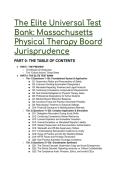
The Elite Universal Test
Bank: Massachusetts
Physical Therapy Board
Jurisprudence
PART 0: THE TABLE OF CONTENTS
● PART I: THE PREVIEW
○ The Mission & Introduction
○ The "Critical Axioms" Cheat Sheet
● PART II: THE ELITE TEST BANK
○ Tier 1 (Questions 1–10): Foundational Syntax & Application
■ Q1: Supervision Ratios and Presumptions of Safety
■ Q2: Licensure Pending Examination Designations
■ Q3: Mandated Reporting Timelines and Legal Protocols
■ Q4: Continuing Competence Jurisprudence Requirements
■ Q5: Sub-Clinical Delegation to Physical Therapy Aides
■ Q6: Professional Designations for Active Students
■ Q7: Medical Record Retention Baselines
■ Q8: Insurance Fraud and Practice Ownership Penalties
■ Q9: Reevaluation Timelines in Subacute Settings
■ Q10: Financial Disclosure in Multidisciplinary Referrals
○ Tier 2 (Questions 11–20): Complex Application & Simulation
■ Q11: Delegation Revocation During Acuity Shifts
■ Q12: Continuing Competence Waiver Mechanics
■ Q13: License Expiration and Immediate Cessation
■ Q14: Internal Escalation vs. Mandated Reporter Liability
■ Q15: Student Supervision and Documentation Authentication
■ Q16: Telehealth and Off-Site Supervisory Tethers
■ Q17: Contextualizing Reevaluation Cadence by Acuity
■ Q18: Scope of Practice and the Dry Needling Debate
■ Q19: NPTE Failure and Privilege Termination
■ Q20: Solo Practice Substitute Coverage Limitations
○ Tier 3 (Questions 21–30): Grandmaster Synthesis
■ Q21: The Clinical Cascade: Supervision Caps and Acute Emergencies
■ Q22: The Ethical Gauntlet: Reporting Immunity vs. Patient Confidentiality
■ Q23: The Compliance Audit: Proration, Ethics, and Invalid CEUs
, ■ Q24: The Disciplinary Matrix: Vicarious Liability and Fraudulent Billing
■ Q25: The Documentation Labyrinth: Multi-Tiered Authentication
■ Q26: The Legislative Grey Area: Advanced Certifications and Scope
■ Q27: The Multidisciplinary Referral Trap: Transparency and Divestment
■ Q28: The Pediatric Discharge Dilemma: Dual-Threshold Retention
■ Q29: The Systemic Failure: Reevaluation Expirations and Unauthorized Care
■ Q30: The Apex Jurisprudence Simulation: Facility Structure and Delegation
PART I: THE PREVIEW
Mastering this test bank translates directly to elite clinical and administrative performance by
transforming abstract legal statutes into reflexive, high-stakes decision-making algorithms. By
internalizing these jurisprudential frameworks, the practitioner eliminates legal liability,
guarantees regulatory compliance, and establishes an impenetrable foundation for superior
patient care within the Commonwealth of Massachusetts.
The "Critical Axioms" Cheat Sheet
Axiom Category The Absolute Legal Standard
Supervision Limits A physical therapist may never safely and
effectively supervise more than three (3)
physical therapist assistants at one time.
Mandated Reporting Suspected abuse requires an IMMEDIATE oral
report to the Department of Children and
Families, followed strictly by a written report
within 48 HOURS.
Continuing Competence Licensees must accrue 24 points biennially,
strictly including 2 points dedicated to ethics,
laws, and regulations.
Aide Delegation Physical Therapy Aides are restricted to
non-skilled tasks, limited to activities such as
previously established endurance ambulation
and the application of superficial modalities.
Reevaluation Rhythm Plan of Care reviews occur every 7-10 days
(acute), every 30 days (outpatient/SNF/home
health), and every 90 days (chronic/school).
PART II: THE ELITE TEST BANK
Tier 1: Foundational Syntax & Application
Q1: A newly appointed Rehabilitation Director in a large outpatient facility is finalizing the daily
clinical schedule. The facility employs two licensed Physical Therapists (PTs) and eight licensed
Physical Therapist Assistants (PTAs). Based on the Massachusetts Board of Allied Health
Professions regulations regarding patient care management, which conclusion regarding
staffing allocation is the MOST ACCURATE? A) The two PTs can safely supervise all eight
PTAs if they remain physically present in the same building during all treatment hours. B) The
two PTs are legally restricted to supervising a maximum of six PTAs simultaneously, rendering
the current staffing model non-compliant. C) The facility may utilize all eight PTAs
, simultaneously provided that the PTs conduct daily end-of-shift documentation reviews. D) The
supervisory ratio is at the discretion of the Rehabilitation Director, provided patient outcomes
remain uncompromised.
● Answer: B (The two PTs are legally restricted to supervising a maximum of six PTAs
simultaneously, rendering the current staffing model non-compliant.)
● Distractor Analysis:
○ A is incorrect: Physical presence does not override the statutory cap on the number
of assistants a single therapist can manage. The ratio applies regardless of
proximity.
○ C is incorrect: Retrospective documentation review does not satisfy active
supervision requirements, nor does it expand the legal maximum ratio.
○ D is incorrect: The Board explicitly removes discretionary ratios that exceed the
established maximum, presuming any ratio above 1:3 to be inherently unsafe.
The Mentor's Analysis: The Board explicitly states that it will presume a ratio exceeding one
physical therapist to three physical therapist assistants (1:3) is not safe and effective. Therefore,
two PTs can legally supervise a maximum of six PTAs. By strictly adhering to the 1:3
mathematical limit, practitioners bypass the common administrative trap of assuming facility
volume dictates regulatory compliance. Professional/Academic Intuition: Never exceed the
1:3 PT-to-PTA ratio; administrative pressure does not absolve regulatory liability.
Q2: A recent graduate from an accredited Doctor of Physical Therapy program has submitted a
complete application for licensure by examination in Massachusetts. While waiting for the date
of the National Physical Therapy Examination (NPTE), the applicant accepts a clinical position
under the direct supervision of a licensed physical therapist. According to M.G.L. c. 112, § 23C,
which signature designation is MOST APPROPRIATE for this individual to utilize in the medical
record? A) Physical Therapy Student (PT/s) B) Unlicensed Physical Therapist (UPT) C) Physical
Therapist Candidate (PT/c) D) Physical Therapy Intern (PTI)
● Answer: C (Physical Therapist Candidate (PT/c))
● Distractor Analysis:
○ A is incorrect: The student designation requires active enrollment in an academic
program. Graduation voids the legal use of the student suffix.
○ B is incorrect: This is a fabricated, unrecognized designation that exposes the clinic
to immediate billing and compliance audits.
○ D is incorrect: While colloquially used in some medical disciplines, "intern" is not the
statutory designation for a graduate practicing under a filed application in
Massachusetts.
The Mentor's Analysis: Massachusetts jurisprudence establishes a specific grace window
allowing graduates to practice between filing an application for licensure and the announcement
of the results of the next succeeding examination. During this precise timeframe, the individual
is classified as a candidate and must append PT/c to their signature. Using legacy or fabricated
titles violates documentation standards. Professional/Academic Intuition: The "c" stands for
candidate; it is a temporary, conditional legal shield that exists only until the first exam
score is posted.
Q3: A physical therapist providing home health services observes widespread, unexplained
bruising and severe malnourishment in a 7-year-old patient. The therapist develops a
reasonable cause to believe the child is suffering from neglect. Under M.G.L. c. 119, § 51A,
what is the FIRST legally mandated action the practitioner must execute? A) File a
comprehensive written report with the Department of Children and Families within 24 hours of
the observation. B) Confront the primary caregiver to gather contextual evidence before
Bank: Massachusetts
Physical Therapy Board
Jurisprudence
PART 0: THE TABLE OF CONTENTS
● PART I: THE PREVIEW
○ The Mission & Introduction
○ The "Critical Axioms" Cheat Sheet
● PART II: THE ELITE TEST BANK
○ Tier 1 (Questions 1–10): Foundational Syntax & Application
■ Q1: Supervision Ratios and Presumptions of Safety
■ Q2: Licensure Pending Examination Designations
■ Q3: Mandated Reporting Timelines and Legal Protocols
■ Q4: Continuing Competence Jurisprudence Requirements
■ Q5: Sub-Clinical Delegation to Physical Therapy Aides
■ Q6: Professional Designations for Active Students
■ Q7: Medical Record Retention Baselines
■ Q8: Insurance Fraud and Practice Ownership Penalties
■ Q9: Reevaluation Timelines in Subacute Settings
■ Q10: Financial Disclosure in Multidisciplinary Referrals
○ Tier 2 (Questions 11–20): Complex Application & Simulation
■ Q11: Delegation Revocation During Acuity Shifts
■ Q12: Continuing Competence Waiver Mechanics
■ Q13: License Expiration and Immediate Cessation
■ Q14: Internal Escalation vs. Mandated Reporter Liability
■ Q15: Student Supervision and Documentation Authentication
■ Q16: Telehealth and Off-Site Supervisory Tethers
■ Q17: Contextualizing Reevaluation Cadence by Acuity
■ Q18: Scope of Practice and the Dry Needling Debate
■ Q19: NPTE Failure and Privilege Termination
■ Q20: Solo Practice Substitute Coverage Limitations
○ Tier 3 (Questions 21–30): Grandmaster Synthesis
■ Q21: The Clinical Cascade: Supervision Caps and Acute Emergencies
■ Q22: The Ethical Gauntlet: Reporting Immunity vs. Patient Confidentiality
■ Q23: The Compliance Audit: Proration, Ethics, and Invalid CEUs
, ■ Q24: The Disciplinary Matrix: Vicarious Liability and Fraudulent Billing
■ Q25: The Documentation Labyrinth: Multi-Tiered Authentication
■ Q26: The Legislative Grey Area: Advanced Certifications and Scope
■ Q27: The Multidisciplinary Referral Trap: Transparency and Divestment
■ Q28: The Pediatric Discharge Dilemma: Dual-Threshold Retention
■ Q29: The Systemic Failure: Reevaluation Expirations and Unauthorized Care
■ Q30: The Apex Jurisprudence Simulation: Facility Structure and Delegation
PART I: THE PREVIEW
Mastering this test bank translates directly to elite clinical and administrative performance by
transforming abstract legal statutes into reflexive, high-stakes decision-making algorithms. By
internalizing these jurisprudential frameworks, the practitioner eliminates legal liability,
guarantees regulatory compliance, and establishes an impenetrable foundation for superior
patient care within the Commonwealth of Massachusetts.
The "Critical Axioms" Cheat Sheet
Axiom Category The Absolute Legal Standard
Supervision Limits A physical therapist may never safely and
effectively supervise more than three (3)
physical therapist assistants at one time.
Mandated Reporting Suspected abuse requires an IMMEDIATE oral
report to the Department of Children and
Families, followed strictly by a written report
within 48 HOURS.
Continuing Competence Licensees must accrue 24 points biennially,
strictly including 2 points dedicated to ethics,
laws, and regulations.
Aide Delegation Physical Therapy Aides are restricted to
non-skilled tasks, limited to activities such as
previously established endurance ambulation
and the application of superficial modalities.
Reevaluation Rhythm Plan of Care reviews occur every 7-10 days
(acute), every 30 days (outpatient/SNF/home
health), and every 90 days (chronic/school).
PART II: THE ELITE TEST BANK
Tier 1: Foundational Syntax & Application
Q1: A newly appointed Rehabilitation Director in a large outpatient facility is finalizing the daily
clinical schedule. The facility employs two licensed Physical Therapists (PTs) and eight licensed
Physical Therapist Assistants (PTAs). Based on the Massachusetts Board of Allied Health
Professions regulations regarding patient care management, which conclusion regarding
staffing allocation is the MOST ACCURATE? A) The two PTs can safely supervise all eight
PTAs if they remain physically present in the same building during all treatment hours. B) The
two PTs are legally restricted to supervising a maximum of six PTAs simultaneously, rendering
the current staffing model non-compliant. C) The facility may utilize all eight PTAs
, simultaneously provided that the PTs conduct daily end-of-shift documentation reviews. D) The
supervisory ratio is at the discretion of the Rehabilitation Director, provided patient outcomes
remain uncompromised.
● Answer: B (The two PTs are legally restricted to supervising a maximum of six PTAs
simultaneously, rendering the current staffing model non-compliant.)
● Distractor Analysis:
○ A is incorrect: Physical presence does not override the statutory cap on the number
of assistants a single therapist can manage. The ratio applies regardless of
proximity.
○ C is incorrect: Retrospective documentation review does not satisfy active
supervision requirements, nor does it expand the legal maximum ratio.
○ D is incorrect: The Board explicitly removes discretionary ratios that exceed the
established maximum, presuming any ratio above 1:3 to be inherently unsafe.
The Mentor's Analysis: The Board explicitly states that it will presume a ratio exceeding one
physical therapist to three physical therapist assistants (1:3) is not safe and effective. Therefore,
two PTs can legally supervise a maximum of six PTAs. By strictly adhering to the 1:3
mathematical limit, practitioners bypass the common administrative trap of assuming facility
volume dictates regulatory compliance. Professional/Academic Intuition: Never exceed the
1:3 PT-to-PTA ratio; administrative pressure does not absolve regulatory liability.
Q2: A recent graduate from an accredited Doctor of Physical Therapy program has submitted a
complete application for licensure by examination in Massachusetts. While waiting for the date
of the National Physical Therapy Examination (NPTE), the applicant accepts a clinical position
under the direct supervision of a licensed physical therapist. According to M.G.L. c. 112, § 23C,
which signature designation is MOST APPROPRIATE for this individual to utilize in the medical
record? A) Physical Therapy Student (PT/s) B) Unlicensed Physical Therapist (UPT) C) Physical
Therapist Candidate (PT/c) D) Physical Therapy Intern (PTI)
● Answer: C (Physical Therapist Candidate (PT/c))
● Distractor Analysis:
○ A is incorrect: The student designation requires active enrollment in an academic
program. Graduation voids the legal use of the student suffix.
○ B is incorrect: This is a fabricated, unrecognized designation that exposes the clinic
to immediate billing and compliance audits.
○ D is incorrect: While colloquially used in some medical disciplines, "intern" is not the
statutory designation for a graduate practicing under a filed application in
Massachusetts.
The Mentor's Analysis: Massachusetts jurisprudence establishes a specific grace window
allowing graduates to practice between filing an application for licensure and the announcement
of the results of the next succeeding examination. During this precise timeframe, the individual
is classified as a candidate and must append PT/c to their signature. Using legacy or fabricated
titles violates documentation standards. Professional/Academic Intuition: The "c" stands for
candidate; it is a temporary, conditional legal shield that exists only until the first exam
score is posted.
Q3: A physical therapist providing home health services observes widespread, unexplained
bruising and severe malnourishment in a 7-year-old patient. The therapist develops a
reasonable cause to believe the child is suffering from neglect. Under M.G.L. c. 119, § 51A,
what is the FIRST legally mandated action the practitioner must execute? A) File a
comprehensive written report with the Department of Children and Families within 24 hours of
the observation. B) Confront the primary caregiver to gather contextual evidence before


