

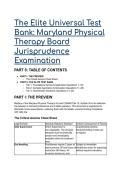
The Elite Universal Test
Bank: Maryland Physical
Therapy Board
Jurisprudence
Examination
PART 0: TABLE OF CONTENTS
● PART I: THE PREVIEW
○ The Critical Axioms Cheat Sheet
● PART II: THE ELITE TEST BANK
○ Tier 1: Foundational Syntax & Application (Questions 1–10)
○ Tier 2: Complex Application & Simulation (Questions 11–20)
○ Tier 3: Grandmaster Synthesis (Questions 21–30)
PART I: THE PREVIEW
Mastery of the Maryland Physical Therapy Act and COMAR Title 10, Subtitle 38 is the definitive
line between a licensed professional and a liable operative. This document is engineered to
dismantle novice assumptions, replacing them with immediate, uncompromising compliance
with state law.
The Critical Axioms Cheat Sheet
Legal Domain Absolute Statutory Standard Critical Consequence of Failure
Aide Supervision Direct Supervision is Unauthorized practice;
non-negotiable. The physical fraudulent billing if notes are
therapist must be physically co-signed.
present and immediately
available within the treatment
area.
Dry Needling Practitioners require 2 years of Subject to immediate
active practice, 80 total hours of disciplinary action for practicing
instruction (40 theory, 40 without required education.
in-person hands-on), and
,Legal Domain Absolute Statutory Standard Critical Consequence of Failure
official Board registration.
Record Retention Adult medical records must be Unlawful destruction constitutes
retained for exactly 7 years a misdemeanor.
after the record or report is
made.
Telehealth Practitioner must hold an active Practicing medicine without a
Maryland license or PT license; full disciplinary board
Compact Privilege if the patient action.
is physically located in
Maryland.
Re-evaluation A physical therapist must Operating outside the legal plan
re-evaluate the patient as the of care; substandard care.
condition requires, but no later
than every 30 days, unless
clinical rationale is
documented.
PART II: THE ELITE TEST BANK
Tier 1: Foundational Syntax & Application
Q1: An advocacy group is petitioning the Governor of Maryland to alter the composition of the
State Board of Physical Therapy Examiners to include more consumer voices. Based on the
principles of the Maryland Health Occupations Article, § 13-202, which conclusion regarding the
current Board composition is the MOST ACCURATE? A) The Board consists of 9 members: 6
physical therapists, 1 physical therapist assistant, and 2 consumer members. B) The Board
consists of 8 members: 5 physical therapists, 1 physical therapist assistant, and 2 consumer
members. C) The Board consists of 7 members: 4 physical therapists, 1 physical therapist
assistant, and 2 consumer members. D) The Board consists of 8 members, all of whom must be
actively practicing physical therapists or assistants in the state.
● Answer: B (The Board consists of 8 members: 5 physical therapists, 1 physical therapist
assistant, and 2 consumer members.)
● Distractor Analysis:
○ A is incorrect: This overestimates the total board size and physical therapist
representation, violating the statutory cap of 8 total members.
○ C is incorrect: This underestimates the required number of physical therapists,
failing to meet the statutory requirement of 5 licensed physical therapists.
○ D is incorrect: This is a critical novice error that ignores the statutory mandate
requiring exactly two consumer members to protect public interests.
The Mentor's Analysis: Regulatory boards are designed to balance professional clinical
expertise with objective public accountability. The Maryland Board strictly adheres to an
8-member structure, ensuring clinical insight without monopolizing public policy.
Professional/Academic Intuition: Regulatory oversight requires public representation;
exactly two consumer members are mandated to ensure objective governance without
industry bias.
Q2: A physical therapist leaves the immediate treatment floor to take a 15-minute phone call in
a separate administrative suite on the floor above. During this time, a physical therapy aide
, initiates a prescribed progressive resistance exercise program with a patient. Based on the
principles of COMAR 10.38.04 and 10.38.01, which action/conclusion is the MOST
ACCURATE? A) The action is legal as long as the physical therapist is in the same building and
can be reached by a communication device. B) The action is legal because progressive
resistance exercises are routine and do not require ongoing clinical assessment. C) The action
constitutes unauthorized practice, as the aide is operating without direct supervision. D) The
action constitutes unauthorized practice unless a physical therapist assistant is present in the
administrative suite.
● Answer: C (The action constitutes unauthorized practice, as the aide is operating without
direct supervision.)
● Distractor Analysis:
○ A is incorrect: "In the building" defines general supervision, which is illegal for aides
in Maryland. Direct supervision requires physical presence within the treatment
area.
○ B is incorrect: Aides cannot independently initiate or progress treatments without
the physical presence of the therapist, regardless of task complexity.
○ D is incorrect: The presence of a PTA in a separate suite is irrelevant; a PTA cannot
supervise an aide, and neither clinician is providing direct, in-room supervision.
The Mentor's Analysis: Delegation is a transfer of task, not a transfer of liability. COMAR
defines Direct Supervision with geographic strictness: the therapist must be physically present
and immediately available in the treatment area. When you step out of the room, the aide's legal
authority to touch a patient drops to zero. Professional/Academic Intuition: Direct
supervision is defined by line-of-sight and physical proximity, never by pager or phone
proximity.
Q3: A recent graduate applies for a temporary license to practice physical therapy in Maryland
while awaiting national examination results. Based on the principles of COMAR 10.38.06, which
action/conclusion regarding the temporary license is the MOST ACCURATE? A) The temporary
license is valid for 120 days and allows the individual to practice under general supervision. B)
The temporary license is valid for 90 days and requires the holder to achieve a passing score on
the Maryland jurisprudence exam. C) The temporary license allows independent practice for up
to 6 months provided the criminal history check is clear. D) The temporary license is valid
indefinitely until the national board scores are officially released by the FSBPT.
● Answer: B (The temporary license is valid for 90 days and requires the holder to achieve
a passing score on the Maryland jurisprudence exam.)
● Distractor Analysis:
○ A is incorrect: The timeframe is strictly 90 days, and practice must be under direct
supervision, not general.
○ C is incorrect: Independent practice is strictly forbidden for temporary license
holders; direct supervision is an absolute requirement.
○ D is incorrect: Temporary licenses have a hard expiration at 90 days, or upon
issuance of a full license, or upon revocation, completely independent of indefinite
administrative delays from the FSBPT.
The Mentor's Analysis: The temporary license is a highly restricted, short-term mechanism
designed solely to bridge the gap between graduation and full licensure. It inherently assumes
the practitioner is clinically unvetted, thus demanding direct supervision and the immediate
passage of the state jurisprudence exam to ensure legal competency. Professional/Academic
Intuition: Temporary licensure is a 90-day probationary window demanding direct
supervision and immediate jurisprudential compliance.
Bank: Maryland Physical
Therapy Board
Jurisprudence
Examination
PART 0: TABLE OF CONTENTS
● PART I: THE PREVIEW
○ The Critical Axioms Cheat Sheet
● PART II: THE ELITE TEST BANK
○ Tier 1: Foundational Syntax & Application (Questions 1–10)
○ Tier 2: Complex Application & Simulation (Questions 11–20)
○ Tier 3: Grandmaster Synthesis (Questions 21–30)
PART I: THE PREVIEW
Mastery of the Maryland Physical Therapy Act and COMAR Title 10, Subtitle 38 is the definitive
line between a licensed professional and a liable operative. This document is engineered to
dismantle novice assumptions, replacing them with immediate, uncompromising compliance
with state law.
The Critical Axioms Cheat Sheet
Legal Domain Absolute Statutory Standard Critical Consequence of Failure
Aide Supervision Direct Supervision is Unauthorized practice;
non-negotiable. The physical fraudulent billing if notes are
therapist must be physically co-signed.
present and immediately
available within the treatment
area.
Dry Needling Practitioners require 2 years of Subject to immediate
active practice, 80 total hours of disciplinary action for practicing
instruction (40 theory, 40 without required education.
in-person hands-on), and
,Legal Domain Absolute Statutory Standard Critical Consequence of Failure
official Board registration.
Record Retention Adult medical records must be Unlawful destruction constitutes
retained for exactly 7 years a misdemeanor.
after the record or report is
made.
Telehealth Practitioner must hold an active Practicing medicine without a
Maryland license or PT license; full disciplinary board
Compact Privilege if the patient action.
is physically located in
Maryland.
Re-evaluation A physical therapist must Operating outside the legal plan
re-evaluate the patient as the of care; substandard care.
condition requires, but no later
than every 30 days, unless
clinical rationale is
documented.
PART II: THE ELITE TEST BANK
Tier 1: Foundational Syntax & Application
Q1: An advocacy group is petitioning the Governor of Maryland to alter the composition of the
State Board of Physical Therapy Examiners to include more consumer voices. Based on the
principles of the Maryland Health Occupations Article, § 13-202, which conclusion regarding the
current Board composition is the MOST ACCURATE? A) The Board consists of 9 members: 6
physical therapists, 1 physical therapist assistant, and 2 consumer members. B) The Board
consists of 8 members: 5 physical therapists, 1 physical therapist assistant, and 2 consumer
members. C) The Board consists of 7 members: 4 physical therapists, 1 physical therapist
assistant, and 2 consumer members. D) The Board consists of 8 members, all of whom must be
actively practicing physical therapists or assistants in the state.
● Answer: B (The Board consists of 8 members: 5 physical therapists, 1 physical therapist
assistant, and 2 consumer members.)
● Distractor Analysis:
○ A is incorrect: This overestimates the total board size and physical therapist
representation, violating the statutory cap of 8 total members.
○ C is incorrect: This underestimates the required number of physical therapists,
failing to meet the statutory requirement of 5 licensed physical therapists.
○ D is incorrect: This is a critical novice error that ignores the statutory mandate
requiring exactly two consumer members to protect public interests.
The Mentor's Analysis: Regulatory boards are designed to balance professional clinical
expertise with objective public accountability. The Maryland Board strictly adheres to an
8-member structure, ensuring clinical insight without monopolizing public policy.
Professional/Academic Intuition: Regulatory oversight requires public representation;
exactly two consumer members are mandated to ensure objective governance without
industry bias.
Q2: A physical therapist leaves the immediate treatment floor to take a 15-minute phone call in
a separate administrative suite on the floor above. During this time, a physical therapy aide
, initiates a prescribed progressive resistance exercise program with a patient. Based on the
principles of COMAR 10.38.04 and 10.38.01, which action/conclusion is the MOST
ACCURATE? A) The action is legal as long as the physical therapist is in the same building and
can be reached by a communication device. B) The action is legal because progressive
resistance exercises are routine and do not require ongoing clinical assessment. C) The action
constitutes unauthorized practice, as the aide is operating without direct supervision. D) The
action constitutes unauthorized practice unless a physical therapist assistant is present in the
administrative suite.
● Answer: C (The action constitutes unauthorized practice, as the aide is operating without
direct supervision.)
● Distractor Analysis:
○ A is incorrect: "In the building" defines general supervision, which is illegal for aides
in Maryland. Direct supervision requires physical presence within the treatment
area.
○ B is incorrect: Aides cannot independently initiate or progress treatments without
the physical presence of the therapist, regardless of task complexity.
○ D is incorrect: The presence of a PTA in a separate suite is irrelevant; a PTA cannot
supervise an aide, and neither clinician is providing direct, in-room supervision.
The Mentor's Analysis: Delegation is a transfer of task, not a transfer of liability. COMAR
defines Direct Supervision with geographic strictness: the therapist must be physically present
and immediately available in the treatment area. When you step out of the room, the aide's legal
authority to touch a patient drops to zero. Professional/Academic Intuition: Direct
supervision is defined by line-of-sight and physical proximity, never by pager or phone
proximity.
Q3: A recent graduate applies for a temporary license to practice physical therapy in Maryland
while awaiting national examination results. Based on the principles of COMAR 10.38.06, which
action/conclusion regarding the temporary license is the MOST ACCURATE? A) The temporary
license is valid for 120 days and allows the individual to practice under general supervision. B)
The temporary license is valid for 90 days and requires the holder to achieve a passing score on
the Maryland jurisprudence exam. C) The temporary license allows independent practice for up
to 6 months provided the criminal history check is clear. D) The temporary license is valid
indefinitely until the national board scores are officially released by the FSBPT.
● Answer: B (The temporary license is valid for 90 days and requires the holder to achieve
a passing score on the Maryland jurisprudence exam.)
● Distractor Analysis:
○ A is incorrect: The timeframe is strictly 90 days, and practice must be under direct
supervision, not general.
○ C is incorrect: Independent practice is strictly forbidden for temporary license
holders; direct supervision is an absolute requirement.
○ D is incorrect: Temporary licenses have a hard expiration at 90 days, or upon
issuance of a full license, or upon revocation, completely independent of indefinite
administrative delays from the FSBPT.
The Mentor's Analysis: The temporary license is a highly restricted, short-term mechanism
designed solely to bridge the gap between graduation and full licensure. It inherently assumes
the practitioner is clinically unvetted, thus demanding direct supervision and the immediate
passage of the state jurisprudence exam to ensure legal competency. Professional/Academic
Intuition: Temporary licensure is a 90-day probationary window demanding direct
supervision and immediate jurisprudential compliance.


