

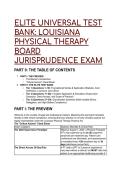
ELITE UNIVERSAL TEST
BANK: LOUISIANA
PHYSICAL THERAPY
BOARD
JURISPRUDENCE EXAM
PART 0: THE TABLE OF CONTENTS
1. PART I: THE PREVIEW
○ The Mentor's Introduction
○ "Critical Axioms" Cheat Sheet
2. PART II: THE ELITE TEST BANK
○ Tier 1 (Questions 1–10): Foundational Syntax & Application (Statutes, Core
Definitions, Licensure, and CEUs)
○ Tier 2 (Questions 11–20): Complex Application & Simulation (Supervision
Dynamics, Direct Access, and Scope of Practice)
○ Tier 3 (Questions 21–30): Grandmaster Synthesis (Multi-variable Ethics,
Delegation, and High-Stakes Compliance)
PART I: THE PREVIEW
Welcome to the crucible of legal and professional mastery. Mastering this test bank translates
directly to elite clinical compliance, ensuring that your practice is not only clinically superior but
legally impenetrable under the Louisiana Physical Therapy Practice Act.
The "Critical Axioms" Cheat Sheet
Axiom Category Statutory Mandate & Critical Rule
The 2025 Supervision Paradigm Effective August 1, 2025, a Physical Therapist
(PT) may supervise up to six (6) supportive
personnel per treatment day. Patient care
conferences are eliminated, and reassessment
is mandated every 12th treatment day or 30
days (whichever occurs first).
The Direct Access 30-Day Rule A PT (with a DPT or 5 years of experience)
may treat without a referral, but MUST refer the
patient to an appropriate healthcare provider if
,Axiom Category Statutory Mandate & Critical Rule
no measurable or functional improvement is
documented within 30 days.
The Dry Needling Mandate Requires no fewer than 25 hours of in-person,
hands-on instruction. The PT MUST educate
the patient on risks/benefits and secure
informed consent documented directly in the
patient's treatment record prior to the
procedure.
The Biennial CEU Law Licensees require 30 board-approved
continuing education hours every two years
(birth year odd/even cycle). This strictly
includes 2 hours of Jurisprudence and 2 hours
of Ethics.
PART II: THE ELITE TEST BANK
TIER 1: FOUNDATIONAL SYNTAX & APPLICATION
Q1: A newly licensed physical therapist in Louisiana is outlining their continuing education
(CEU) strategy for their first biennial renewal cycle. Based on the principles of the Louisiana
Physical Therapy Board (LPTB) continuing education requirements, which conclusion regarding
CEU allocation is the MOST ACCURATE? A) The licensee must complete 30 hours of CEUs
annually, including 4 hours of jurisprudence and ethics. B) The licensee must complete 30 hours
biennially, which must include a minimum of 2 hours of ethics and 2 hours of jurisprudence. C)
The licensee must complete 30 hours biennially, but if they graduated in the same calendar
year, they are only exempt from the clinical hours requirement. D) The licensee must complete
25 hours of clinical education, 3 hours of ethics, and 2 hours of jurisprudence biennially.
● Answer/Respuesta/Réponse: B (The licensee must complete 30 hours biennially, which
must include a minimum of 2 hours of ethics and 2 hours of jurisprudence.)
● Distractor Analysis:
○ A is incorrect: The LPTB stipulates that CEU requirements are calculated on a
biennial (two-year) cycle tied to the licensee's birth year, not annually.
○ C is incorrect: New graduates are fully exempt from all CE requirements in the
calendar year in which they graduate, not merely the clinical hours.
○ D is incorrect: The exact statutory distribution requires a minimum of 2 hours in
jurisprudence, 2 hours in ethics/professionalism, leaving 26 hours for
clinical/administrative categories.
The Mentor's Analysis: Mastery of administrative compliance is the bedrock of clinical
privilege. The LPTB mandates a strict 30-hour biennial CEU requirement to ensure practitioners
remain tethered to both clinical advancements and ethical frameworks.
CEU Category Minimum Contact Hours Required (Biennial)
Jurisprudence 2 hours
Ethics / Professionalism 2 hours
Clinical / Administrative 26 hours
Total 30 hours
By utilizing Biennial CEU Allocation, you bypass the common trap of miscalculating mandatory
, categorical minimums. Professional/Academic Intuition: Never assume clinical excellence
negates administrative duty; exactly 4 of your 30 biennial hours must be strictly
dedicated to legal and ethical compliance.
Q2: A physical therapist with an odd-year birthdate is preparing to renew their active license.
They realize it is April 15th of an odd-numbered year. Based on the principles of Louisiana
Physical Therapy Board renewal timelines, which action/conclusion is the MOST ACCURATE?
A) The license is already expired, and the PT must immediately cease practice and apply for
reinstatement. B) The license remains active until April 30th, but the PT is now subject to an
additional late renewal fee of $120. C) The PT is within the standard renewal grace period and
may renew by April 30th without any financial penalty. D) The PT must complete an additional
10 hours of continuing education due to missing the March 31st deadline.
● Answer/Respuesta/Réponse: B (The license remains active until April 30th, but the PT
is now subject to an additional late renewal fee of $120.)
● Distractor Analysis:
○ A is incorrect: The license does not officially expire until April 30th. Practice is still
legally permitted in April, provided the late renewal is processed.
○ C is incorrect: While they can still renew, doing so in the month of April triggers a
mandatory $120 late fee in addition to the standard $140 renewal fee.
○ D is incorrect: There is no punitive CEU multiplier for late renewals; the penalty is
strictly financial.
The Mentor's Analysis: The board utilizes structured deadlines to maintain administrative
order. The standard renewal season opens February 1st and closes on March 31st, triggering a
punitive, yet legally active, "late renewal" phase through April 30th. By utilizing Timeline
Adherence, you bypass the common trap of practicing on an expired license on May 1st.
Professional/Academic Intuition: March 31st is the financial deadline; April 30th is the
legal hard-deck for expiration.
Q3: The Governor of Louisiana is preparing to appoint a new member to the Louisiana Physical
Therapy Board. Based on the principles of LPTB Board Composition, which configuration of the
8-member board is the MOST ACCURATE? A) Six physical therapists, one physician, and one
physical therapist assistant. B) Five physical therapists, one physical therapist assistant, one
medical doctor, and one consumer member. C) Four physical therapists, two physical therapist
assistants, and two consumer members. D) Five physical therapists, two medical doctors, and
one consumer member.
● Answer/Respuesta/Réponse: B (Five physical therapists, one physical therapist
assistant, one medical doctor, and one consumer member.)
● Distractor Analysis:
○ A is incorrect: This configuration excludes the statutorily required consumer (public)
member.
○ C is incorrect: The board strictly limits PTA representation to one member and
mandates the inclusion of a medical doctor.
○ D is incorrect: The board mandates PTA representation, which is excluded in this
distractor.
The Mentor's Analysis: Regulatory boards are architected to balance intra-professional
expertise with inter-professional oversight and public accountability. The LPTB's specific ratio (8
members appointed by the governor for three-year terms) ensures clinical governance while
preventing echo-chamber policymaking. By utilizing Statutory Board Composition, you bypass
the common trap of assuming boards are exclusively populated by physical therapists.
Professional/Academic Intuition: True regulatory oversight demands a matrix of
BANK: LOUISIANA
PHYSICAL THERAPY
BOARD
JURISPRUDENCE EXAM
PART 0: THE TABLE OF CONTENTS
1. PART I: THE PREVIEW
○ The Mentor's Introduction
○ "Critical Axioms" Cheat Sheet
2. PART II: THE ELITE TEST BANK
○ Tier 1 (Questions 1–10): Foundational Syntax & Application (Statutes, Core
Definitions, Licensure, and CEUs)
○ Tier 2 (Questions 11–20): Complex Application & Simulation (Supervision
Dynamics, Direct Access, and Scope of Practice)
○ Tier 3 (Questions 21–30): Grandmaster Synthesis (Multi-variable Ethics,
Delegation, and High-Stakes Compliance)
PART I: THE PREVIEW
Welcome to the crucible of legal and professional mastery. Mastering this test bank translates
directly to elite clinical compliance, ensuring that your practice is not only clinically superior but
legally impenetrable under the Louisiana Physical Therapy Practice Act.
The "Critical Axioms" Cheat Sheet
Axiom Category Statutory Mandate & Critical Rule
The 2025 Supervision Paradigm Effective August 1, 2025, a Physical Therapist
(PT) may supervise up to six (6) supportive
personnel per treatment day. Patient care
conferences are eliminated, and reassessment
is mandated every 12th treatment day or 30
days (whichever occurs first).
The Direct Access 30-Day Rule A PT (with a DPT or 5 years of experience)
may treat without a referral, but MUST refer the
patient to an appropriate healthcare provider if
,Axiom Category Statutory Mandate & Critical Rule
no measurable or functional improvement is
documented within 30 days.
The Dry Needling Mandate Requires no fewer than 25 hours of in-person,
hands-on instruction. The PT MUST educate
the patient on risks/benefits and secure
informed consent documented directly in the
patient's treatment record prior to the
procedure.
The Biennial CEU Law Licensees require 30 board-approved
continuing education hours every two years
(birth year odd/even cycle). This strictly
includes 2 hours of Jurisprudence and 2 hours
of Ethics.
PART II: THE ELITE TEST BANK
TIER 1: FOUNDATIONAL SYNTAX & APPLICATION
Q1: A newly licensed physical therapist in Louisiana is outlining their continuing education
(CEU) strategy for their first biennial renewal cycle. Based on the principles of the Louisiana
Physical Therapy Board (LPTB) continuing education requirements, which conclusion regarding
CEU allocation is the MOST ACCURATE? A) The licensee must complete 30 hours of CEUs
annually, including 4 hours of jurisprudence and ethics. B) The licensee must complete 30 hours
biennially, which must include a minimum of 2 hours of ethics and 2 hours of jurisprudence. C)
The licensee must complete 30 hours biennially, but if they graduated in the same calendar
year, they are only exempt from the clinical hours requirement. D) The licensee must complete
25 hours of clinical education, 3 hours of ethics, and 2 hours of jurisprudence biennially.
● Answer/Respuesta/Réponse: B (The licensee must complete 30 hours biennially, which
must include a minimum of 2 hours of ethics and 2 hours of jurisprudence.)
● Distractor Analysis:
○ A is incorrect: The LPTB stipulates that CEU requirements are calculated on a
biennial (two-year) cycle tied to the licensee's birth year, not annually.
○ C is incorrect: New graduates are fully exempt from all CE requirements in the
calendar year in which they graduate, not merely the clinical hours.
○ D is incorrect: The exact statutory distribution requires a minimum of 2 hours in
jurisprudence, 2 hours in ethics/professionalism, leaving 26 hours for
clinical/administrative categories.
The Mentor's Analysis: Mastery of administrative compliance is the bedrock of clinical
privilege. The LPTB mandates a strict 30-hour biennial CEU requirement to ensure practitioners
remain tethered to both clinical advancements and ethical frameworks.
CEU Category Minimum Contact Hours Required (Biennial)
Jurisprudence 2 hours
Ethics / Professionalism 2 hours
Clinical / Administrative 26 hours
Total 30 hours
By utilizing Biennial CEU Allocation, you bypass the common trap of miscalculating mandatory
, categorical minimums. Professional/Academic Intuition: Never assume clinical excellence
negates administrative duty; exactly 4 of your 30 biennial hours must be strictly
dedicated to legal and ethical compliance.
Q2: A physical therapist with an odd-year birthdate is preparing to renew their active license.
They realize it is April 15th of an odd-numbered year. Based on the principles of Louisiana
Physical Therapy Board renewal timelines, which action/conclusion is the MOST ACCURATE?
A) The license is already expired, and the PT must immediately cease practice and apply for
reinstatement. B) The license remains active until April 30th, but the PT is now subject to an
additional late renewal fee of $120. C) The PT is within the standard renewal grace period and
may renew by April 30th without any financial penalty. D) The PT must complete an additional
10 hours of continuing education due to missing the March 31st deadline.
● Answer/Respuesta/Réponse: B (The license remains active until April 30th, but the PT
is now subject to an additional late renewal fee of $120.)
● Distractor Analysis:
○ A is incorrect: The license does not officially expire until April 30th. Practice is still
legally permitted in April, provided the late renewal is processed.
○ C is incorrect: While they can still renew, doing so in the month of April triggers a
mandatory $120 late fee in addition to the standard $140 renewal fee.
○ D is incorrect: There is no punitive CEU multiplier for late renewals; the penalty is
strictly financial.
The Mentor's Analysis: The board utilizes structured deadlines to maintain administrative
order. The standard renewal season opens February 1st and closes on March 31st, triggering a
punitive, yet legally active, "late renewal" phase through April 30th. By utilizing Timeline
Adherence, you bypass the common trap of practicing on an expired license on May 1st.
Professional/Academic Intuition: March 31st is the financial deadline; April 30th is the
legal hard-deck for expiration.
Q3: The Governor of Louisiana is preparing to appoint a new member to the Louisiana Physical
Therapy Board. Based on the principles of LPTB Board Composition, which configuration of the
8-member board is the MOST ACCURATE? A) Six physical therapists, one physician, and one
physical therapist assistant. B) Five physical therapists, one physical therapist assistant, one
medical doctor, and one consumer member. C) Four physical therapists, two physical therapist
assistants, and two consumer members. D) Five physical therapists, two medical doctors, and
one consumer member.
● Answer/Respuesta/Réponse: B (Five physical therapists, one physical therapist
assistant, one medical doctor, and one consumer member.)
● Distractor Analysis:
○ A is incorrect: This configuration excludes the statutorily required consumer (public)
member.
○ C is incorrect: The board strictly limits PTA representation to one member and
mandates the inclusion of a medical doctor.
○ D is incorrect: The board mandates PTA representation, which is excluded in this
distractor.
The Mentor's Analysis: Regulatory boards are architected to balance intra-professional
expertise with inter-professional oversight and public accountability. The LPTB's specific ratio (8
members appointed by the governor for three-year terms) ensures clinical governance while
preventing echo-chamber policymaking. By utilizing Statutory Board Composition, you bypass
the common trap of assuming boards are exclusively populated by physical therapists.
Professional/Academic Intuition: True regulatory oversight demands a matrix of


