

lOMoAR cPSD| 67691079
Introduction to Urinary Tract Infections
Urinary tract infections (UTIs) can affect the kidneys, bladder, or urethra. UTIs
can be managed in most instances with antibiotics. The severity of the
infection often increases with kidney involvement; therefore, prompt
identification and treatment of UTIs are essential.
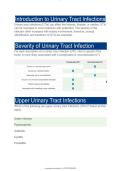
Severity of Urinary Tract Infection
For each description of a urinary tract infection (UTI), click to specify if the
factor is more likely associated with a complicated or uncomplicated UTI.
Upper Urinary Tract Infections
Which of the following are upper urinary tract infections (UTIs)? Select all that
apply.
Ureter infection
Pyelonephritis
Urethritis
Cystitis
Prostatitis
messages.downloaded_by PERFORMANCE
, lOMoAR cPSD| 67691079
Client Education: Urinary Tract
Infection
Which of the following instructions should the nurse practitioner (NP) provide
to a 20-year-old female being discharged with a urinary tract infection (UTI)?
Select all that apply.
Wipe front to back
Empty the bladder every 5 hours
Drink at least 2 liters of water per day
Void after sex
Wear latex, rayon underwear
Normal Physiology of the Urinary
System
The urinary system is responsible for the removal of waste from the blood by
converting it to urine. The kidneys, ureters, bladder, and urethra must all
function adequately for normal urination to occur. Click each plus (+) sign in
the activity below to review the normal function of the urinary system.
Pathophysiology of Urinary Tract
Infections
The most common organisms that cause a urinary tract infection (UTI) are
Escherichia coli (E. coli), Staphylococcus saprophyticus, Proteus mirabilis,
and Klebsiella. E. coli causes approximately 80% of the cases of UTI as it is
the most common organism contained in fecal matter that is easily accessible
from the anus to the urethra.
Introduction to Urinary Tract Infections
Urinary tract infections (UTIs) can affect the kidneys, bladder, or urethra. UTIs
can be managed in most instances with antibiotics. The severity of the
infection often increases with kidney involvement; therefore, prompt
identification and treatment of UTIs are essential.
Severity of Urinary Tract Infection
For each description of a urinary tract infection (UTI), click to specify if the
factor is more likely associated with a complicated or uncomplicated UTI.
Upper Urinary Tract Infections
Which of the following are upper urinary tract infections (UTIs)? Select all that
apply.
Ureter infection
Pyelonephritis
Urethritis
Cystitis
Prostatitis
messages.downloaded_by PERFORMANCE
, lOMoAR cPSD| 67691079
Client Education: Urinary Tract
Infection
Which of the following instructions should the nurse practitioner (NP) provide
to a 20-year-old female being discharged with a urinary tract infection (UTI)?
Select all that apply.
Wipe front to back
Empty the bladder every 5 hours
Drink at least 2 liters of water per day
Void after sex
Wear latex, rayon underwear
Normal Physiology of the Urinary
System
The urinary system is responsible for the removal of waste from the blood by
converting it to urine. The kidneys, ureters, bladder, and urethra must all
function adequately for normal urination to occur. Click each plus (+) sign in
the activity below to review the normal function of the urinary system.
Pathophysiology of Urinary Tract
Infections
The most common organisms that cause a urinary tract infection (UTI) are
Escherichia coli (E. coli), Staphylococcus saprophyticus, Proteus mirabilis,
and Klebsiella. E. coli causes approximately 80% of the cases of UTI as it is
the most common organism contained in fecal matter that is easily accessible
from the anus to the urethra.


