

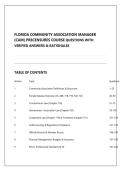
FLORIDA COMMUNITY ASSOCIATION MANAGER
(CAM) PRECENSURES COURSE QUESTIONS WITH
VERIFIED ANSWERS & RATIONALES
TABLE OF CONTENTS
Section Topic Questions
1 Community Association Definitions & Structures 1–25
2 Florida Statutes Overview (Ch. 468, 718, 719, 720, 721) 26–50
3 Condominium Law (Chapter 718) 51–75
4 Homeowners' Association Law (Chapter 720) 76–100
5 Cooperative Law (Chapter 719) & Timeshare (Chapter 721) 101–120
6 CAM Licensing & Regulatory Compliance 121–145
7 Official Records & Member Access 146–160
8 Financial Management, Budgets & Insurance 161–180
9 Ethics, Professional Standards & CE 181–200
,SECTION 1 – COMMUNITY ASSOCIATION DEFINITIONS
& STRUCTURES
Question 1
What is the definition of a "Community Association" under Florida law?
A) A residential homeowners' association in which membership is a condition of
ownership (mandatory) of a unit in a planned unit development, or of a lot for a home
or a mobile home, or of a townhouse, villa, condominium, cooperative, or other
residential unit which is part of a residential development scheme and which is
authorized to impose a fee (assessment) which may become a lien on the parcel.
B) Any group of homeowners who meet monthly to discuss neighborhood issues.
C) A government agency responsible for maintaining public parks.
D) A commercial real estate development company.
Answer: A) A residential homeowners' association in which membership is a
condition of ownership (mandatory) of a unit in a planned unit development, or of
a lot for a home or a mobile home, or of a townhouse, villa, condominium,
cooperative, or other residential unit which is part of a residential development
scheme and which is authorized to impose a fee (assessment) which may become a
lien on the parcel.
Rationale: This is the statutory definition of a community association under Florida law.
The key elements are mandatory membership, the authority to impose assessments, and
the ability to place a lien on the parcel for unpaid assessments .
,Question 2
What is an "Assessment" in the context of a community association?
A) The amount of money a unit or parcel owner pays for their share of the expenses of
the community association.
B) A fee charged only when a member violates a rule.
C) A voluntary contribution to the association's social fund.
D) A tax levied by the county government.
Answer: A) The amount of money a unit or parcel owner pays for their share of the
expenses of the community association.
Rationale: The statute allows the association to file an assessment lien against the unit or
parcel if unpaid. Assessments are mandatory payments for the operation and
maintenance of the community .
Question 3
What does "running with the land" mean in the context of community association
covenants?
A) Covenants expire when the property is sold.
B) Covenants continue to exist for the life of the condominium or parcel and upon
resale, the next owner inherits the same covenants.
C) Covenants only apply to the original owner.
D) Covenants can be changed by each new owner.
Answer: B) Covenants continue to exist for the life of the condominium or parcel
and upon resale, the next owner inherits the same covenants.
Rationale: When you purchase property in a community association, covenants exist and
will continue to exist for the life of the condominium or parcel. Upon resale, the next
owner inherits the same covenants—this is called "running with the land" .
, Question 4
What is a condominium form of ownership?
A) Ownership of a unit with joint ownership of a proportional share in the common
elements.
B) Ownership of shares of stock in a corporation.
C) Ownership of a unit with exclusive use of common areas.
D) Ownership of land with shared maintenance responsibilities.
Answer: A) Ownership of a unit with joint ownership of a proportional share in the
common elements.
Rationale: Condominium means individual ownership of a unit coupled with joint
ownership of an undivided share of the common elements, as well as mandatory
membership in the association .
Question 5
What is a cooperative form of ownership?
A) Individual ownership of a unit with joint ownership of common elements.
B) A type of joint ownership of real estate where an individual purchases shares of stock
in a corporation, which gives the purchaser the right to occupy a unit under a
proprietary lease.
C) Ownership of a unit with a timeshare interest.
D) Ownership of a parcel of land with shared common areas.
Answer: B) A type of joint ownership of real estate where an individual purchases
shares of stock in a corporation, which gives the purchaser the right to occupy a
unit under a proprietary lease.
Rationale: A cooperative is a form of ownership where individuals purchase shares of stock
(CAM) PRECENSURES COURSE QUESTIONS WITH
VERIFIED ANSWERS & RATIONALES
TABLE OF CONTENTS
Section Topic Questions
1 Community Association Definitions & Structures 1–25
2 Florida Statutes Overview (Ch. 468, 718, 719, 720, 721) 26–50
3 Condominium Law (Chapter 718) 51–75
4 Homeowners' Association Law (Chapter 720) 76–100
5 Cooperative Law (Chapter 719) & Timeshare (Chapter 721) 101–120
6 CAM Licensing & Regulatory Compliance 121–145
7 Official Records & Member Access 146–160
8 Financial Management, Budgets & Insurance 161–180
9 Ethics, Professional Standards & CE 181–200
,SECTION 1 – COMMUNITY ASSOCIATION DEFINITIONS
& STRUCTURES
Question 1
What is the definition of a "Community Association" under Florida law?
A) A residential homeowners' association in which membership is a condition of
ownership (mandatory) of a unit in a planned unit development, or of a lot for a home
or a mobile home, or of a townhouse, villa, condominium, cooperative, or other
residential unit which is part of a residential development scheme and which is
authorized to impose a fee (assessment) which may become a lien on the parcel.
B) Any group of homeowners who meet monthly to discuss neighborhood issues.
C) A government agency responsible for maintaining public parks.
D) A commercial real estate development company.
Answer: A) A residential homeowners' association in which membership is a
condition of ownership (mandatory) of a unit in a planned unit development, or of
a lot for a home or a mobile home, or of a townhouse, villa, condominium,
cooperative, or other residential unit which is part of a residential development
scheme and which is authorized to impose a fee (assessment) which may become a
lien on the parcel.
Rationale: This is the statutory definition of a community association under Florida law.
The key elements are mandatory membership, the authority to impose assessments, and
the ability to place a lien on the parcel for unpaid assessments .
,Question 2
What is an "Assessment" in the context of a community association?
A) The amount of money a unit or parcel owner pays for their share of the expenses of
the community association.
B) A fee charged only when a member violates a rule.
C) A voluntary contribution to the association's social fund.
D) A tax levied by the county government.
Answer: A) The amount of money a unit or parcel owner pays for their share of the
expenses of the community association.
Rationale: The statute allows the association to file an assessment lien against the unit or
parcel if unpaid. Assessments are mandatory payments for the operation and
maintenance of the community .
Question 3
What does "running with the land" mean in the context of community association
covenants?
A) Covenants expire when the property is sold.
B) Covenants continue to exist for the life of the condominium or parcel and upon
resale, the next owner inherits the same covenants.
C) Covenants only apply to the original owner.
D) Covenants can be changed by each new owner.
Answer: B) Covenants continue to exist for the life of the condominium or parcel
and upon resale, the next owner inherits the same covenants.
Rationale: When you purchase property in a community association, covenants exist and
will continue to exist for the life of the condominium or parcel. Upon resale, the next
owner inherits the same covenants—this is called "running with the land" .
, Question 4
What is a condominium form of ownership?
A) Ownership of a unit with joint ownership of a proportional share in the common
elements.
B) Ownership of shares of stock in a corporation.
C) Ownership of a unit with exclusive use of common areas.
D) Ownership of land with shared maintenance responsibilities.
Answer: A) Ownership of a unit with joint ownership of a proportional share in the
common elements.
Rationale: Condominium means individual ownership of a unit coupled with joint
ownership of an undivided share of the common elements, as well as mandatory
membership in the association .
Question 5
What is a cooperative form of ownership?
A) Individual ownership of a unit with joint ownership of common elements.
B) A type of joint ownership of real estate where an individual purchases shares of stock
in a corporation, which gives the purchaser the right to occupy a unit under a
proprietary lease.
C) Ownership of a unit with a timeshare interest.
D) Ownership of a parcel of land with shared common areas.
Answer: B) A type of joint ownership of real estate where an individual purchases
shares of stock in a corporation, which gives the purchaser the right to occupy a
unit under a proprietary lease.
Rationale: A cooperative is a form of ownership where individuals purchase shares of stock


