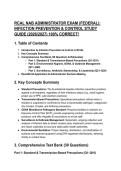
RCAL NAB ADMINISTRATOR EXAM (FEDERAL):
INFECTION PREVENTION & CONTROL STUDY
GUIDE (2026/2027) 100% CORRECT!
1. Table of Contents
1. Introduction to Infection Prevention & Control in RC/AL
2. Key Concepts Summary
3. Comprehensive Test Bank (30 Questions & Rationales)
○ Part 1: Standard & Transmission-Based Precautions (Q1–Q10)
○ Part 2: Environmental Hygiene, OSHA, & Outbreak Management
(Q11–Q20)
○ Part 3: Surveillance, Antibiotic Stewardship, & Leadership (Q21–Q30)
4. Real-World Application & Administrator Decision-Making
2. Key Concepts Summary
● Standard Precautions: The foundational baseline infection prevention practices
applied to all residents, regardless of their infectious status (e.g., hand hygiene,
proper use of PPE, safe injection practices).
● Transmission-Based Precautions: Specialized precautions utilized when a
resident is suspected or confirmed to have a transmissible pathogen; categorized
into Contact, Droplet, and Airborne precautions.
● OSHA Bloodborne Pathogens Standard: Requires facilities to maintain an
Exposure Control Plan (ECP), provide engineering controls, enforce safe work
practices, and offer Hepatitis B vaccinations to at-risk staff.
● Surveillance & Outbreak Management: Systematic, ongoing collection and
analysis of infection data to detect clusters early, implement control measures,
and report outbreaks to local and state public health authorities.
● Environmental Sanitation: Proper cleaning, disinfection, and sterilization of
surfaces and medical equipment using EPA-registered disinfectants, adhering
strictly to contact times.
3. Comprehensive Test Bank (30 Questions)
Part 1: Standard & Transmission-Based Precautions (Q1–Q10)
, Q1. What is the single most effective method for preventing the transmission of
healthcare-associated infections in an assisted living facility?
A) Wearing double gloves during every interaction.
B) Frequent and proper hand hygiene (handwashing with soap and water or using
alcohol-based hand rub).
C) Restricting all visitors from entering the building permanently.
D) Administering prophylactic antibiotics to all residents.
Answer: B | Rationale: Hand hygiene is universally recognized by CDC and OSHA as
the primary defense against pathogen spread. Double-gloving and blanket restrictions
are unnecessary and clinically invalid.
Q2. Standard Precautions must be applied to:
A) Only residents who have a diagnosed infectious disease.
B) Only residents who cough or display symptoms of illness.
C) All residents, regardless of their diagnosis or presumed infection status.
D) Only staff members during annual surveys.
Answer: C | Rationale: Standard precautions assume that every person's blood and
body fluids are potentially infectious, protecting both staff and residents uniformly.
Q3. A resident is diagnosed with an infection spread through large respiratory
droplets (e.g., Influenza). In addition to Standard Precautions, what
transmission-based precautions should staff implement?
A) Airborne Precautions (negative pressure room).
B) Droplet Precautions (wearing a surgical mask when working within three to six feet of
the resident).
C) Contact Precautions (gowns and gloves only).
D) Complete isolation with no human contact.
Answer: B | Rationale: Droplet precautions require a surgical mask when close to the
resident because large droplets do not remain suspended in the air long.
INFECTION PREVENTION & CONTROL STUDY
GUIDE (2026/2027) 100% CORRECT!
1. Table of Contents
1. Introduction to Infection Prevention & Control in RC/AL
2. Key Concepts Summary
3. Comprehensive Test Bank (30 Questions & Rationales)
○ Part 1: Standard & Transmission-Based Precautions (Q1–Q10)
○ Part 2: Environmental Hygiene, OSHA, & Outbreak Management
(Q11–Q20)
○ Part 3: Surveillance, Antibiotic Stewardship, & Leadership (Q21–Q30)
4. Real-World Application & Administrator Decision-Making
2. Key Concepts Summary
● Standard Precautions: The foundational baseline infection prevention practices
applied to all residents, regardless of their infectious status (e.g., hand hygiene,
proper use of PPE, safe injection practices).
● Transmission-Based Precautions: Specialized precautions utilized when a
resident is suspected or confirmed to have a transmissible pathogen; categorized
into Contact, Droplet, and Airborne precautions.
● OSHA Bloodborne Pathogens Standard: Requires facilities to maintain an
Exposure Control Plan (ECP), provide engineering controls, enforce safe work
practices, and offer Hepatitis B vaccinations to at-risk staff.
● Surveillance & Outbreak Management: Systematic, ongoing collection and
analysis of infection data to detect clusters early, implement control measures,
and report outbreaks to local and state public health authorities.
● Environmental Sanitation: Proper cleaning, disinfection, and sterilization of
surfaces and medical equipment using EPA-registered disinfectants, adhering
strictly to contact times.
3. Comprehensive Test Bank (30 Questions)
Part 1: Standard & Transmission-Based Precautions (Q1–Q10)
, Q1. What is the single most effective method for preventing the transmission of
healthcare-associated infections in an assisted living facility?
A) Wearing double gloves during every interaction.
B) Frequent and proper hand hygiene (handwashing with soap and water or using
alcohol-based hand rub).
C) Restricting all visitors from entering the building permanently.
D) Administering prophylactic antibiotics to all residents.
Answer: B | Rationale: Hand hygiene is universally recognized by CDC and OSHA as
the primary defense against pathogen spread. Double-gloving and blanket restrictions
are unnecessary and clinically invalid.
Q2. Standard Precautions must be applied to:
A) Only residents who have a diagnosed infectious disease.
B) Only residents who cough or display symptoms of illness.
C) All residents, regardless of their diagnosis or presumed infection status.
D) Only staff members during annual surveys.
Answer: C | Rationale: Standard precautions assume that every person's blood and
body fluids are potentially infectious, protecting both staff and residents uniformly.
Q3. A resident is diagnosed with an infection spread through large respiratory
droplets (e.g., Influenza). In addition to Standard Precautions, what
transmission-based precautions should staff implement?
A) Airborne Precautions (negative pressure room).
B) Droplet Precautions (wearing a surgical mask when working within three to six feet of
the resident).
C) Contact Precautions (gowns and gloves only).
D) Complete isolation with no human contact.
Answer: B | Rationale: Droplet precautions require a surgical mask when close to the
resident because large droplets do not remain suspended in the air long.