

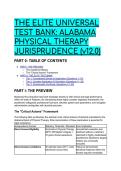
THE ELITE UNIVERSAL
TEST BANK: ALABAMA
PHYSICAL THERAPY
JURISPRUDENCE (v12.0)
PART 0: TABLE OF CONTENTS
● PART I: THE PREVIEW
○ The Academic Mission
○ The "Critical Axioms" Framework
● PART II: THE ELITE TEST BANK
○ Tier 1: Foundational Syntax & Application (Questions 1–10)
○ Tier 2: Complex Application & Simulation (Questions 11–20)
○ Tier 3: Grandmaster Synthesis (Questions 21–30)
PART I: THE PREVIEW
Mastering this exhaustive test bank translates directly to elite clinical and legal performance
within the state of Alabama. By internalizing these highly complex regulatory frameworks, the
practitioner safeguards professional licensure, elevates patient care parameters, and navigates
administrative ambiguities with absolute precision.
The "Critical Axioms" Framework
The following table synthesizes the absolute most critical statutory thresholds mandated by the
Alabama Board of Physical Therapy. Rote memorization of these parameters is essential for
legal compliance.
Jurisprudence Domain Statutory Threshold / Standard Core Implication
Direct Access Eligibility Doctorate in Physical Therapy Unrestricted evaluation and
(DPT) OR Master's Degree + treatment without a referral is
10 years clinical experience. restricted to highly credentialed
practitioners; Bachelor's degree
holders are universally
excluded.
Direct Access Limitations 30 calendar days OR 11 visits Failure to demonstrate
(whichever occurs first). beneficial response within this
window requires immediate
,Jurisprudence Domain Statutory Threshold / Standard Core Implication
referral to a qualified health
care provider.
Delegation Maximums 1:4 (Physical Therapist to A single physical therapist may
Physical Therapist Assistants). supervise a maximum of four
PTAs simultaneously;
exceeding this ratio constitutes
professional misconduct.
Continuing Education (CE) 10 hours annually (October 1 Standard compliance requires
deadline); 12 hours for Direct 10 hours; direct access
Access. privileges mandate an
additional 2 hours focused on
the standard of care.
Jurisprudence is required in
years ending in "0" or "5".
Aide Restrictions Zero clinical decision-making; Physical therapy aides are
zero manual therapy. strictly prohibited from
performing hands-on
interventions such as passive
range of motion (PROM) or
joint mobilizations.
Disciplinary Authority Maximum $1,000 administrative The Board may assess severe
fine per violation. financial penalties per individual
infraction, alongside license
suspension or revocation.
PART II: THE ELITE TEST BANK
Tier 1: Foundational Syntax & Application (Questions 1–10)
Q1: An Alabama physical therapist intends to evaluate and treat a patient via direct access for
an acute ankle sprain. The patient is paying through private health insurance. Based on the
provisions of the Alabama Physical Therapy Practice Act, which of the following criteria is an
absolute PREREQUISITE for the therapist to initiate treatment without a referral from a qualified
physical therapy referrer? A) The physical therapist must hold a doctorate in physical therapy
(DPT) regardless of clinical experience, or have 15 years of experience with a bachelor's
degree. B) The physical therapist must possess a DPT or a Master's degree combined with 10
years of clinical practice experience. C) The physical therapist must notify the patient's primary
care physician within 7 days of the initial evaluation. D) The physical therapist must obtain a
temporary direct access permit from the Board and complete 5 additional CEU hours annually.
● Answer: B (The physical therapist must possess a DPT or a Master's degree combined
with 10 years of clinical practice experience.)
● Distractor Analysis:
○ A is incorrect: The statute specifically designates a DPT or a Master's degree
paired with 10 years of experience. Bachelor's degrees do not grant direct access
privileges regardless of tenure.
○ C is incorrect: While collaborative communication represents a clinical best
practice, the statute does not mandate a 7-day notification to a primary care
, physician for standard outpatient direct access.
○ D is incorrect: There is no independent "temporary direct access permit." The
therapist simply must meet the educational/experience criteria and complete 2
additional CEU hours annually regarding the professional standard of care.
The Mentor's Analysis: The Alabama Practice Act carefully restricts autonomous direct access
to clinicians who have demonstrated advanced academic training or a high threshold of clinical
tenure. When evaluating direct access eligibility, the immediate priority is verifying the provider's
academic credentials. By utilizing the statutory educational minimums, the practitioner bypasses
the common trap of assuming all licensed personnel possess equal autonomous practice rights.
Professional/Academic Intuition: Direct access is a privilege earned through specific
academic and experiential thresholds, not an automatic right of licensure.
Q2: A physical therapist licensed in Alabama is preparing for the annual license renewal
process. The therapist does not utilize direct access privileges. Which of the following accurately
reflects the standard continuing education (CE) requirements to maintain an active license? A)
12 contact hours annually, including 2 hours of Alabama Jurisprudence every year. B) 10
contact hours annually, with 2 hours of Alabama Jurisprudence required only in years ending in
"0" or "5". C) 10 contact hours biennially, including mandatory CPR certification. D) 15 contact
hours annually, with a maximum of 5 hours permitted through non-traditional, self-directed study.
● Answer: B (10 contact hours annually, with 2 hours of Alabama Jurisprudence required
only in years ending in "0" or "5".)
● Distractor Analysis:
○ A is incorrect: The 12-hour requirement applies exclusively to physical therapists
who evaluate and treat patients via direct access (10 standard hours plus 2
specialized hours). Furthermore, jurisprudence is not an annual requirement for
established licensees.
○ C is incorrect: Alabama operates on an annual renewal cycle (expiring October 1),
not a biennial cycle. Additionally, the Board explicitly excludes CPR/BLS
certification from counting toward clinical physical therapy CE hours.
○ D is incorrect: The standard baseline requirement is 10 hours, not 15.
The Mentor's Analysis: Maintaining active licensure requires strict adherence to continuing
education timelines and content restrictions. When calculating CE compliance, the immediate
priority is distinguishing between standard foundational requirements and specialized practice
additions. By utilizing the 10-hour baseline rule, the clinician bypasses the novice error of
miscalculating audit requirements or improperly submitting employer-mandated CPR courses.
Professional/Academic Intuition: Base CE compliance demands 10 hours annually;
specialized autonomous practice inherently adds targeted regulatory burdens.
Q3: A busy outpatient clinic director is restructuring staffing to maximize efficiency. The clinic
employs multiple physical therapists (PTs) and physical therapist assistants (PTAs). According
to the Alabama Administrative Code, what is the MAXIMUM number of licensed PTAs that a
single physical therapist can direct at any one time? A) Two (2) B) Three (3) C) Four (4) D) Five
(5)
● Answer: C (Four (4))
● Distractor Analysis:
○ A is incorrect: A 1:2 ratio is a legacy restriction utilized in other jurisdictions (such as
California) but is overly restrictive according to current Alabama administrative
statutes.
○ B is incorrect: While several states cap supervision at three assistants, Alabama
explicitly allows up to four.
TEST BANK: ALABAMA
PHYSICAL THERAPY
JURISPRUDENCE (v12.0)
PART 0: TABLE OF CONTENTS
● PART I: THE PREVIEW
○ The Academic Mission
○ The "Critical Axioms" Framework
● PART II: THE ELITE TEST BANK
○ Tier 1: Foundational Syntax & Application (Questions 1–10)
○ Tier 2: Complex Application & Simulation (Questions 11–20)
○ Tier 3: Grandmaster Synthesis (Questions 21–30)
PART I: THE PREVIEW
Mastering this exhaustive test bank translates directly to elite clinical and legal performance
within the state of Alabama. By internalizing these highly complex regulatory frameworks, the
practitioner safeguards professional licensure, elevates patient care parameters, and navigates
administrative ambiguities with absolute precision.
The "Critical Axioms" Framework
The following table synthesizes the absolute most critical statutory thresholds mandated by the
Alabama Board of Physical Therapy. Rote memorization of these parameters is essential for
legal compliance.
Jurisprudence Domain Statutory Threshold / Standard Core Implication
Direct Access Eligibility Doctorate in Physical Therapy Unrestricted evaluation and
(DPT) OR Master's Degree + treatment without a referral is
10 years clinical experience. restricted to highly credentialed
practitioners; Bachelor's degree
holders are universally
excluded.
Direct Access Limitations 30 calendar days OR 11 visits Failure to demonstrate
(whichever occurs first). beneficial response within this
window requires immediate
,Jurisprudence Domain Statutory Threshold / Standard Core Implication
referral to a qualified health
care provider.
Delegation Maximums 1:4 (Physical Therapist to A single physical therapist may
Physical Therapist Assistants). supervise a maximum of four
PTAs simultaneously;
exceeding this ratio constitutes
professional misconduct.
Continuing Education (CE) 10 hours annually (October 1 Standard compliance requires
deadline); 12 hours for Direct 10 hours; direct access
Access. privileges mandate an
additional 2 hours focused on
the standard of care.
Jurisprudence is required in
years ending in "0" or "5".
Aide Restrictions Zero clinical decision-making; Physical therapy aides are
zero manual therapy. strictly prohibited from
performing hands-on
interventions such as passive
range of motion (PROM) or
joint mobilizations.
Disciplinary Authority Maximum $1,000 administrative The Board may assess severe
fine per violation. financial penalties per individual
infraction, alongside license
suspension or revocation.
PART II: THE ELITE TEST BANK
Tier 1: Foundational Syntax & Application (Questions 1–10)
Q1: An Alabama physical therapist intends to evaluate and treat a patient via direct access for
an acute ankle sprain. The patient is paying through private health insurance. Based on the
provisions of the Alabama Physical Therapy Practice Act, which of the following criteria is an
absolute PREREQUISITE for the therapist to initiate treatment without a referral from a qualified
physical therapy referrer? A) The physical therapist must hold a doctorate in physical therapy
(DPT) regardless of clinical experience, or have 15 years of experience with a bachelor's
degree. B) The physical therapist must possess a DPT or a Master's degree combined with 10
years of clinical practice experience. C) The physical therapist must notify the patient's primary
care physician within 7 days of the initial evaluation. D) The physical therapist must obtain a
temporary direct access permit from the Board and complete 5 additional CEU hours annually.
● Answer: B (The physical therapist must possess a DPT or a Master's degree combined
with 10 years of clinical practice experience.)
● Distractor Analysis:
○ A is incorrect: The statute specifically designates a DPT or a Master's degree
paired with 10 years of experience. Bachelor's degrees do not grant direct access
privileges regardless of tenure.
○ C is incorrect: While collaborative communication represents a clinical best
practice, the statute does not mandate a 7-day notification to a primary care
, physician for standard outpatient direct access.
○ D is incorrect: There is no independent "temporary direct access permit." The
therapist simply must meet the educational/experience criteria and complete 2
additional CEU hours annually regarding the professional standard of care.
The Mentor's Analysis: The Alabama Practice Act carefully restricts autonomous direct access
to clinicians who have demonstrated advanced academic training or a high threshold of clinical
tenure. When evaluating direct access eligibility, the immediate priority is verifying the provider's
academic credentials. By utilizing the statutory educational minimums, the practitioner bypasses
the common trap of assuming all licensed personnel possess equal autonomous practice rights.
Professional/Academic Intuition: Direct access is a privilege earned through specific
academic and experiential thresholds, not an automatic right of licensure.
Q2: A physical therapist licensed in Alabama is preparing for the annual license renewal
process. The therapist does not utilize direct access privileges. Which of the following accurately
reflects the standard continuing education (CE) requirements to maintain an active license? A)
12 contact hours annually, including 2 hours of Alabama Jurisprudence every year. B) 10
contact hours annually, with 2 hours of Alabama Jurisprudence required only in years ending in
"0" or "5". C) 10 contact hours biennially, including mandatory CPR certification. D) 15 contact
hours annually, with a maximum of 5 hours permitted through non-traditional, self-directed study.
● Answer: B (10 contact hours annually, with 2 hours of Alabama Jurisprudence required
only in years ending in "0" or "5".)
● Distractor Analysis:
○ A is incorrect: The 12-hour requirement applies exclusively to physical therapists
who evaluate and treat patients via direct access (10 standard hours plus 2
specialized hours). Furthermore, jurisprudence is not an annual requirement for
established licensees.
○ C is incorrect: Alabama operates on an annual renewal cycle (expiring October 1),
not a biennial cycle. Additionally, the Board explicitly excludes CPR/BLS
certification from counting toward clinical physical therapy CE hours.
○ D is incorrect: The standard baseline requirement is 10 hours, not 15.
The Mentor's Analysis: Maintaining active licensure requires strict adherence to continuing
education timelines and content restrictions. When calculating CE compliance, the immediate
priority is distinguishing between standard foundational requirements and specialized practice
additions. By utilizing the 10-hour baseline rule, the clinician bypasses the novice error of
miscalculating audit requirements or improperly submitting employer-mandated CPR courses.
Professional/Academic Intuition: Base CE compliance demands 10 hours annually;
specialized autonomous practice inherently adds targeted regulatory burdens.
Q3: A busy outpatient clinic director is restructuring staffing to maximize efficiency. The clinic
employs multiple physical therapists (PTs) and physical therapist assistants (PTAs). According
to the Alabama Administrative Code, what is the MAXIMUM number of licensed PTAs that a
single physical therapist can direct at any one time? A) Two (2) B) Three (3) C) Four (4) D) Five
(5)
● Answer: C (Four (4))
● Distractor Analysis:
○ A is incorrect: A 1:2 ratio is a legacy restriction utilized in other jurisdictions (such as
California) but is overly restrictive according to current Alabama administrative
statutes.
○ B is incorrect: While several states cap supervision at three assistants, Alabama
explicitly allows up to four.


