

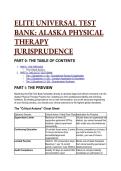
ELITE UNIVERSAL TEST
BANK: ALASKA PHYSICAL
THERAPY
JURISPRUDENCE
PART 0: THE TABLE OF CONTENTS
1. PART I: THE PREVIEW
○ The Critical Axioms
2. PART II: THE ELITE TEST BANK
○ Tier 1 (Questions 1–10) - Foundational Syntax & Application
○ Tier 2 (Questions 11–20) - Complex Application & Simulation
○ Tier 3 (Questions 21–30) - Grandmaster Synthesis
PART I: THE PREVIEW
Mastering this Elite Test Bank translates directly to absolute legal and ethical command over the
Alaska Physical Therapy Practice Act, isolating you from professional liability and licensing
forfeiture. By treating jurisprudence not as rote memorization, but as the structural engineering
of your clinical practice, you elevate your clinical autonomy to the highest global standards.
The "Critical Axioms" Cheat Sheet
Statutory Domain Critical Axiom / Hard Deck Rule Implication for Practice
Supervision Limits Maximum of three (3) Volume does not supersede the
supportive personnel (PTAs, statute; you cannot exceed this
students, aides) supervised ratio under any circumstances.
concurrently.
Continuing Education 24 contact hours every 2 years; Proving competency is binary; if
12 hours minimum from you hold a license for 12+
accredited/approved months, you owe 24 hours.
organizations.
Limited Permits Valid for 120 consecutive days. Blocks out-of-state therapists
Maximum 1 per 12-month from circumventing permanent
period; maximum 3 per lifetime. Alaska licensure.
Audit Compliance Exactly 30 days to submit CEU Failure to comply instantly
documentation upon constitutes an admission of
,Statutory Domain Critical Axiom / Hard Deck Rule Implication for Practice
notification. material misrepresentation.
Lapsed Licenses 2 to <5 years requires full Time degrades privilege;
back-fees, all CEUs, and beyond 5 years, you must apply
multi-state verification. 5+ years as a completely new candidate.
= permanent lapse.
PART II: THE ELITE TEST BANK
Tier 1 (Questions 1–10) - Foundational Syntax & Application
Q1: A physical therapist (PT) in a busy Anchorage outpatient clinic is currently directing the
treatment plans for two Physical Therapist Assistants (PTAs), one physical therapy student, and
one physical therapy aide. Based on the principles of the Alaska Administrative Code (12 AAC
54), which action/conclusion is the MOST ACCURATE? A) This staffing arrangement is
perfectly legal provided the PT is physically present in the clinic at all times. B) The PT may
supervise this number of personnel only if the student is currently completing a formal,
CAPTE-accredited clinical rotation. C) The PT is in direct violation of the maximum supervision
ratio and must immediately transfer supervision of at least one individual to another licensed PT.
D) The PT is compliant because aides are not counted toward the statutory limit of supportive
personnel.
● Answer: C (The PT is in direct violation of the maximum supervision ratio and must
immediately transfer supervision of at least one individual to another licensed PT.)
● Distractor Analysis:
○ A is incorrect: Physical presence does not override or nullify the strict statutory
supervision cap mandated by the state.
○ B is incorrect: While students are in CAPTE programs, they still fundamentally
count toward the absolute supervision limit of supportive personnel.
○ D is incorrect: Aides are explicitly included in the maximum ratio of three (3)
supervised personnel in Alaska.
The Mentor's Analysis: The Alaska Board enforces a strict, non-negotiable hard deck: a PT
may supervise a maximum of 3 individuals total, regardless of their designation (PTA, student,
or aide). When facing high patient volume, the immediate priority is legal compliance over
clinical efficiency. By utilizing the Rule of 3, you bypass the common trap of over-delegation.
Professional/Academic Intuition: Never exceed three supervised supportive personnel
under any circumstance; clinical volume does not supersede the statute.
Q2: A physical therapist is renewing their Alaska license after being licensed for 18 months of
the concluding biennial licensing period. Based on the principles of continuing education
requirements under 12 AAC 54.410, which action/conclusion is the MOST ACCURATE? A) The
therapist must complete 12 contact hours of continuing education because they were licensed
for less than 24 months. B) The therapist is entirely exempt from continuing education for their
first renewal cycle. C) The therapist must complete the full 24 contact hours of continuing
education for this renewal period. D) The therapist must complete a prorated 18 contact hours
of continuing education.
● Answer: C (The therapist must complete the full 24 contact hours of continuing education
for this renewal period.)
● Distractor Analysis:
○ A is incorrect: The 12-hour reduction applies only to those licensed for less than 12
, months of the concluding period.
○ B is incorrect: There is no blanket exemption for first-time renewals; continuing
competency is legally mandatory.
○ D is incorrect: Alaska statutes do not prorate CEUs by the individual month; the
requirement is strictly binary (above or below 12 months).
The Mentor's Analysis: Continuing education thresholds in Alaska are triggered precisely at
the 12-month mark. When facing renewal timelines, the immediate priority is determining if the
license was active for 12 months or more. By utilizing the 12-Month Threshold, you bypass the
common trap of assuming CEUs are prorated precisely by time active. Professional/Academic
Intuition: If you hold a license for 12 months or a single day longer in a licensing period,
you legally owe the Board 24 hours of continuing education.
Q3: An applicant for a physical therapist license by examination is issued a temporary permit to
practice in Alaska. They are scheduled to take the National Physical Therapy Examination
(NPTE) in two months. Based on the principles of AS 08.84.065, which action/conclusion is the
MOST ACCURATE regarding the expiration of their permit? A) The temporary permit will
unconditionally remain valid for exactly 12 months from the date of issuance to allow for exam
retakes. B) The temporary permit is valid for one year, provided the applicant remains under the
continuous onsite supervision of a PT. C) The temporary permit expires either 8 months from the
date of issue, or on the date the exam scores are posted to the board, whichever occurs first. D)
The permit expires immediately upon taking the exam, regardless of when the scores are
published.
● Answer: C (The temporary permit expires either 8 months from the date of issue, or on
the date the exam scores are posted to the board, whichever occurs first.)
● Distractor Analysis:
○ A is incorrect: Temporary permits do not last 12 months, and failing an exam
invalidates the permit immediately upon the score posting.
○ B is incorrect: Onsite supervision is required, but the temporal duration cited is
statutorily incorrect.
○ D is incorrect: The permit remains active during the grading period; it lapses
precisely when the scores are posted.
The Mentor's Analysis: Temporary permits are a bridge, not a permanent credential. When
facing the interim period before licensure, the immediate priority is tracking the exact expiration
parameters. By utilizing the 8-Month/Score Posting Limit, you bypass the common novice error
of practicing without a license while waiting for official mail. Professional/Academic Intuition:
A temporary permit is instantly nullified the moment NPTE scores are officially posted to
the board.
Q4: A foreign-educated physical therapist applicant completes a board-approved credentials
evaluation verifying CAPTE equivalence. They apply for an Alaska license. Based on the
principles of AS 08.84.032, what is the MOST APPROPRIATE mechanism for this applicant to
satisfy the English language proficiency requirement? A) The applicant must submit a minimum
passing score of 26 on the Speaking section of the TOEFL-iBT. B) The applicant must verify
achieving a passing score on the National Physical Therapy Examination (NPTE). C) The
applicant must complete a 6-month internship under an Alaska-licensed preceptor to prove
verbal competency. D) The applicant must submit a letter from the head of their physical therapy
school attesting to their English fluency.
● Answer: B (The applicant must verify achieving a passing score on the National Physical
Therapy Examination (NPTE).)
● Distractor Analysis:
BANK: ALASKA PHYSICAL
THERAPY
JURISPRUDENCE
PART 0: THE TABLE OF CONTENTS
1. PART I: THE PREVIEW
○ The Critical Axioms
2. PART II: THE ELITE TEST BANK
○ Tier 1 (Questions 1–10) - Foundational Syntax & Application
○ Tier 2 (Questions 11–20) - Complex Application & Simulation
○ Tier 3 (Questions 21–30) - Grandmaster Synthesis
PART I: THE PREVIEW
Mastering this Elite Test Bank translates directly to absolute legal and ethical command over the
Alaska Physical Therapy Practice Act, isolating you from professional liability and licensing
forfeiture. By treating jurisprudence not as rote memorization, but as the structural engineering
of your clinical practice, you elevate your clinical autonomy to the highest global standards.
The "Critical Axioms" Cheat Sheet
Statutory Domain Critical Axiom / Hard Deck Rule Implication for Practice
Supervision Limits Maximum of three (3) Volume does not supersede the
supportive personnel (PTAs, statute; you cannot exceed this
students, aides) supervised ratio under any circumstances.
concurrently.
Continuing Education 24 contact hours every 2 years; Proving competency is binary; if
12 hours minimum from you hold a license for 12+
accredited/approved months, you owe 24 hours.
organizations.
Limited Permits Valid for 120 consecutive days. Blocks out-of-state therapists
Maximum 1 per 12-month from circumventing permanent
period; maximum 3 per lifetime. Alaska licensure.
Audit Compliance Exactly 30 days to submit CEU Failure to comply instantly
documentation upon constitutes an admission of
,Statutory Domain Critical Axiom / Hard Deck Rule Implication for Practice
notification. material misrepresentation.
Lapsed Licenses 2 to <5 years requires full Time degrades privilege;
back-fees, all CEUs, and beyond 5 years, you must apply
multi-state verification. 5+ years as a completely new candidate.
= permanent lapse.
PART II: THE ELITE TEST BANK
Tier 1 (Questions 1–10) - Foundational Syntax & Application
Q1: A physical therapist (PT) in a busy Anchorage outpatient clinic is currently directing the
treatment plans for two Physical Therapist Assistants (PTAs), one physical therapy student, and
one physical therapy aide. Based on the principles of the Alaska Administrative Code (12 AAC
54), which action/conclusion is the MOST ACCURATE? A) This staffing arrangement is
perfectly legal provided the PT is physically present in the clinic at all times. B) The PT may
supervise this number of personnel only if the student is currently completing a formal,
CAPTE-accredited clinical rotation. C) The PT is in direct violation of the maximum supervision
ratio and must immediately transfer supervision of at least one individual to another licensed PT.
D) The PT is compliant because aides are not counted toward the statutory limit of supportive
personnel.
● Answer: C (The PT is in direct violation of the maximum supervision ratio and must
immediately transfer supervision of at least one individual to another licensed PT.)
● Distractor Analysis:
○ A is incorrect: Physical presence does not override or nullify the strict statutory
supervision cap mandated by the state.
○ B is incorrect: While students are in CAPTE programs, they still fundamentally
count toward the absolute supervision limit of supportive personnel.
○ D is incorrect: Aides are explicitly included in the maximum ratio of three (3)
supervised personnel in Alaska.
The Mentor's Analysis: The Alaska Board enforces a strict, non-negotiable hard deck: a PT
may supervise a maximum of 3 individuals total, regardless of their designation (PTA, student,
or aide). When facing high patient volume, the immediate priority is legal compliance over
clinical efficiency. By utilizing the Rule of 3, you bypass the common trap of over-delegation.
Professional/Academic Intuition: Never exceed three supervised supportive personnel
under any circumstance; clinical volume does not supersede the statute.
Q2: A physical therapist is renewing their Alaska license after being licensed for 18 months of
the concluding biennial licensing period. Based on the principles of continuing education
requirements under 12 AAC 54.410, which action/conclusion is the MOST ACCURATE? A) The
therapist must complete 12 contact hours of continuing education because they were licensed
for less than 24 months. B) The therapist is entirely exempt from continuing education for their
first renewal cycle. C) The therapist must complete the full 24 contact hours of continuing
education for this renewal period. D) The therapist must complete a prorated 18 contact hours
of continuing education.
● Answer: C (The therapist must complete the full 24 contact hours of continuing education
for this renewal period.)
● Distractor Analysis:
○ A is incorrect: The 12-hour reduction applies only to those licensed for less than 12
, months of the concluding period.
○ B is incorrect: There is no blanket exemption for first-time renewals; continuing
competency is legally mandatory.
○ D is incorrect: Alaska statutes do not prorate CEUs by the individual month; the
requirement is strictly binary (above or below 12 months).
The Mentor's Analysis: Continuing education thresholds in Alaska are triggered precisely at
the 12-month mark. When facing renewal timelines, the immediate priority is determining if the
license was active for 12 months or more. By utilizing the 12-Month Threshold, you bypass the
common trap of assuming CEUs are prorated precisely by time active. Professional/Academic
Intuition: If you hold a license for 12 months or a single day longer in a licensing period,
you legally owe the Board 24 hours of continuing education.
Q3: An applicant for a physical therapist license by examination is issued a temporary permit to
practice in Alaska. They are scheduled to take the National Physical Therapy Examination
(NPTE) in two months. Based on the principles of AS 08.84.065, which action/conclusion is the
MOST ACCURATE regarding the expiration of their permit? A) The temporary permit will
unconditionally remain valid for exactly 12 months from the date of issuance to allow for exam
retakes. B) The temporary permit is valid for one year, provided the applicant remains under the
continuous onsite supervision of a PT. C) The temporary permit expires either 8 months from the
date of issue, or on the date the exam scores are posted to the board, whichever occurs first. D)
The permit expires immediately upon taking the exam, regardless of when the scores are
published.
● Answer: C (The temporary permit expires either 8 months from the date of issue, or on
the date the exam scores are posted to the board, whichever occurs first.)
● Distractor Analysis:
○ A is incorrect: Temporary permits do not last 12 months, and failing an exam
invalidates the permit immediately upon the score posting.
○ B is incorrect: Onsite supervision is required, but the temporal duration cited is
statutorily incorrect.
○ D is incorrect: The permit remains active during the grading period; it lapses
precisely when the scores are posted.
The Mentor's Analysis: Temporary permits are a bridge, not a permanent credential. When
facing the interim period before licensure, the immediate priority is tracking the exact expiration
parameters. By utilizing the 8-Month/Score Posting Limit, you bypass the common novice error
of practicing without a license while waiting for official mail. Professional/Academic Intuition:
A temporary permit is instantly nullified the moment NPTE scores are officially posted to
the board.
Q4: A foreign-educated physical therapist applicant completes a board-approved credentials
evaluation verifying CAPTE equivalence. They apply for an Alaska license. Based on the
principles of AS 08.84.032, what is the MOST APPROPRIATE mechanism for this applicant to
satisfy the English language proficiency requirement? A) The applicant must submit a minimum
passing score of 26 on the Speaking section of the TOEFL-iBT. B) The applicant must verify
achieving a passing score on the National Physical Therapy Examination (NPTE). C) The
applicant must complete a 6-month internship under an Alaska-licensed preceptor to prove
verbal competency. D) The applicant must submit a letter from the head of their physical therapy
school attesting to their English fluency.
● Answer: B (The applicant must verify achieving a passing score on the National Physical
Therapy Examination (NPTE).)
● Distractor Analysis:


