

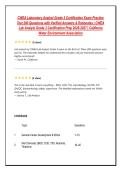
CWEA Laboratory Analyst Grade 3 Certification Exam Practice
Test 200 Questions with Verified Answers & Rationales | CWEA
Lab Analyst Grade 3 Certification Prep 2026-2027 | California
Water Environment Association
⭐⭐⭐⭐⭐ (5 stars)
Just passed my CWEA Lab Analyst Grade 3 exam on the first try! These 200 questions were
spot on. The rationales helped me understand the concepts, not just memorize answers.
Highly recommend!
— Sarah M., California
⭐⭐⭐⭐⭐ (5 stars)
This is the real deal. Covers everything – BOD, COD, TSS, microbiology, GC/MS, ICP,
QA/QC, biomonitoring, safety, supervision. The detailed explanations saved me. Worth
every penny.
— Jessica T., Lab Analyst
COVERAGE
Topic Questions
1 General Career Development & Ethics 1–15
Wet Chemistry (BOD, COD, TSS, Nutrients,
2 16–45
Titrations)
, Topic Questions
Laboratory Instrumentation (Theory &
3 46–65
Components)
Specific Instrumentation Techniques (AA, ICP,
4 66–90
GC, HPLC, IC)
5 Microbiological Analysis 91–105
6 Biomonitoring and Toxicity 106–115
General Chemistry, Mathematics, QA/QC &
7 116–145
Statistics
8 Process Control 146–160
9 Safety and Regulations 161–175
10 Supervision & Lab Management 176–200
Total Questions: 200 | Passing Score: 70% | Exam Format: Multiple-Choice,
Computer-Based | Governing Agency: CWEA (California Water Environment
Association) | Primary References: Standard Methods for the Examination of Water
and Wastewater, EPA 600/4-79-019, Operation of Wastewater Treatment Plants, 40
CFR Part 136
,Skill Set 1: General Career Development & Ethics (Questions 1–15)
1. A Grade III Laboratory Analyst is expected to supervise other analysts. According
to CWEA standards, which of the following is a key supervisory responsibility?
a) Performing all analyses personally to ensure quality
b) Delegating all quality control responsibilities to junior staff
c) Ensuring all analyses are performed correctly and providing staff training
d) Focusing exclusively on instrument maintenance
The Grade III analyst is capable of supervising other analysts and ensuring all analyses are
performed correctly. Supervisors are responsible for training and for ensuring all analyses
are performed correctly .
2. According to CWEA, what is the primary difference between fraud and error in
laboratory work?
a) Fraud is accidental; error is intentional
b) Fraud is intentional misrepresentation; error is unintentional
c) Fraud is a minor issue; error is a major violation
d) Fraud and error are the same
, The Grade III analyst knows the difference between fraud and error and why mistakes
should not be punished. Ethics are an individual choice—supervisors need to set examples
and encourage ethics to protect employees and the laboratory .
3. What does "cherry picking" refer to in laboratory data management?
a) Selecting the best samples for analysis
b) Choosing only data that supports a desired outcome and ignoring data that does
not
c) Picking the most ripe samples for testing
d) Selecting the best analytical method
Cherry picking is a form of data manipulation that involves selecting only favorable data
points. Supervisors need to know what "cherry picking" is and how to avoid it .
4. Why should mistakes in the laboratory not be punished according to CWEA ethics
guidelines?
Test 200 Questions with Verified Answers & Rationales | CWEA
Lab Analyst Grade 3 Certification Prep 2026-2027 | California
Water Environment Association
⭐⭐⭐⭐⭐ (5 stars)
Just passed my CWEA Lab Analyst Grade 3 exam on the first try! These 200 questions were
spot on. The rationales helped me understand the concepts, not just memorize answers.
Highly recommend!
— Sarah M., California
⭐⭐⭐⭐⭐ (5 stars)
This is the real deal. Covers everything – BOD, COD, TSS, microbiology, GC/MS, ICP,
QA/QC, biomonitoring, safety, supervision. The detailed explanations saved me. Worth
every penny.
— Jessica T., Lab Analyst
COVERAGE
Topic Questions
1 General Career Development & Ethics 1–15
Wet Chemistry (BOD, COD, TSS, Nutrients,
2 16–45
Titrations)
, Topic Questions
Laboratory Instrumentation (Theory &
3 46–65
Components)
Specific Instrumentation Techniques (AA, ICP,
4 66–90
GC, HPLC, IC)
5 Microbiological Analysis 91–105
6 Biomonitoring and Toxicity 106–115
General Chemistry, Mathematics, QA/QC &
7 116–145
Statistics
8 Process Control 146–160
9 Safety and Regulations 161–175
10 Supervision & Lab Management 176–200
Total Questions: 200 | Passing Score: 70% | Exam Format: Multiple-Choice,
Computer-Based | Governing Agency: CWEA (California Water Environment
Association) | Primary References: Standard Methods for the Examination of Water
and Wastewater, EPA 600/4-79-019, Operation of Wastewater Treatment Plants, 40
CFR Part 136
,Skill Set 1: General Career Development & Ethics (Questions 1–15)
1. A Grade III Laboratory Analyst is expected to supervise other analysts. According
to CWEA standards, which of the following is a key supervisory responsibility?
a) Performing all analyses personally to ensure quality
b) Delegating all quality control responsibilities to junior staff
c) Ensuring all analyses are performed correctly and providing staff training
d) Focusing exclusively on instrument maintenance
The Grade III analyst is capable of supervising other analysts and ensuring all analyses are
performed correctly. Supervisors are responsible for training and for ensuring all analyses
are performed correctly .
2. According to CWEA, what is the primary difference between fraud and error in
laboratory work?
a) Fraud is accidental; error is intentional
b) Fraud is intentional misrepresentation; error is unintentional
c) Fraud is a minor issue; error is a major violation
d) Fraud and error are the same
, The Grade III analyst knows the difference between fraud and error and why mistakes
should not be punished. Ethics are an individual choice—supervisors need to set examples
and encourage ethics to protect employees and the laboratory .
3. What does "cherry picking" refer to in laboratory data management?
a) Selecting the best samples for analysis
b) Choosing only data that supports a desired outcome and ignoring data that does
not
c) Picking the most ripe samples for testing
d) Selecting the best analytical method
Cherry picking is a form of data manipulation that involves selecting only favorable data
points. Supervisors need to know what "cherry picking" is and how to avoid it .
4. Why should mistakes in the laboratory not be punished according to CWEA ethics
guidelines?


