

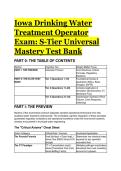
Iowa Drinking Water
Treatment Operator
Exam: S-Tier Universal
Mastery Test Bank
PART 0: THE TABLE OF CONTENTS
Section Cognitive Tier Subject Matter Focus
PART I: THE PREVIEW Axiomatic Protocol Core Directives, Critical
Formulas, Regulatory
Baselines
PART II: THE ELITE TEST Tier 1 (Questions 1–10) Foundational Syntax &
BANK Application (MCLs, Basic
Dosages, SWTR)
Tier 2 (Questions 11–20) Complex Application &
Simulation (Stoichiometry, CT,
Membrane Flux)
Tier 3 (Questions 21–30) Grandmaster Synthesis (Plant
Failures, Crisis Response,
Softening)
PART I: THE PREVIEW
Mastery of this examination protocol separates standard operational technicians from elite,
analytical water treatment professionals. The immediate cognitive integration of these principles
guarantees regulatory compliance and operational excellence under the most severe systemic
stresses encountered in municipal water engineering.
The "Critical Axioms" Cheat Sheet
Axiom Category Critical Rule / Formula Contextual Application
The Pounds Formula Feed (lbs/day) = Dose (mg/L) Determines raw chemical mass
\times Flow (MGD) \times 8.34 required for any specified
(lbs/gal) volumetric flow.
The CT Paradigm CT = Concentration (mg/L) Validates pathogen inactivation;
\times [Theoretical Time (min) theoretical time must invariably
\times Baffling Factor] account for hydraulic
,Axiom Category Critical Rule / Formula Contextual Application
short-circuiting.
Softening Stoichiometry Ca(OH)_2 neutralizes Applied during cold-lime
carbonate hardness; softening to target specific
Na_2CO_3 neutralizes hardness fractions.
non-carbonate hardness.
Oxidation Kinetics 0.94 mg/L KMnO_4 per 1.0 Dictates stoichiometric feed
mg/L Fe^{2+}; 1.92 mg/L rates prior to greensand
KMnO_4 per 1.0 mg/L Mn^{2+}. filtration.
Turbidity (SWTR) CFE must remain \le 0.5 NTU Governs the treatment
in 95% of monthly samples; technique compliance for
absolute maximum is 5.0 NTU. pathogen removal in surface
water.
PART II: THE ELITE TEST BANK
Tier 1 - Foundational Syntax & Application
Q1: A conventional surface water treatment plant in Iowa operates under the Surface Water
Treatment Rule (SWTR). During a spring runoff event, raw water turbidity spikes significantly.
Based on the principles of 567 IAC 43.5, which conclusion regarding filtered water turbidity
compliance is the MOST ACCURATE? A) Combined Filter Effluent (CFE) turbidity must be \le
0.3 NTU in 95% of samples, never exceeding 1.0 NTU under any circumstance. B) Combined
Filter Effluent (CFE) turbidity must be \le 0.5 NTU in 95% of samples, never exceeding 5.0 NTU.
C) The treatment technique requires the turbidity limit to remain \le 1.0 NTU in 90% of samples,
regardless of individual daily spikes. D) Turbidity levels carry acute health effects and mandate
immediate Tier 1 public notification if a single sample exceeds 0.5 NTU.
● Answer/Respuesta/Réponse: B (Combined Filter Effluent (CFE) turbidity must be \le 0.5
NTU in 95% of samples, never exceeding 5.0 NTU.)
● Distractor Analysis:
○ A is incorrect: This reflects the stricter 0.3 NTU / 1.0 NTU standard established by
the Enhanced Surface Water Treatment Rule for certain states or highly optimized
programs, not the baseline standard specified by Iowa DNR 567 IAC 43.5.
○ C is incorrect: This relies on an outdated legacy framework. Modern compliance
strictly demands a 95% threshold at the specified limit, and single samples cannot
ever exceed the absolute maximum.
○ D is incorrect: Turbidity itself does not have a direct physiological health effect; it is
a precursor indicating the potential survival of pathogens. A single 0.5 NTU
exceedance triggers operational review and treatment technique evaluation, not an
immediate Tier 1 notice.
The Mentor's Analysis: Turbidity serves as the primary surrogate parameter for pathogen
removal efficiency in surface water systems. When facing elevated raw water turbidity, the
immediate operational priority is coagulation optimization to maintain CFE standards. By
utilizing the 95% compliance threshold, operators bypass the common trap of reacting
chaotically to a single nominal baseline excursion. Professional/Academic Intuition: Turbidity
is a treatment technique metric, not a Maximum Contaminant Level (MCL); its violation
signifies a systemic barrier failure, demanding immediate physical process adjustment
over mere chemical compensation.
, Q2: A treatment facility distributes 3.5 Million Gallons per Day (MGD). The facility determines
that a total chlorine dose of 2.2 mg/L is required to satisfy organic demand and achieve a 0.5
mg/L free chlorine residual in the clearwell. Based on the principles of the Pounds Formula,
which calculation is the MOST ACCURATE to determine the daily gas chlorine requirement? A)
The facility must feed 19.4 lbs/day of chlorine gas to achieve the desired residual. B) The facility
must feed 64.2 lbs/day of chlorine gas to satisfy total demand and residual. C) The facility must
calculate based solely on the required 0.5 mg/L residual, yielding 14.6 lbs/day. D) The facility
must convert the flow to gallons per minute (gpm) prior to applying the 8.34 lbs/gal constant.
● Answer/Respuesta/Réponse: B (The facility must feed 64.2 lbs/day of chlorine gas to
satisfy total demand and residual.)
● Distractor Analysis:
○ A is incorrect: This total results from multiplying flow (3.5) by dose (2.2) while
omitting the universal water weight constant (8.34), representing a common novice
arithmetic error.
○ C is incorrect: Chemical feed calculations must always be based on the total dose
(Demand + Residual), not merely the targeted residual at the end of the contact
basin.
○ D is incorrect: The Pounds Formula mathematically requires the flow parameter to
remain in MGD (Million Gallons per Day) to cancel out units properly alongside the
8.34 lbs/gal constant.
The Mentor's Analysis: The Pounds Formula is the mathematical bedrock of water treatment
engineering. When facing dosage determinations, the immediate priority is isolating the total
required dose, not just the residual. By utilizing the standard MGD framework, operators bypass
the common trap of unit-conversion failures. Professional/Academic Intuition: Chemical
mass requirements demand total dose evaluation; the residual is merely the diagnostic
proof that the chemical demand has been successfully satisfied.
Q3: During routine monitoring under the Lead and Copper Rule (LCR), a community water
system evaluates its 90th percentile concentrations from customer tap samples. Based on the
principles of 567 IAC 41.4, which conclusion is the MOST ACCURATE? A) The action level (AL)
for lead is 0.015 mg/L, and its exceedance is classified directly as a Maximum Contaminant
Level (MCL) violation. B) The action level (AL) for copper is 1.0 mg/L, triggering immediate Tier
1 public notification upon exceedance. C) The action level (AL) for lead is 0.015 mg/L, and its
exceedance is defined strictly as a Treatment Technique (TT) violation. D) The system must
immediately transition to providing bottled water if the 90th percentile lead concentration
exceeds 0.050 mg/L.
● Answer/Respuesta/Réponse: C (The action level (AL) for lead is 0.015 mg/L, and its
exceedance is defined strictly as a Treatment Technique (TT) violation.)
● Distractor Analysis:
○ A is incorrect: Lead and Copper are regulated via Action Levels (AL), not strict
MCLs. An AL exceedance requires mandatory system optimization and public
education, not an immediate MCL citation.
○ B is incorrect: The established action level for copper is 1.3 mg/L, not 1.0 mg/L.
○ D is incorrect: Bottled water provision is a secondary, highly conditional mitigation
strategy generally reserved for acute nitrate/nitrite crises or total system failure, not
standard LCR AL exceedances.
The Mentor's Analysis: The LCR governs the interaction between finished water chemistry
and distribution infrastructure. When facing an AL exceedance, the immediate priority is
corrosion control parameter optimization (pH, alkalinity, orthophosphate inhibitors). By utilizing
Treatment Operator
Exam: S-Tier Universal
Mastery Test Bank
PART 0: THE TABLE OF CONTENTS
Section Cognitive Tier Subject Matter Focus
PART I: THE PREVIEW Axiomatic Protocol Core Directives, Critical
Formulas, Regulatory
Baselines
PART II: THE ELITE TEST Tier 1 (Questions 1–10) Foundational Syntax &
BANK Application (MCLs, Basic
Dosages, SWTR)
Tier 2 (Questions 11–20) Complex Application &
Simulation (Stoichiometry, CT,
Membrane Flux)
Tier 3 (Questions 21–30) Grandmaster Synthesis (Plant
Failures, Crisis Response,
Softening)
PART I: THE PREVIEW
Mastery of this examination protocol separates standard operational technicians from elite,
analytical water treatment professionals. The immediate cognitive integration of these principles
guarantees regulatory compliance and operational excellence under the most severe systemic
stresses encountered in municipal water engineering.
The "Critical Axioms" Cheat Sheet
Axiom Category Critical Rule / Formula Contextual Application
The Pounds Formula Feed (lbs/day) = Dose (mg/L) Determines raw chemical mass
\times Flow (MGD) \times 8.34 required for any specified
(lbs/gal) volumetric flow.
The CT Paradigm CT = Concentration (mg/L) Validates pathogen inactivation;
\times [Theoretical Time (min) theoretical time must invariably
\times Baffling Factor] account for hydraulic
,Axiom Category Critical Rule / Formula Contextual Application
short-circuiting.
Softening Stoichiometry Ca(OH)_2 neutralizes Applied during cold-lime
carbonate hardness; softening to target specific
Na_2CO_3 neutralizes hardness fractions.
non-carbonate hardness.
Oxidation Kinetics 0.94 mg/L KMnO_4 per 1.0 Dictates stoichiometric feed
mg/L Fe^{2+}; 1.92 mg/L rates prior to greensand
KMnO_4 per 1.0 mg/L Mn^{2+}. filtration.
Turbidity (SWTR) CFE must remain \le 0.5 NTU Governs the treatment
in 95% of monthly samples; technique compliance for
absolute maximum is 5.0 NTU. pathogen removal in surface
water.
PART II: THE ELITE TEST BANK
Tier 1 - Foundational Syntax & Application
Q1: A conventional surface water treatment plant in Iowa operates under the Surface Water
Treatment Rule (SWTR). During a spring runoff event, raw water turbidity spikes significantly.
Based on the principles of 567 IAC 43.5, which conclusion regarding filtered water turbidity
compliance is the MOST ACCURATE? A) Combined Filter Effluent (CFE) turbidity must be \le
0.3 NTU in 95% of samples, never exceeding 1.0 NTU under any circumstance. B) Combined
Filter Effluent (CFE) turbidity must be \le 0.5 NTU in 95% of samples, never exceeding 5.0 NTU.
C) The treatment technique requires the turbidity limit to remain \le 1.0 NTU in 90% of samples,
regardless of individual daily spikes. D) Turbidity levels carry acute health effects and mandate
immediate Tier 1 public notification if a single sample exceeds 0.5 NTU.
● Answer/Respuesta/Réponse: B (Combined Filter Effluent (CFE) turbidity must be \le 0.5
NTU in 95% of samples, never exceeding 5.0 NTU.)
● Distractor Analysis:
○ A is incorrect: This reflects the stricter 0.3 NTU / 1.0 NTU standard established by
the Enhanced Surface Water Treatment Rule for certain states or highly optimized
programs, not the baseline standard specified by Iowa DNR 567 IAC 43.5.
○ C is incorrect: This relies on an outdated legacy framework. Modern compliance
strictly demands a 95% threshold at the specified limit, and single samples cannot
ever exceed the absolute maximum.
○ D is incorrect: Turbidity itself does not have a direct physiological health effect; it is
a precursor indicating the potential survival of pathogens. A single 0.5 NTU
exceedance triggers operational review and treatment technique evaluation, not an
immediate Tier 1 notice.
The Mentor's Analysis: Turbidity serves as the primary surrogate parameter for pathogen
removal efficiency in surface water systems. When facing elevated raw water turbidity, the
immediate operational priority is coagulation optimization to maintain CFE standards. By
utilizing the 95% compliance threshold, operators bypass the common trap of reacting
chaotically to a single nominal baseline excursion. Professional/Academic Intuition: Turbidity
is a treatment technique metric, not a Maximum Contaminant Level (MCL); its violation
signifies a systemic barrier failure, demanding immediate physical process adjustment
over mere chemical compensation.
, Q2: A treatment facility distributes 3.5 Million Gallons per Day (MGD). The facility determines
that a total chlorine dose of 2.2 mg/L is required to satisfy organic demand and achieve a 0.5
mg/L free chlorine residual in the clearwell. Based on the principles of the Pounds Formula,
which calculation is the MOST ACCURATE to determine the daily gas chlorine requirement? A)
The facility must feed 19.4 lbs/day of chlorine gas to achieve the desired residual. B) The facility
must feed 64.2 lbs/day of chlorine gas to satisfy total demand and residual. C) The facility must
calculate based solely on the required 0.5 mg/L residual, yielding 14.6 lbs/day. D) The facility
must convert the flow to gallons per minute (gpm) prior to applying the 8.34 lbs/gal constant.
● Answer/Respuesta/Réponse: B (The facility must feed 64.2 lbs/day of chlorine gas to
satisfy total demand and residual.)
● Distractor Analysis:
○ A is incorrect: This total results from multiplying flow (3.5) by dose (2.2) while
omitting the universal water weight constant (8.34), representing a common novice
arithmetic error.
○ C is incorrect: Chemical feed calculations must always be based on the total dose
(Demand + Residual), not merely the targeted residual at the end of the contact
basin.
○ D is incorrect: The Pounds Formula mathematically requires the flow parameter to
remain in MGD (Million Gallons per Day) to cancel out units properly alongside the
8.34 lbs/gal constant.
The Mentor's Analysis: The Pounds Formula is the mathematical bedrock of water treatment
engineering. When facing dosage determinations, the immediate priority is isolating the total
required dose, not just the residual. By utilizing the standard MGD framework, operators bypass
the common trap of unit-conversion failures. Professional/Academic Intuition: Chemical
mass requirements demand total dose evaluation; the residual is merely the diagnostic
proof that the chemical demand has been successfully satisfied.
Q3: During routine monitoring under the Lead and Copper Rule (LCR), a community water
system evaluates its 90th percentile concentrations from customer tap samples. Based on the
principles of 567 IAC 41.4, which conclusion is the MOST ACCURATE? A) The action level (AL)
for lead is 0.015 mg/L, and its exceedance is classified directly as a Maximum Contaminant
Level (MCL) violation. B) The action level (AL) for copper is 1.0 mg/L, triggering immediate Tier
1 public notification upon exceedance. C) The action level (AL) for lead is 0.015 mg/L, and its
exceedance is defined strictly as a Treatment Technique (TT) violation. D) The system must
immediately transition to providing bottled water if the 90th percentile lead concentration
exceeds 0.050 mg/L.
● Answer/Respuesta/Réponse: C (The action level (AL) for lead is 0.015 mg/L, and its
exceedance is defined strictly as a Treatment Technique (TT) violation.)
● Distractor Analysis:
○ A is incorrect: Lead and Copper are regulated via Action Levels (AL), not strict
MCLs. An AL exceedance requires mandatory system optimization and public
education, not an immediate MCL citation.
○ B is incorrect: The established action level for copper is 1.3 mg/L, not 1.0 mg/L.
○ D is incorrect: Bottled water provision is a secondary, highly conditional mitigation
strategy generally reserved for acute nitrate/nitrite crises or total system failure, not
standard LCR AL exceedances.
The Mentor's Analysis: The LCR governs the interaction between finished water chemistry
and distribution infrastructure. When facing an AL exceedance, the immediate priority is
corrosion control parameter optimization (pH, alkalinity, orthophosphate inhibitors). By utilizing


