

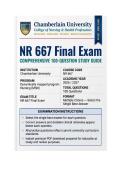
,NR 667 Final Exam – FNP Capstone Practicum –
Q&A (2026) PDF | Chamberlain
1. During which phase of the cardiac cycle is the first heart sound (S1) best
heard on auscultation?
A) Diastole
B) Atrial filling phase
C) Ventricular systole
D) Isovolumetric relaxation
Correct Answer: C) Ventricular systole
Rationale: S1 (“lub”) occurs when the mitral and tricuspid valves close at the
beginning of ventricular systole. It signals the start of ejection. Diastole and
isovolumetric relaxation are associated with S2 and S3/S4.
2. A 60-year-old man with hypertension and diabetes presents with a sudden
severe headache, blurred vision, and a blood pressure of 200/110 mmHg. The
FNP should:
A) Start an oral ACE inhibitor and schedule follow-up in one week
B) Refer the patient immediately to the emergency department
C) Order a stat CT scan and manage as outpatient
D) Recommend lifestyle modifications and recheck in 48 hours
Correct Answer: B) Refer the patient immediately to the emergency department
,Rationale: This is a hypertensive emergency (BP ≥180/120 mmHg with acute
target organ damage). Immediate IV antihypertensive therapy in a controlled
setting is required to prevent stroke or renal failure.
3. A 35-year-old woman with allergic rhinitis reports persistent nasal
congestion, sneezing, and itchy eyes despite using over-the-counter
antihistamines. The most appropriate next step is:
A) Add an oral decongestant
B) Prescribe a leukotriene receptor antagonist
C) Start an intranasal corticosteroid
D) Refer for allergy immunotherapy
Correct Answer: C) Start an intranasal corticosteroid
Rationale: Intranasal corticosteroids are first-line for moderate-to-severe
allergic rhinitis, especially when congestion is the dominant symptom. They
reduce inflammation more effectively than antihistamines alone.
4. A patient undergoing concurrent chemotherapy and radiation for glottic
cancer develops intractable nausea and dehydration. Admission labs show WBC
1.3 × 10³/µL, hemoglobin 7.5 g/dL, platelets 45 × 10³/µL, ANC 0.8 × 10³/µL. The
FNP recognizes this as:
A) Iron deficiency anemia
B) Macrocytic anemia
C) Aplastic anemia due to bone marrow suppression
D) Hemolytic anemia
, Correct Answer: C) Aplastic anemia due to bone marrow suppression
Rationale: Pancytopenia (low WBC, Hgb, Plt) with severe neutropenia and
thrombocytopenia is classic for chemotherapy/radiation-induced bone marrow
failure. Iron or B12 deficiencies would have different lab patterns.
5. The nurse practitioner is notified that a patient in normal sinus rhythm has
begun having extra beats every six normal beats, with an inverted P wave after
a narrow QRS complex. This rhythm is most likely:
A) Premature atrial contractions
B) Premature junctional contractions
C) Premature ventricular contractions
D) Sinus arrhythmia
Correct Answer: B) Premature junctional contractions
Rationale: Premature junctional contractions originate near the AV node,
producing an inverted P wave that may appear before, during, or after the QRS,
which remains narrow. PACs have an early P wave; PVCs are wide.
6. The FNP is assessing a patient with a rapid, irregular heart rate. To detect a
pulse deficit, the FNP should:
A) Auscultate the apical pulse while palpating the radial pulse
B) Compare blood pressure in both arms
C) Auscultate the heart while observing the ECG monitor
D) Measure the difference between apical and carotid pulses
Q&A (2026) PDF | Chamberlain
1. During which phase of the cardiac cycle is the first heart sound (S1) best
heard on auscultation?
A) Diastole
B) Atrial filling phase
C) Ventricular systole
D) Isovolumetric relaxation
Correct Answer: C) Ventricular systole
Rationale: S1 (“lub”) occurs when the mitral and tricuspid valves close at the
beginning of ventricular systole. It signals the start of ejection. Diastole and
isovolumetric relaxation are associated with S2 and S3/S4.
2. A 60-year-old man with hypertension and diabetes presents with a sudden
severe headache, blurred vision, and a blood pressure of 200/110 mmHg. The
FNP should:
A) Start an oral ACE inhibitor and schedule follow-up in one week
B) Refer the patient immediately to the emergency department
C) Order a stat CT scan and manage as outpatient
D) Recommend lifestyle modifications and recheck in 48 hours
Correct Answer: B) Refer the patient immediately to the emergency department
,Rationale: This is a hypertensive emergency (BP ≥180/120 mmHg with acute
target organ damage). Immediate IV antihypertensive therapy in a controlled
setting is required to prevent stroke or renal failure.
3. A 35-year-old woman with allergic rhinitis reports persistent nasal
congestion, sneezing, and itchy eyes despite using over-the-counter
antihistamines. The most appropriate next step is:
A) Add an oral decongestant
B) Prescribe a leukotriene receptor antagonist
C) Start an intranasal corticosteroid
D) Refer for allergy immunotherapy
Correct Answer: C) Start an intranasal corticosteroid
Rationale: Intranasal corticosteroids are first-line for moderate-to-severe
allergic rhinitis, especially when congestion is the dominant symptom. They
reduce inflammation more effectively than antihistamines alone.
4. A patient undergoing concurrent chemotherapy and radiation for glottic
cancer develops intractable nausea and dehydration. Admission labs show WBC
1.3 × 10³/µL, hemoglobin 7.5 g/dL, platelets 45 × 10³/µL, ANC 0.8 × 10³/µL. The
FNP recognizes this as:
A) Iron deficiency anemia
B) Macrocytic anemia
C) Aplastic anemia due to bone marrow suppression
D) Hemolytic anemia
, Correct Answer: C) Aplastic anemia due to bone marrow suppression
Rationale: Pancytopenia (low WBC, Hgb, Plt) with severe neutropenia and
thrombocytopenia is classic for chemotherapy/radiation-induced bone marrow
failure. Iron or B12 deficiencies would have different lab patterns.
5. The nurse practitioner is notified that a patient in normal sinus rhythm has
begun having extra beats every six normal beats, with an inverted P wave after
a narrow QRS complex. This rhythm is most likely:
A) Premature atrial contractions
B) Premature junctional contractions
C) Premature ventricular contractions
D) Sinus arrhythmia
Correct Answer: B) Premature junctional contractions
Rationale: Premature junctional contractions originate near the AV node,
producing an inverted P wave that may appear before, during, or after the QRS,
which remains narrow. PACs have an early P wave; PVCs are wide.
6. The FNP is assessing a patient with a rapid, irregular heart rate. To detect a
pulse deficit, the FNP should:
A) Auscultate the apical pulse while palpating the radial pulse
B) Compare blood pressure in both arms
C) Auscultate the heart while observing the ECG monitor
D) Measure the difference between apical and carotid pulses


