AP CHEMISTRY Scoring Guide
Unit 5 PA MCQs
1. 2 A(g) + B(g) → 2 C(g)
When the concentration of substance B in the reaction above is doubled, all other factors being held constant, it is
found that the rate of the reaction remains unchanged. The most probable explanation for this observation is that
(A) the order of the reaction with respect to substance B is 1
(B) substance B is not involved in any of the steps in the mechanism of the reaction
substance B is not involved in the rate–determined step of the mechanism, but is involved in subsequent
(C)
steps
substance B is probably a catalyst, and as such, its effect on the rate of the reaction does not depend on
(D)
its concentration
the reactant with the smallest coefficient in the balanced equation generally has little or no effect on the
(E)
rate of the reaction
2.
2N2O5(g) → 4NO2(g) + O2(g)
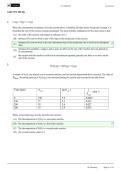
A sample of N2O5 was placed in an evacuated container, and the reaction represented above occurred. The value of
, the partial pressure of N2O5(g), was measured during the reaction and recorded in the table below.
Which of the following correctly describes the reaction?
(A) The decomposition of N2O5 is a zero-order reaction.
(B) The decomposition of N2O5 is a first-order reaction.
(C) The decomposition of N2O5 is a second-order reaction.
(D) The overall reaction order is 3.
AP Chemistry Page 1 of 11
, Scoring Guide
Unit 5 PA MCQs
3.
2NO(g) + O2(g)→N2O2(g)
A possible mechanism for the overall reaction represented above is the following.
1. NO(g) + NO(g) → N2O2(g) slow
2. N2O2(g) + O2(g) → 2NO2(g) fast
Which of the following rate expressions agrees best with this possible mechanism?
(A) Rate = k[NO]2
(B) Rate =
(C) Rate =
(D) Rate = k[NO]2 [O2]
(E) Rate = k[N2O2] [O2]
4. A kinetics experiment is set up to collect the gas that is generated when a sample of chalk, consisting primarily of
solid CaCO3, is added to a solution of ethanoic acid, CH3COOH. The rate of reaction between CaCO3 and
CH3COOH is determined by measuring the volume of gas generated at 22oC and 1 atm as a function of time. Which
of the following experimental conditions is most likely to increase the rate of gas production?
(A) Decreasing the volume of ethanoic acid solution used in the experiment
(B) Decreasing the concentration of the ethanoic acid solution used in the experiment
(C) Decreasing the temperature at which the experiment is performed
(D) Decreasing the particle size of the CaCO3 by grinding it into a fine powder
5.
The energy diagram for the reaction X + Y → Z is shown above. The addition of a catalyst to this reaction would
cause a change in which of the indicated energy differences?
Page 2 of 11 AP Chemistry
Unit 5 PA MCQs
1. 2 A(g) + B(g) → 2 C(g)
When the concentration of substance B in the reaction above is doubled, all other factors being held constant, it is
found that the rate of the reaction remains unchanged. The most probable explanation for this observation is that
(A) the order of the reaction with respect to substance B is 1
(B) substance B is not involved in any of the steps in the mechanism of the reaction
substance B is not involved in the rate–determined step of the mechanism, but is involved in subsequent
(C)
steps
substance B is probably a catalyst, and as such, its effect on the rate of the reaction does not depend on
(D)
its concentration
the reactant with the smallest coefficient in the balanced equation generally has little or no effect on the
(E)
rate of the reaction
2.
2N2O5(g) → 4NO2(g) + O2(g)
A sample of N2O5 was placed in an evacuated container, and the reaction represented above occurred. The value of
, the partial pressure of N2O5(g), was measured during the reaction and recorded in the table below.
Which of the following correctly describes the reaction?
(A) The decomposition of N2O5 is a zero-order reaction.
(B) The decomposition of N2O5 is a first-order reaction.
(C) The decomposition of N2O5 is a second-order reaction.
(D) The overall reaction order is 3.
AP Chemistry Page 1 of 11
, Scoring Guide
Unit 5 PA MCQs
3.
2NO(g) + O2(g)→N2O2(g)
A possible mechanism for the overall reaction represented above is the following.
1. NO(g) + NO(g) → N2O2(g) slow
2. N2O2(g) + O2(g) → 2NO2(g) fast
Which of the following rate expressions agrees best with this possible mechanism?
(A) Rate = k[NO]2
(B) Rate =
(C) Rate =
(D) Rate = k[NO]2 [O2]
(E) Rate = k[N2O2] [O2]
4. A kinetics experiment is set up to collect the gas that is generated when a sample of chalk, consisting primarily of
solid CaCO3, is added to a solution of ethanoic acid, CH3COOH. The rate of reaction between CaCO3 and
CH3COOH is determined by measuring the volume of gas generated at 22oC and 1 atm as a function of time. Which
of the following experimental conditions is most likely to increase the rate of gas production?
(A) Decreasing the volume of ethanoic acid solution used in the experiment
(B) Decreasing the concentration of the ethanoic acid solution used in the experiment
(C) Decreasing the temperature at which the experiment is performed
(D) Decreasing the particle size of the CaCO3 by grinding it into a fine powder
5.
The energy diagram for the reaction X + Y → Z is shown above. The addition of a catalyst to this reaction would
cause a change in which of the indicated energy differences?
Page 2 of 11 AP Chemistry