

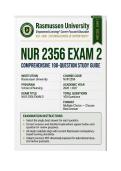
,NUR 2356 Exam 2 | Multidimensional Care I (2026)
Actual Q&A PDF | Rasmussen
1. The nurse is assessing a patient's pain using the PQRST framework. The nurse
asks, "What makes the pain better or worse?" This question addresses which
component?
A) Quality/Quantity
B) Region/Radiation
C) Provocation/Palliation
D) Severity/Scale
Correct Answer: C) Provocation/Palliation
Rationale: The PQRST framework includes Provocation/Palliation (what worsens
or relieves pain), Quality/Quantity (description), Region/Radiation (location),
Severity (intensity), and Timing (onset/duration).
2. A patient with a fractured femur is being assessed. Which action is the nurse's
highest priority?
A) Administer pain medication
B) Apply a splint to the extremity
C) Check for bleeding at the site
D) Assess for neurovascular compromise
Correct Answer: D) Assess for neurovascular compromise
,Rationale: Neurovascular assessment (pulses, sensation, color, temperature,
movement) is the priority to detect compartment syndrome. Pain management
and splinting follow assessment.
3. The nurse is evaluating a patient for carpal tunnel syndrome. Which test
involves flexing the patient's wrists for 60 seconds to reproduce symptoms?
A) Phalen's test
B) Tinel's sign
C) Lachman's test
D) McMurray's test
Correct Answer: A) Phalen's test
Rationale: Phalen's test is positive if wrist flexion causes numbness or tingling.
Tinel's sign involves tapping over the median nerve. Lachman and McMurray are
knee tests.
4. A patient with a long leg cast reports severe pain with passive toe movement.
The nurse recognizes this as a sign of:
A) Deep vein thrombosis
B) Cast syndrome
C) Compartment syndrome
D) Fat embolism
Correct Answer: C) Compartment syndrome
, Rationale: Pain with passive stretch is a classic early sign of compartment
syndrome, a medical emergency requiring immediate fasciotomy. DVT and fat
embolism present differently.
5. A patient with systemic lupus erythematosus (SLE) is being assessed. Which
hallmark finding is the nurse most likely to observe?
A) Joint crepitus
B) Butterfly rash across the cheeks and nose
C) Positive Tinel's sign
D) Heel pain
Correct Answer: B) Butterfly rash across the cheeks and nose
Rationale: The malar (butterfly) rash is characteristic of SLE. Joint crepitus is
common in osteoarthritis. Tinel's sign is for carpal tunnel. Heel pain suggests
plantar fasciitis.
6. The nurse is preparing to assist a patient from bed to a chair. To reduce the
risk of orthostatic hypotension, the nurse should first:
A) Use a transfer belt
B) Have the patient stand up quickly
C) Raise the bed to the highest position
D) Have the patient dangle at the edge of the bed
Correct Answer: D) Have the patient dangle at the edge of the bed
Actual Q&A PDF | Rasmussen
1. The nurse is assessing a patient's pain using the PQRST framework. The nurse
asks, "What makes the pain better or worse?" This question addresses which
component?
A) Quality/Quantity
B) Region/Radiation
C) Provocation/Palliation
D) Severity/Scale
Correct Answer: C) Provocation/Palliation
Rationale: The PQRST framework includes Provocation/Palliation (what worsens
or relieves pain), Quality/Quantity (description), Region/Radiation (location),
Severity (intensity), and Timing (onset/duration).
2. A patient with a fractured femur is being assessed. Which action is the nurse's
highest priority?
A) Administer pain medication
B) Apply a splint to the extremity
C) Check for bleeding at the site
D) Assess for neurovascular compromise
Correct Answer: D) Assess for neurovascular compromise
,Rationale: Neurovascular assessment (pulses, sensation, color, temperature,
movement) is the priority to detect compartment syndrome. Pain management
and splinting follow assessment.
3. The nurse is evaluating a patient for carpal tunnel syndrome. Which test
involves flexing the patient's wrists for 60 seconds to reproduce symptoms?
A) Phalen's test
B) Tinel's sign
C) Lachman's test
D) McMurray's test
Correct Answer: A) Phalen's test
Rationale: Phalen's test is positive if wrist flexion causes numbness or tingling.
Tinel's sign involves tapping over the median nerve. Lachman and McMurray are
knee tests.
4. A patient with a long leg cast reports severe pain with passive toe movement.
The nurse recognizes this as a sign of:
A) Deep vein thrombosis
B) Cast syndrome
C) Compartment syndrome
D) Fat embolism
Correct Answer: C) Compartment syndrome
, Rationale: Pain with passive stretch is a classic early sign of compartment
syndrome, a medical emergency requiring immediate fasciotomy. DVT and fat
embolism present differently.
5. A patient with systemic lupus erythematosus (SLE) is being assessed. Which
hallmark finding is the nurse most likely to observe?
A) Joint crepitus
B) Butterfly rash across the cheeks and nose
C) Positive Tinel's sign
D) Heel pain
Correct Answer: B) Butterfly rash across the cheeks and nose
Rationale: The malar (butterfly) rash is characteristic of SLE. Joint crepitus is
common in osteoarthritis. Tinel's sign is for carpal tunnel. Heel pain suggests
plantar fasciitis.
6. The nurse is preparing to assist a patient from bed to a chair. To reduce the
risk of orthostatic hypotension, the nurse should first:
A) Use a transfer belt
B) Have the patient stand up quickly
C) Raise the bed to the highest position
D) Have the patient dangle at the edge of the bed
Correct Answer: D) Have the patient dangle at the edge of the bed


