

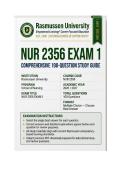
,NUR 2356 Exam 1 | Multidimensional Care I
(2026) Actual Q&A PDF | Rasmussen
1. A patient with burns over 30% of the body is demonstrating signs of third
spacing. The nurse understands that third spacing results in:
A) Hypervolemia
B) Fluid volume excess
C) Hypovolemia
D) Hypernatremia
Correct Answer: C) Hypovolemia
Rationale: Third spacing is the movement of fluid from the intravascular space
into the interstitial space, reducing circulating blood volume and causing signs
of hypovolemia such as tachycardia, hypotension, and decreased urine output.
2. The nurse is caring for a patient with chronic kidney disease who has edema,
jugular vein distention, and pulmonary crackles. Which type of medication does
the nurse anticipate the provider will order?
A) Loop diuretic
B) Antibiotic
C) Antihypertensive only
D) Anticoagulant
Correct Answer: A) Loop diuretic
,Rationale: Loop diuretics such as furosemide reduce fluid volume excess by
promoting sodium and water excretion. The nurse should closely monitor serum
potassium and kidney function.
3. A patient admitted with vomiting and diarrhea has a BUN of 28 mg/dL and
creatinine of 1.1 mg/dL. What BUN/creatinine ratio does the nurse calculate,
and what does it suggest?
A) 10:1, suggesting normal hydration
B) 25:1, suggesting fluid volume deficit
C) 15:1, suggesting hypervolemia
D) 5:1, suggesting kidney injury
Correct Answer: B) 25:1, suggesting fluid volume deficit
Rationale: BUN/creatinine ratio = 28/1.1 ≈ 25.4:1. A ratio >20:1 typically
indicates dehydration or prerenal azotemia due to fluid volume deficit.
4. The nurse is assessing a patient with hypovolemia. Which finding does the
nurse expect?
A) Jugular vein distention
B) Bounding peripheral pulses
C) Crackles in the lungs
D) Dry mucous membranes and poor skin turgor
Correct Answer: D) Dry mucous membranes and poor skin turgor
, Rationale: Hypovolemia decreases tissue perfusion, leading to dry mucous
membranes, decreased skin turgor, flat neck veins, and orthostatic hypotension.
5. A patient with heart failure is receiving furosemide. Which laboratory value is
most important for the nurse to monitor?
A) Serum potassium
B) Serum calcium
C) Serum sodium
D) Blood urea nitrogen
Correct Answer: A) Serum potassium
Rationale: Furosemide is a loop diuretic that causes potassium loss.
Hypokalemia can lead to life-threatening cardiac arrhythmias. Potassium levels
must be monitored closely.
6. A patient is prescribed 0.9% normal saline for hypovolemia. The nurse
understands this solution is:
A) Hypotonic
B) Hypertonic
C) Isotonic
D) Colloid
Correct Answer: C) Isotonic
(2026) Actual Q&A PDF | Rasmussen
1. A patient with burns over 30% of the body is demonstrating signs of third
spacing. The nurse understands that third spacing results in:
A) Hypervolemia
B) Fluid volume excess
C) Hypovolemia
D) Hypernatremia
Correct Answer: C) Hypovolemia
Rationale: Third spacing is the movement of fluid from the intravascular space
into the interstitial space, reducing circulating blood volume and causing signs
of hypovolemia such as tachycardia, hypotension, and decreased urine output.
2. The nurse is caring for a patient with chronic kidney disease who has edema,
jugular vein distention, and pulmonary crackles. Which type of medication does
the nurse anticipate the provider will order?
A) Loop diuretic
B) Antibiotic
C) Antihypertensive only
D) Anticoagulant
Correct Answer: A) Loop diuretic
,Rationale: Loop diuretics such as furosemide reduce fluid volume excess by
promoting sodium and water excretion. The nurse should closely monitor serum
potassium and kidney function.
3. A patient admitted with vomiting and diarrhea has a BUN of 28 mg/dL and
creatinine of 1.1 mg/dL. What BUN/creatinine ratio does the nurse calculate,
and what does it suggest?
A) 10:1, suggesting normal hydration
B) 25:1, suggesting fluid volume deficit
C) 15:1, suggesting hypervolemia
D) 5:1, suggesting kidney injury
Correct Answer: B) 25:1, suggesting fluid volume deficit
Rationale: BUN/creatinine ratio = 28/1.1 ≈ 25.4:1. A ratio >20:1 typically
indicates dehydration or prerenal azotemia due to fluid volume deficit.
4. The nurse is assessing a patient with hypovolemia. Which finding does the
nurse expect?
A) Jugular vein distention
B) Bounding peripheral pulses
C) Crackles in the lungs
D) Dry mucous membranes and poor skin turgor
Correct Answer: D) Dry mucous membranes and poor skin turgor
, Rationale: Hypovolemia decreases tissue perfusion, leading to dry mucous
membranes, decreased skin turgor, flat neck veins, and orthostatic hypotension.
5. A patient with heart failure is receiving furosemide. Which laboratory value is
most important for the nurse to monitor?
A) Serum potassium
B) Serum calcium
C) Serum sodium
D) Blood urea nitrogen
Correct Answer: A) Serum potassium
Rationale: Furosemide is a loop diuretic that causes potassium loss.
Hypokalemia can lead to life-threatening cardiac arrhythmias. Potassium levels
must be monitored closely.
6. A patient is prescribed 0.9% normal saline for hypovolemia. The nurse
understands this solution is:
A) Hypotonic
B) Hypertonic
C) Isotonic
D) Colloid
Correct Answer: C) Isotonic


